




Coming back to this. With enough intelligence, making money is trivial. Skeptics are thinking too small... the TAM is all knowledge work.

I always learn a lot from John Hempton podcasts. Some very interesting takes on AI.

I enjoyed this podcast with short seller @John_Hempton. Lots of wisdom and some great contrarian takes.
podcasts.apple.com/us/podcas…

Walter retweeted

One of my observations during Covid as well. All of the demand from stay at home and an e-commerce boom, but 2 years later AMZN, SHOP, ETSY all down near or below precovid levels. I misread this cyclicality at that time. This is even more pronounced with commodity producers. I’m not sure these booms are as beneficial to their businesses long term as people might think.
Take a look at any internet supplier during 1996-2005. Not just their stock chart but their underlying GAAP earnings (which includes the massive write-downs which are real value destroyed). Boom was first 5 years bust was last 5.
Same exercise with investment banks and home builders between 2003-2013. Biggest housing boom in history and more value was destroyed than created in both those groups. Same with shale boom: check oil company fundamentals between 2010-2019.
The overinvestment often leads to a digestion phase that often more than offsets the value accrued during the boom. Can’t prevent these cycles because that’s capitalism, and it is hard to believe when stocks like DELL and MU are still up 150% YTD, but I think some of these picks and shovels stocks might actually end up doing worse vs the alternate universe where the boom/bust didn’t happen

Flashback to June 14, 2024.
At the time, frontier AI models have zero fluid intelligence. They score around 5% on ARC 1. They can't reliably add two numbers. They make laughable logic errors every other prompt. Reasoning models don't exist. Coding agents don't exist. Claude Code doesn't exist. "Code gen" is a complete joke. Scaling up next-token prediction based on web text data is hitting a wall.
What if a time traveler told you that, by November 2026...
• AI models would have human-like fluid intelligence, thanks to a new paradigm: test-time induction (modern reasoning models).
• Not only would ARC 1 be saturated, but unreleased benchmarks 10x harder (ARC 2) and 100x harder (ARC 3) would be saturated too.
• Nearly all code would be written by AI, and models could one-shot complex codebases flawlessly.
• AI models would be solving multiple Millennium Prize problems.
• OpenAI's valuation would be 15x higher, and Anthropic's would be 85x higher.
And on top of all that...
• Nvidia would still hold ~80% of the AI compute market.
• Nvidia would have grown its revenue and earnings 4.5x.
• Nvidia would still be growing 75% a year.
• Nvidia would have even higher operating margins (67% vs. 65% back then).
Based on that information, straight from the future, would you have bought NVDA?
If you answered yes -- congrats. Today, 2.5 years later, you'd be down 5% on your investment (even more after inflation).
Walter retweeted

Excellent, short article by one of the GOATs.
wsj.com/opinion/theres-no-su…

Walter retweeted

people are starting to realize.
there *are* no moats left. the only true moat in existence was intelligence, and now that's out of the equation.

Normies still believe AI-related extinction risk is just sci-fi/hype/marketing. But look at AI progress vs expectations 1-2 years ago and we are way ahead of schedule. I think most continue underestimating exponential improvement.
From 2015: waitbutwhy.com/2015/01/artif…

Walter retweeted

I was the main counterparty for airline puts before/during the 9/11 attacks (I was in the World Trade Center building for lunch the day before); they were buying puts in $UAL and American Airlines for weeks before the attacks. Brokers would call me and ask for a bid, I sold some, they seemed rich, then richer, then they just kept coming. When someone is buying a dollar bill for $1.01, you think, "sucker." When someone pays you $1.05 for a dollar, you think this is free money; when someone pays you $5 for $1, you bury your face in research, study the trade and you're very worried; when someone pays you $10 for $1, you know you're dead, but it just has not happened yet (and this is after I already got my ass kicked in Enron). The morning of 9/11, I would have blown out hard and would have had to fire about 60 or 70 people; the market didn't open, so that saved my firm. We didn't know there were 4 planes in the air, it could have been 4000 planes for all I knew so I told all of my traders to go home. My office was at the Cboe so I assumed it was also a target, and our lives were in danger. I was very worried that my NYC guys were dead (they were ok). I had no idea what to expect the next few days. When the market did open, I was down massively, but not blown out. The markets were so wide and the trading was so good we were net profitable by early November, a stunning turn of events. Stories about money feel gross when some people lost everything; I'm very sympathetic to the people who went through unimaginable hardship and I feel like me talking about trading is so small and petty in juxtaposition to the seriousness of true loss that many thousands of people experienced.


Walter retweeted

An internal version of Astra, @OpenAI’s next major model family, solved 10 major open problems in mathematics, quantum complexity, and theoretical computer science.
We believe it will be a major step for scientific reasoning. openai.com/index/ten-advance…


Walter retweeted

Momentum factor (blue) and Nasdaq (red) during the Dotcom bubble
🟩 As the bubble is forming (green) momentum is winning.
🟨🟥It takes a hit exactly when the Nasdaq tops (yellow), but keeps winning during the years long actual crash (red).
🟦When the Nasdaq rebounds, Momentum starts falling.
So it was a great strategy overall to hold during the bubble and its aftermath, with momentum crashes when the index changes direction, both on top and at the bottom.
Both momentum crashes were comparably mild as compared to the post GFC rebound momentum crash.

Walter retweeted

TLDR: leveraged ETFs are an accident waiting to happen (soon).
Welcome to the end of quite a week. Risk history buffs "celebrated" the 10 year anniversary of Brexit on 6/24, a day when, a decade ago, the SX5E plunged by 8% and the Euro fell by 2% on the same day. The incoming correlations suggested it "could not happen, it would not happen", to borrow from Ace Rothstein in Casino.
But the real action is not in global macro but in single stocks, and specifically, chips and memory and the leveraged ETFs built on top of them. There's an accident waiting to happen here. Not a bear market, but an extreme one to three day move forthcoming.
In 2017, as the SPX experienced a 50 year low in realized volatility, the inverse VIX complex got larger and larger...there was a story about Capstone CIO Paul Britton having to tell a cab driver, excited that he'd found a winning stock pick, that the XIV was not actually a company. The story (clipped below) underscored just how over-consumed this short vol trade was by folks who just think that "number go up".
Today's equivalent of the XIV is not capitalizing on an undersupply of realized vol, but on an undersupply of memory. One might ask, "what are these companies?"
$MUU $SNXX $SOXL $KORU ...they are funds that own a single stock with an inconceivable trading strategy that gets much larger on the way up.
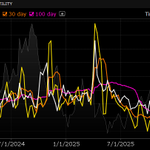
Memory is indeed undersupplied. That is, people have short memories. Or, more bluntly, they never learn. The KORU is a 3xer on the KOSPI Index with nearly 2bln in AuM. This "company" had a 36% down move on Tuesday. Its 10d realized vol is 300.
As Kevin Warsh takes the helm at the Fed, there is some complaining that he's not making his "reaction function" more transparent. Well, the RF for these leveraged ETFs could not be more specific. We know exactly what they need to do - and yesterday, MUU and SNXX had to buy right around 2bln and 1.8bln of MU and SNDK, respectively. It's value investing flipped upside down.
MUU starts today long 18bln of Micron, SNXX long 13bln of SNDK. Don't forget the SOXL which is long 90bln of SOXX. 7709 HK Equity is long 28bln of SK Hynix.
The regulators need to be watched as well. Below, a clip from a story yday from the top regulator in South Korea who expresses regret about the Frankenstein that has been unleashed. I would argue that the leveraged ETF providers in the US are vulnerable to litigation. Below a snapshot of the table from the SNXX prospectus. It shows the standard matrix of simulated performance of the lev product versus the underlying at different vol levels.
It is beyond ridiculous and deceitful to include 10 realized vol in this table. You know what assets are currently 10 vol? The TLT. It's daily moves have generally been around 30-80bps a day for the last month. Sandisk regularly has moves well north of 10% on a single day.
The realized vol table for the 2x on SNDK should start at 50 and run to 150. It looks much different - that is, much worse - when you do that.
tradretfs.com/hubfs/SNXX/SUM…


Walter retweeted
Poorly paraphrasing a locked account, the problem with buying things like Sk Square because they're at a discount is that when there's good news the degens buy Sk Hynix and the cheap bastards you're in Sk Square with sell because it's too expensive. Maybe works longer-term but then you might need to hold through the down cycle.