Open infrastructure for building cloud software factories
Joined June 2021
- Tweets3.3K
- Following3
- Followers59.4K
- Likes3.9K







Warp retweeted

Your team should have a shared configuration for your agents that lives in code. The same way you use Terraform to deploy cloud infrastructure, you use a factory configuration to deploy your software factory.
This gives you the typical advantages of version controlled systems: check in changes with code owners, test changes with rollback support, and review updates as diffs.
Warp retweeted
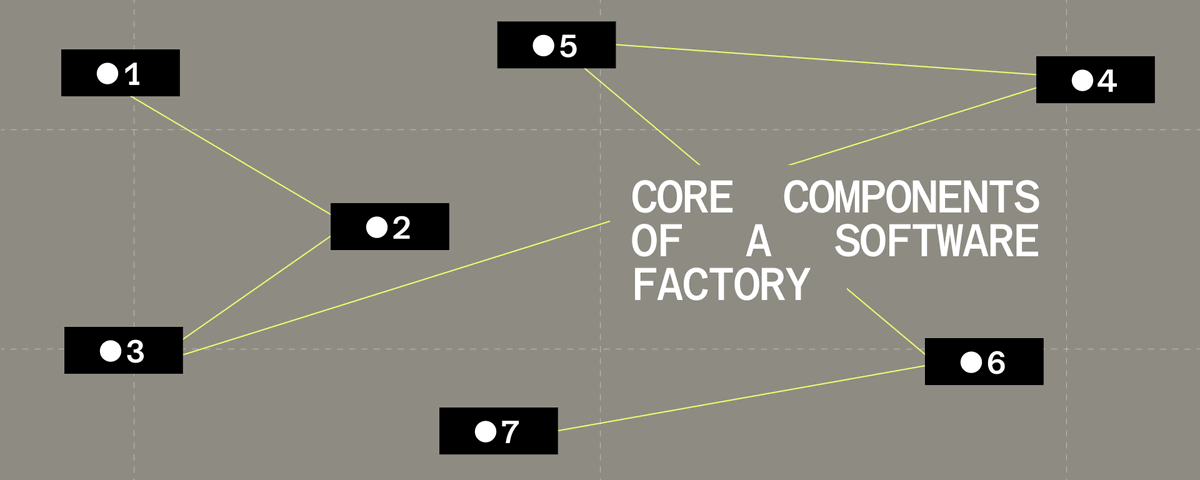
We've landed on 7 core components to building a good software factory. Here's the full overview:

Warp retweeted
There are many ways to define “software factory”, and here’s the one we’ve settled on: centralizing your system of agents into one place to build software. This means going from custom coding setups on everyone's machines to a single definition in code that runs in the cloud. The same way engineers agree on CI, we should agree on how agents are run.
Why is this important? Better security management, better ROI tracking, and mainly, improving agent efficiency as a team – instead of copying config to everyone’s local setups and trying to manage individual skill sprawl.
Warp retweeted
On Friday, we became aware of what we believe to be an active and narrow-banded exploitation of a vendor in Warp's infrastructure. We detected the operation within hours and were able to remediate and mitigate the impact. We have been in touch with the vendor about the vulnerability.
Everyone who uses Warp places a lot of trust in us and that’s not something we take lightly. I’m very sorry that this incident has occurred.
The attack appears to have come from an agent swarm using a very sophisticated penetration and escalation technique, likely starting with a hole in a vendor dependency, and ultimately accessing a limited amount of agent trace and telemetry data.
We have been working over the weekend and we have notified anyone who we have positively identified as impacted. As of today, we believe an upper bound of roughly 1% of Warp users may have been impacted.
We are working closely with the team at Crowdstrike to do a more extensive and comprehensive investigation and have engaged law enforcement.
Anyone who has been impacted will receive instructions from us on action they need to take. We will continue to post updates as we learn more.
Warp retweeted

Want better quality output from your agent? Give it a way to verify its own work.
Love what Warp is doing here: every agent gets a computer and brings back a video of what it did. I do something similar in my workflow - on top of E2E tests, Claude gives me recorded videos + screenshots as part of the evidence work is "done".
My bet is verification becomes one of the most important problems to work on this year.

verification is the biggest bottleneck for coding agents right now according to @addyosmani.
we @warpdotdev have put a lot of thought into building a good computer-use tool for Warp Factories. every agents gets a computer to navigate the apps they built, take screenshots and recordings, and post them back for human review.
3-4mins of activity get edited down to 15 clips stitched together with cursor clicks, mouse animations, and key presses.
we've been able to dramatically cut our time to merge and unlocked faster iteration + review cycles, especially for projects that are hard to mock out locally!
Warp retweeted

Stop asking agents for text summaries of a PR. They're capable of so much more:
- Architecture diagrams to visually explain the change. Could be ascii, mermaid, HTML, or animated walkthroughs. /show-me is a great starting point.
- Screen recordings verifying the change end-to-end. Most harnesses can do this now with Chrome DevTools or computer use. Warp Factories will auto-edit video and highlight cursor clicks as well.
- Planning documents when humans were in the loop, checked in as code. This is optional, but a product spec explaining the purpose and expected user flow will a) guide the agent to better screen recording verification, and b) help the reviewer when looking at another engineer's work.
Warp Factories shows all artifacts connected to an agent session to make these easy to find.
Warp retweeted

verification is the biggest bottleneck for coding agents right now according to @addyosmani.
we @warpdotdev have put a lot of thought into building a good computer-use tool for Warp Factories. every agents gets a computer to navigate the apps they built, take screenshots and recordings, and post them back for human review.
3-4mins of activity get edited down to 15 clips stitched together with cursor clicks, mouse animations, and key presses.
we've been able to dramatically cut our time to merge and unlocked faster iteration + review cycles, especially for projects that are hard to mock out locally!
Warp retweeted
We made a skill for assessing the risk of merging a PR: /merge-risk
This addresses the code review bottleneck by helping devs trust the agent for lower risk changes.
It grades risk across 5 categories: alignment, impact, verification, rollback cost, and error detection.
- Alignment: does code follow the PR description and related tickets?
- Impact: what is the blast radius, and does it touch sensitive code paths?
- Verification: does the change include end-to-end verification? This means computer use, screen recordings, before/after screenshots... going beyond unit test coverage.
- Rollback cost: once it's shipped, how trivial is it to revert? @mattpocockuk calls this a "two-way door" vs. a "one-way door."
- Error detection: are errors reported, logged, or simply swallowed?
Try it out:
> npx skills add warpdotdev/common-skills --skill merge-risk
Warp retweeted

Building Evals on Production Data: 🦄 AI That Works #79 nitter.cf/i/broadcasts/1oJMvNZWv…

Warp retweeted
At @aiDotEngineer, I presented our skill called /skill-doctor. It's a skill to improve your agent skills.
It aggregates your past agent sessions, grades their quality, and propose improvements to fix common failures.
Warp retweeted
Getting software factories working is going to be one of the more interesting software engineering challenges in the next few years.
Software engineering is becoming factory engineering. Organizations that can make their factories robust, dependable, and self-improving will be able to ship more at better cost and have a competitive advantage.
Warp retweeted
An interesting engineering challenge this next year will be closing the development loop we've started.
We have small loops already (code review, automatic CI fixes, computer use verification), but we need to close the larger loop: let agents suggest what to build next.

Warp retweeted
Software factories can be a real culture shift. The biggest change for us was moving from individual agents on everyone's machines to one central agent setup (a factory) that we can build as a team.
I wrote some learnings on how to navigate that.
Warp retweeted
We've found a few key pieces to successful software factories, both from our internal testing and from helping companies deploy their own:
Factories-as-code: you should configure every part of the factory (agent orchestration, automations, permissions, sandbox configuration, etc) as code. This enables testing of different factory configurations to see which are most efficient, highest quality, etc.
Multi-model & multi-harness: you should make sure that your factories are able to use the latest models, both frontier and open-weight, and use different coding agent harnesses like Claude Code and Codex.
Data ownership: you should make sure you store and own all data coming out of your factory. This is the raw material for improving its operations.
Warp retweeted
Someone asked how I defined a software factory recently, and I think my definition is different from others.
To me, a software factory is centralizing your system of agents into one place to build software. That means going from custom coding setups on everyone's machines to a single definition.
In practice, it's one source of truth for agent automations, repository access, secret access, sandbox environments, model selections... every aspect of the stack.
I think loops and automations are a secondary aspect of this that gets unlocked once you unify everything into an "always-on" agent system. But the heart of it is having the whole team agree on the agent setup, the same way we agree on CI, lint rules, and all the automations we had pre-AI.
This also makes it clear what an engineer's job is now: to make the agents better at building software. Not to be prompt monkeys! We like to call it "factory engineering"
Warp retweeted
I chatted with @hudaman (Sr Engineering Manager, Uber) and @cmhandel (Director of Product, AI Platform, Faire) to compare notes on adopting software factories. We discussed:
- The best starting point for factories
- Code review and spec writing
- How to navigate team culture changes
And how everyone's handling software factory adoption at their companies. Many different approaches to this
youtu.be/0gDHnH89aQs

Warp retweeted
My @aiDotEngineer SF talk is on YouTube.
My take is that software engineering is becoming factory engineering: building the system of agents that builds the product.
We used the Warp open source repo (now at 65k GH Stars) as a testbed for this idea:
youtube.com/watch?v=tUPPVhBB… 🔖

Warp retweeted

Day 2 at @aiDotEngineer NYC
Come find us to see what the Warp team’s been up to over the last couple months!
and plushies 🙂


Warp retweeted
I'll be joining @sergical at @sentry on October 22nd to talk about connecting error monitors to coding agents!
It's how we've closed the loop in our own software factory to have agents assign themselves work automatically. The flow we're using right now:
- Connect to an alert webhook like Sentry
- When errors happen, start a cloud agent run with the alert and the repo as context
- Have the agent ping humans for code review (or better: with an HTML summary of the problem and the solution)
- Merge and keep monitoring
This closes the loop on reducing software bugs. We'll show you how to deploy it in-code yourself!

ALT Two cycles shown side by side. On the left, "Prompting agents yourself," a human tracks bugs by hand. The loop goes from new work to align, implement, and deploy, then stops at a red question mark labeled "No agent watching the deploy." On the right, "Closing the loop," an "Error monitor watches for bugs" step after deploy sends a green arrow back to "New work assigned," so the cycle restarts on its own.