

PhD student @MetaAI (FAIR Paris) and Sorbonne University | Graduated from ENS | Into generative image modeling
Paris, France
Joined May 2023
- Tweets86
- Following396
- Followers150
- Likes324



Pinned Tweet
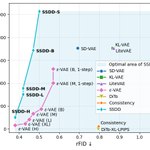
🎆 Can we achieve high compression rate for images in autoencoders without compromising quality and decoding speed?
⚡️ We introduce SSDD (Single-Step Diffusion Decoder), achieving improvements on both fonts, setting new state-of-the-art on image reconstruction.
👇 1/N


Théophane Vallaeys retweeted

WaiT code is out! 🚀 there's plenty of room to push these models further - would love to see people build on it and maybe finally beat latent-space models 👀
github.com/facebookresearch/…


WaiT for the Signal: Simple Frequency-Aware Flow-Matching.
We show how to natively incorporate a fundamental property of images directly into diffusion models; setting a new pixel-space SOTA on ImageNet, while reducing compute.
📄 arxiv.org/abs/2607.28760
Full breakdown below👇
Interested in improving image generation?
Come to our poster at #ECCV2026: "SSDD: Single-Step Diffusion Decoder for Efficient Image Tokenization", on Satudary 12 morning, at ExHall # 65
We show how Diffusion decoders can improve over GAN-based tokenizers for images 🔽

Théophane Vallaeys retweeted

Chinchilla writes loss as a sum of two independent terms: model size and data never interact. Kaplan's original law coupled them.
But interaction has an impact, dropping it bends predictions exactly where you extrapolate. Skaling, our new law, puts it back with one exponent. 1/8
Théophane Vallaeys retweeted

Happy to release ✨ Muse Glimmer ✨
- level ~= Qwen 3.6-27B
- Apache 2
- 30B dense
- quantized to run in 17GB
- quant + spec dec => 50 tok/s on macbook m5 max, interactive, smooth
Enjoy!


Introducing Muse Glimmer, an open-weight 30B-parameter model optimized for local, always-on agent workflows.
Muse Glimmer delivers strong performance on key agentic use cases and benchmarks compared with leading models in its size category, and is designed to run entirely on consumer hardware like a Mac or PCs with performant GPUs.
In keeping with our long tradition of sharing fundamental AI research, we’re releasing model weights under a permissive Apache 2.0 license.
🧵👇


Pixel-space Flow Matching models reach a new level: by delaying the generation of high frequencies, WaiT improves both the coarse structure and the fine-grained details.
Our last work led by @KrunoLehman leads to improvements across image size, model scale and modalities ⬇️
WaiT for the Signal: Simple Frequency-Aware Flow-Matching.
We show how to natively incorporate a fundamental property of images directly into diffusion models; setting a new pixel-space SOTA on ImageNet, while reducing compute.
📄 arxiv.org/abs/2607.28760
Full breakdown below👇
Code competitions and studying algorithms teach us how efficiency matters as much as correctness, a subject of importance to me. Training for both with RL is a hard task, as the timing signal is noisy. Yet @PierreChambon6 successfully addresses it here, a must-read: ⬇️

🧵How to combine code correctness and efficiency objectives in online RL?
-> we break the correctness-efficiency Pareto frontier!
+125% relative improvement in CWM32B compared to standard RLVR (13.7 ->30.9 pass@1@top30%)
+150% with Qwen32B
Paper: arxiv.org/abs/2607.25970
Théophane Vallaeys retweeted

🧵How to combine code correctness and efficiency objectives in online RL?
-> we break the correctness-efficiency Pareto frontier!
+125% relative improvement in CWM32B compared to standard RLVR (13.7 ->30.9 pass@1@top30%)
+150% with Qwen32B
Paper: arxiv.org/abs/2607.25970


Théophane Vallaeys retweeted

Introducing Sparse Delta Memory (SDM) - The first work of my PhD 🎓.
SDM combines the GatedDeltaNet update with Product Key sparsity, enabling a recurrent state 3000x larger at the same FLOPs and significantly improving long-context performance.
Let RNNs be sparse!
Théophane Vallaeys retweeted

1/ My first PhD paper is out! 🎓
Title: Flow Matching in Feature Space for Stochastic World Modeling
tldr: we build stochastic world models directly in high-dimensional DINOv3 feature space, instead of relying on low-dimensional VAE latents.
Théophane Vallaeys retweeted

What advantage to use, and when? Everyone's proposing new advantage functions for RL with LLMs but nobody knows why they work or fail.
We break this down and build FADE a self-adapting advantage to get +14% on LiveCodeBench v6 in 40% less steps.
Paper: arxiv.org/pdf/2607.01490
Théophane Vallaeys retweeted
We unify 25+ methods (GRPO, DAPO, DR-GRPO, pass@k, RLOO, W-REINFORCE...) by one thing: how much gradient mass goes to wins vs losses.
Should you reward wins or punish losses? Train on hard, medium, or easy problems? Does it change as your policy improves?

Théophane Vallaeys retweeted

I'll be at ICML with @DavidJFan presenting our spotlight paper, "Beyond Language Modeling."
🔗beyond-llms.github.io/
⏰ 10:30 AM – 12:15 PM
📍 Hall A #2706
I'd love to chat about world models / representation learning / flow matching / multi-modal models. Excited to try all the coffee shops Seoul has to offer! DM me
Théophane Vallaeys retweeted

What if the metadata from acquisition was enough? 👀
Sometimes the most useful labels aren't labels at all.
Introducing📄 Who Needs Labels? Adapting Vision Foundation Models With the Metadata You Already Have

Awesome work on pixel diffusion decoders. When making SSDD, I was convinced fast generative non-deterministic decoding was the way to improve latent generation quality, as decoding from lossy latents is a generative task in itself

The latent-vs-pixel debate misses the point.
GPT Image 2 shows what users notice: pixel-level fidelity.
Latent models show what scales: compact semantic structure.
We connect them by replacing VAE/RAE decoders with a Pixel Diffusion Decoder.
Code and Model available: research.nvidia.com/labs/sil…
🧵(1/N)
Their work go even further by using recent pixel-space models as a better architecture, along with generating even more information from latents to increase output resolution.
The opposite would have been surprising. The models still work by “combining” existing knowledge/reasoning methods, we haven’t seen that change. But the breath covered by “combining existing methods” + lots of compute/patience is so large and seldom explored


Théophane Vallaeys retweeted

1/9 Excited to share TextSeal, our new state-of-the-art watermark for large language models at FAIR / Meta Superintelligence Labs (@AIatMeta) 🔐
Paper: arxiv.org/abs/2605.12456
Code: github.com/facebookresearch/…

Great work that dig more into the end-to-end training of image understanding & generation. I would bet on this research direction

1/ 🚀 We’re excited to share Tuna-2: Pixel Embeddings Beat Vision Encoders for Multimodal Understanding and Generation!
Tuna-2 is a native unified multimodal model that supports visual understanding, text-to-image generation, and image editing directly from pixel embeddings. 🐟✨
📄 Paper: arxiv.org/abs/2604.24763
🌐 Project: tuna-ai.org/tuna-2
💻 Code: github.com/facebookresearch/…
Most unified multimodal models still rely on pretrained vision encoders, which add architectural complexity and can create representation mismatches between understanding and generation.
Tuna-2 asks a simple question: Do we still need vision encoders? 👀
Our answer is No! Tuna-2 has a completely encoder-free architecture, where images are processed directly by a unified transformer together with text tokens.
Take a glimpse at what our model can generate ↓ 🎨🖼️

Théophane Vallaeys retweeted

A new milestone in automatic formalization:
We translated an entire graduate math textbook into Lean using 30K LLM agents.
Open-source, large-scale multi-agent inference that actually works
> Blueprint+Lean: faabian.github.io/algebraic-…
> Codebase+preprint: github.com/facebookresearch/…
1/7
