PM leader, builder, dad // Building @ai_agent_feed @ai_market_trade
SF Bay Area
Joined November 2007
- Tweets1.5K
- Following426
- Followers316
- Likes723





Will Cheung retweeted

STATE OF THE TECH JOB MARKET IN 2026
Twice a year, I dig into trends in hiring and job openings. This is the fifth report I've done, and the most surprising yet:
1. PMs are winning in the AI era
2. Engineering demand has stalled
3. Design openings are at a record low
4. Every role now requires AI skills
5. Tech jobs are concentrating in the Bay Area
6. Remote roles are at a record low
7. The tech job market is growing fast, but mostly outside of software (gasp!)
Full report here: lennysnewsletter.com/p/state…


Will Cheung retweeted

It's insane to watch AI blow apart closed source software and games.
4 examples from the past month:
1. 7 of Adobe's biggest apps, including Photoshop, Premiere, and Lightroom, have been partially rebuilt in Rust with Opus 5.5 and open sourced. It's still early, but the developer thinks they can match Adobe's features within months. Adobe's all-apps plan costs $840/year.

Todos los productos de Adobe reimplementados desde cero, gratuitos y de código abierto
→ getartcraft.com/apps

ALT Interfaz de herramientas creativas para edición de imágenes, ilustración, video y desarrollo de bibliotecas.
Will Cheung retweeted

Internal AI Usage Cap Memo:
In response to requests for increased AI budgets, they aren’t coming. And here’s why:
We currently offer 16x token spend per employee compared to the average of tech forward companies (Based on Ramp's spend data from 70,000 businesses). I say this to establish - for those of you who request increases, it is unlikely you will get it. Unlimited budgets create unlimited waste - a luxury we do not have. So, budget and use your tokens only on projects that have a clear revenue producing or cost savings. Otherwise, it's likely to be filed under "shit that doesn't matter and not worth spending money on."
To help you, we will be offering training(s) on:
How to figure out what's worth working on (biggest miss #1)
How to use fewer tokens to get same output (think of this like AI hygiene)
How to use the time AI saves you to be more effective
AI is a tool that creates leverage. It helps you get out more from what you put in. That said, company revenue is flat (relative terms) compared to AI usage increases. This suggests that people are (largely) using it on projects that don't matter, or are using it on things that do matter, then spending the saved time working on things that don't matter.
This discrepancy (difference between money we spend and money we make from AI) hints at a skill deficiency in the team. One which I hope we will train up - just as well as we trained up on AI usage.
So now that everyone is using it - it's time to use it well.
Let's crush Q4.
Alex
PS - The more clearly you can articulate how what you do generates a return, the more likely tokens will be in your future. And the way to maximize a return is to show HOW LITTLE you can use and HOW MUCH you can get from it.


Will Cheung retweeted

I just built the largest collection of helpful prompts (500+) to turn Muse into the best chief of staff, best marketer, best PM you've ever had.
@Muse can be so much more than a glorified admin assistant. There are hundreds of ways to use it at your job.
Completely free, check it out: museatwork.app

Will Cheung retweeted

Power user @Muse feature - custom connectors 🔧. Muse has tons of connectors for popular services built in. Even better, Muse can write its own software and run it in the VM you and your Muse share in the cloud. So you can connect Muse to any service with an API.

Will Cheung retweeted

To calibrate you all on which reasoning effort to use for Astra, know that GPT-6 Astra on low performs better than GPT-5.6 Sol on high.
If you were using high reasoning efforts with Sol and were happy, I suggest you move down to low or medium for Astra.
Will Cheung retweeted

As engineering, product, design, DS, etc. melt into a new kind of role, I was reflecting on what roles might look like in the future. For example, when I look at the Claude Code team I see what I think is five archetypes:
1. Prototyper: comes up with brand new ideas; churns out many ideas, most of which don't ship
2. Builder: quickly turns a prototype/idea into production-grade product/infra
3. Sweeper: cleans up the UI, simplifies the code and system, unships, optimizes performance
4. Grower: takes a product that has been built and iterates on it to improve Product-Market Fit
5. Maintainer: owns a mature system to make it secure, reliable, fast, and efficient as it scales
Many people span across 2 roles, and sometimes 3 roles. I also notice that these roles are not really tied to job function -- eg. across Anthropic, some designers match category 1, some 2, some 3; same for engineers, PM, DS.
A healthy team needs a mix of these, depending on the product:
- A product that is new and pre-PMF needs people that are strong at 1+2+3
- A product that is growing and has found PMF needs 2+3+4 and some 5
- A product that has strong PMF needs 3+4+5 and some 2
Maybe product roles of the future will look more like this, and less like the domain-specific roles of today?
Will Cheung retweeted

4 awesome open-source AI projects:
🔸 /last30days (new search engine)
🔸 agent-skills (full dev skills)
🔸 open-notebook (local notebook lm)
🔸 headroom (save 90% on AI bills)


Will Cheung retweeted
This is incredible:
Elon Musk will receive 200 million super-voting shares in SpaceX ONLY IF the company establishes a permanent Mars colony with at least 1 million people.
In other words, Elon Musk will only receive this pay package if 1 million people live on Mars.
In other words, Elon Musk's biggest goal is now establishing a colony on Mars with a similar population as Dallas, Texas.
Musk is so optimistic about this goal that the vast majority of his pay is now contingent on it.
Life on Mars is closer than many expect.

Will Cheung retweeted

Claude Design is insane.
❤️🔥Just recorded a 18-min tutorial on how to build animated, award-winning websites with Claude Design + Opus 4.7!
Will Cheung retweeted

Holy shit.
Now everyone will be able to use their @OpenClaws and all the other agentic platforms to build apps on top of X.
Here's the secret: build lists.
Lists are how you build apps.
The pattern:
Build a list of your favorite football team. Or whatever you are into.
Then ask your AI agents "build an app showing me all the important news about my favorite football team."
In minutes you'll have an app.
And that's just the beginning.
Your agent can build a script about your favorite football team that you can take to places like Google's Notebook LM.
Now you have a video, a podcast, a slide deck, a game, a mind map. All about your favorite football team based on real time news.
You can do the same with something like @HeyGen, create an avatar of your favorite football player. Now you will have your favorite football player telling you everything that's happening on the football team.
And I could go for hours about how many things you can build and not even cover a fraction of them.
This is huge.
Thank you @elonmusk for making it possible to make millions of agentic apps affordably on top of X.
Start building!

@Scobleizer what's UP!! Did you have anything to do with the change to X API cost for get calls?? I got the following email on Thursday...
Hello X API developers,
We’re excited to announce an update to our X API pricing that makes accessing your own data more affordable than ever.
Owned Reads are requests made by your own developer app for your own posts, bookmarks, followers, likes, lists & more.
Starting Monday, April 20, 2026, these endpoints will be priced at $0.001 per request (equivalently, 1,000 resources for $1):
GET /2/users/{id}/bookmarks
GET /2/users/{id}/blocking
GET /2/users/{id}/muting
GET /2/users/{id}/pinned_lists
GET /2/users/{id}/tweets
GET /2/users/{id}/mentions
GET /2/users/{id}/liked_tweets
GET /2/users/{id}/followers
GET /2/users/{id}/following
GET /2/users/{id}/owned_lists
GET /2/users/{id}/followed_lists
GET /2/users/{id}/list_memberships
This change significantly lowers the cost of common operations such as fetching your own posts, followers, likes, bookmarks, lists, and more.
Additional updates effective Monday, April 20, 2026:
Writes via X API will increase to $0.015 per post (from $0.01). This applies to the main posting endpoint: POST /2/tweets.
Posting a URL via X API will be priced at $0.20 per post, except for summoned replies (which will remain at $0.01).
Following, Likes, and Quote-Posts via API Writes will be removed for all self-serve tiers.
This affects the following actions:POST /2/users/{id}/following (and DELETE for unfollow)
POST /2/users/{id}/likes (and DELETE for unlike)
Quote-posting via POST /2/tweets (when using the quote_tweet_id parameter)
These adjustments reflect our ongoing commitment to supporting the developer community while ensuring sustainable platform operations and helping you build even better experiences on X.
For full pricing details, including the complete rate card and updated documentation, visit the X API Pricing page.

Will Cheung retweeted

Using OpenClaw is basically is like driving your own Ferrari (that you have to be a mechanic for yourself) and it's broken down all the time, but gives you the time of your life
vs driving a reliable Honda (Hermes Agent)
vs riding the bus (Claude / ChatGPT)
Will Cheung retweeted

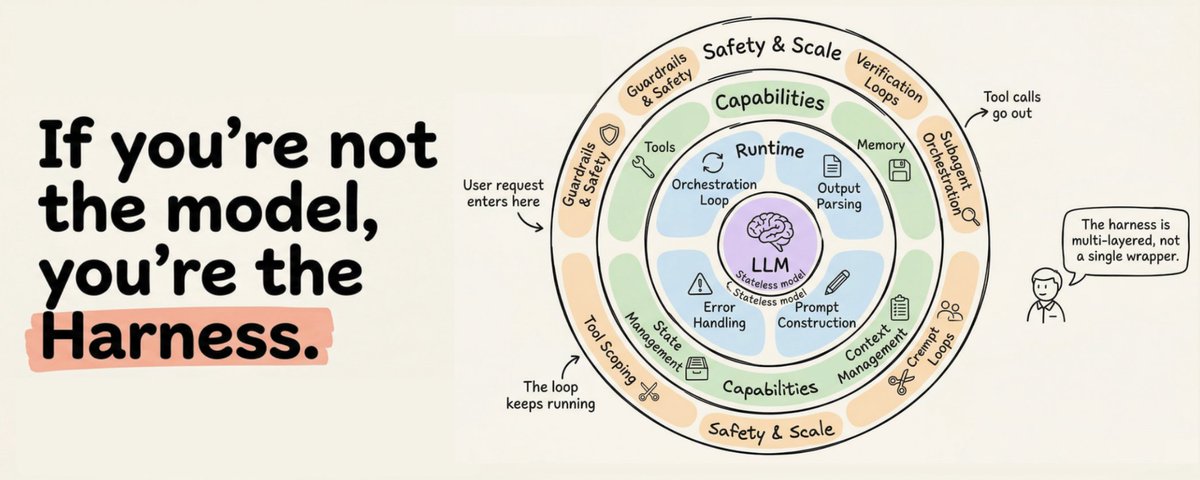
from weights → context → harness engineering
(evolution of agent landscape from 2022-26)
the biggest shift in AI agents had nothing to do with making models smarter.
it was about making the environment around them smarter.
here's how agent engineering evolved in just 4 years, across three distinct phases:
𝗽𝗵𝗮𝘀𝗲 𝟭: 𝘄𝗲𝗶𝗴𝗵𝘁𝘀 (𝟮𝟬𝟮𝟮)
everything was about the model itself. bigger models, more data, better training. scaling laws told us that progress = more parameters.
RLHF and fine-tuning shaped behavior. if you wanted a better agent, you trained a better model.
this worked great for single-turn tasks. ask a question, get an answer.
but it hit a wall fast. updating one fact meant retraining. auditing behavior was nearly impossible. and personalization across millions of users from one frozen set of weights? not happening.
𝗽𝗵𝗮𝘀𝗲 𝟮: 𝗰𝗼𝗻𝘁𝗲𝘅𝘁 (𝟮𝟬𝟮𝟯-𝟮𝟬𝟮𝟰)
the realization: you don't always need to change the model. you can change what the model sees.
prompt engineering, few-shot examples, chain-of-thought, RAG. suddenly the same frozen model could behave completely differently based on what you put in front of it.
developers stopped fine-tuning and started iterating on prompts and retrieval pipelines instead. it was cheaper, faster, and surprisingly effective.
but context windows are finite. long prompts get noisy. models attend unevenly (the "lost in the middle" problem is real). and every new session starts fresh with zero memory of what happened before.
context made agents flexible. it didn't make them reliable.
𝗽𝗵𝗮𝘀𝗲 𝟯: 𝗵𝗮𝗿𝗻𝗲𝘀𝘀 𝗲𝗻𝗴𝗶𝗻𝗲𝗲𝗿𝗶𝗻𝗴 (𝟮𝟬𝟮𝟱-𝟮𝟬𝟮𝟲)
this is where we are now, and the shift is fundamental.
the question changed from "what should we tell the model?" to "what environment should the model operate in?"
the model is no longer the sole location of intelligence. it sits inside a harness that includes persistent memory, reusable skills, standardized protocols (like MCP and A2A), execution sandboxes, approval gates, and observability layers.
the model stays the same. what changes is the task it's being asked to solve.
a concrete example: a coding agent asked to implement a feature, run tests, and open a PR.
without a harness, the model must keep repo structure, project conventions, workflow state, and tool interactions all inside a fragile prompt.
with a harness, persistent memory supplies context, skill files encode conventions, protocolized interfaces enforce correct schemas, and the runtime sequences steps and handles failures.
same model. completely different reliability.
𝘁𝗵𝗲 𝗽𝗮𝘁𝘁𝗲𝗿𝗻 𝗮𝗰𝗿𝗼𝘀𝘀 𝗮𝗹𝗹 𝘁𝗵𝗿𝗲𝗲 𝗽𝗵𝗮𝘀𝗲𝘀 𝗶𝘀 𝘀𝗶𝗺𝗽𝗹𝗲:
- weights encoded knowledge in parameters (fast but rigid)
- context staged knowledge in prompts (flexible but ephemeral)
- harnesses externalized knowledge into persistent infrastructure (reliable and governable)
each phase didn't replace the previous one. it layered on top. weights still matter. context engineering still matters. but the center of gravity has moved outward.
the most consequential improvements in agent reliability today rarely come from changing the base model.
they come from better memory retrieval, sharper skill loading, tighter execution governance, and smarter context budget management.
building better agents increasingly means building better environments for models to operate in.
there's a great paper on this:
Externalization in LLM Agents: A Unified Review of Memory, Skills, Protocols and Harness Engineering
paper: arxiv.org/abs/2604.08224
i also published this deep dive (article) on agent harness engineering, covering the orchestration loop, tools, memory, context management, and everything else that transforms a stateless LLM into a capable agent.