

CEO at Educare (Sultan of Software 👑)
Africa and Europe
Joined October 2009
- Tweets7.7K
- Following46
- Followers113K
- Likes25.6K




Pinned Tweet
Last jamb was a disaster for my village youngsters. Over 70% of them failed jamb and the rest sparely passed. Rather than waiting for the government, we decided to take a different approach. We took the challenge upon ourselves for it not to repeat itself again. Every youngster in my village right now is on an intensive morning and evening drilling for next years Jamb and they undertake CBT once monthly with large pool of 16 years past questions across different subjects. In the CBT we track their performances on different topics and lays more emphasis on their weaknesses across different subject topics. One common thing we noticed is that many of the youngsters are alien to computers and can't even use a mouse nor keyboards. How were they planning to succeed in jamb when they could had probably be using a computer for the first time on Jamb day?
It's an eye opener and our mission is for all of them to score above 250. We will be paying for all their jamb exam fees and are also offering full scholarship to everyone that scores 300 and above.
Today, we officially signed a landmark partnership agreement with Sterling Bank!
Sterling Bank is committing ₦60 million in prizes for the 2027 South East Mathematics & Science Olympiad.
In addition, the bank is committing ₦24 million to our National Mathematics Quiz, where outstanding students will receive ₦1 million in prizes every month.
But it gets even better!
Our star students will now have access to internship opportunities at Sterling Bank, while winners of the South East Mathematics & Science Olympiad will receive an additional one-year scholarship.
What a bank! What a commitment to the future of Nigerian children!
We will continue to double down on our efforts to build the greatest workforce in Africa by 2036.
We are deliberately investing in the next generation of mathematicians, scientists, engineers, innovators, and problem-solvers.
And I have just one request for everyone reading this:
Open an account with Sterling Bank. Encourage your family members, friends, and colleagues to bank with Sterling.
When a bank makes this level of commitment to the education and future of our children, it deserves our support.
This is the kind of corporate investment that can transform a generation.
Sterling Bank is not just banking on Nigerians. It is investing in the future of Nigeria.
Thank you, Sterling Bank. Our children will remember this investment.


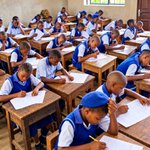
Look at our children in the South East solving mathematics problems this morning. This is Imo State.
We are giving every single one of them a reason to dream, the confidence to believe in themselves, and the opportunity to achieve greatness.
No child will be left behind in the South East.
By 2036, we are determined to build the greatest workforce in Africa.
We are deliberately building the future, one child at a time.
We have made significant progress in redesigning the Igbo Apprenticeship System.
We have now signed an agreement with a German Ausbildung programme, one of the world’s most respected vocational training systems in the world.
We will be selecting 20 young people between the ages of 16 and 25 from across the five South-Eastern states for specialised training in various trades, including carpentry, plumbing, welding, masonry, and other technical skills.
The selected participants will first undergo nine months of intensive German language training in Enugu before securing Ausbildung placements and relocating to Germany for specialised vocational training.
Upon completing their training, they will return to Nigeria to train others, transferring their knowledge and expertise to local communities as we progressively expand the programme.
Our core focus is precision, technical excellence, and world-class craftsmanship.
We want to develop a generation of highly skilled professionals who can build infrastructure, transform industries, create jobs, and contribute meaningfully to the development of our society.
These are the people who will build the future of our region.
We are deliberately building the human capital required to transform the South East.
These are our children today in the South East, Imo State, to be precise.
We are deliberately shaping our future by investing in the next generation.
No child will be left behind.


In 2027, the JAMB, NECO, and WAEC results from the South East will be exceptional, on a scale never witnessed before.
There is something we are going to do, but we will not disclose the strategy publicly just yet.
I implemented this intervention in my village, and the results were remarkable. This time, we are scaling it across the entire South East.
When the results begin to emerge, please do not mistake our success for examination malpractice.
What you will witness will be the outcome of an extraordinary level of deliberate effort, strategic intervention, and academic preparation.
We are about to demonstrate what is possible when you invest intentionally in the academic success of every child.
This is Government College Afikpo, Ebonyi State.
We have succeeded in inspiring these students to dream bigger, aspire to greatness, and take their education seriously.
We are not just improving academic performance. We are raising a generation of young people who believe in their potential and are determined to achieve extraordinary things.
We will not leave a single child behind.
Watch closely as we work to build Africa’s greatest workforce over the next 10 years.
The transformation of Africa begins in our classrooms.
This is how we are transforming the lives of children in Ebonyi State.
No child will be left behind in the South East.
We are laying the foundation to build Africa’s greatest workforce within the next 10 years.
The future of Africa will be shaped by the quality of education we give our children today.


There is a question I have been thinking deeply about.
Many children of Nigerian politicians have had the privilege of receiving some of the finest education in the world. They have lived in societies where institutions function, public resources are managed with accountability, and leadership is expected to serve the people.
When they eventually return to Nigeria and inherit political influence, what happens?
Does their exposure to functioning societies fundamentally change their understanding of leadership, or does the political environment they grew up in ultimately shape their behaviour?
Can education genuinely transform a person's values when the very system that gave them privilege rewards the opposite of what they were taught?
Imagine what even a fraction of that coastal highway investment could achieve if directed towards significantly improving teachers’ salaries, recruiting exceptional educators, developing school leaders and equipping public schools.
Imagine making teaching one of the most competitive and respected professions in Nigeria.
Imagine our brightest graduates competing to become teachers because the profession offers dignity, excellent remuneration and genuine opportunities for career advancement.
A PUBLIC SCHOOL PRINCIPAL IN SINGAPORE CAN EARN MORE IN ONE MONTH THAN A NIGERIAN PUBLIC SCHOOL PRINCIPAL EARNS IN AN ENTIRE YEAR.
Read that again.
In Singapore, a PUBLIC SCHOOL PRINCIPAL can earn an estimated S$8,000–S$15,000 monthly, excluding bonuses.
In Nigeria, a PUBLIC SCHOOL PRINCIPAL may earn approximately ₦150,000–₦320,000 monthly, depending on the state and experience.
Now consider this.
A graduate trainee at Chevron Nigeria can reportedly earn ₦450,000–₦750,000 or more monthly.
A Nigerian senator receives ₦1.06 million monthly in officially prescribed salary and allowances, according to the Revenue Mobilisation Allocation and Fiscal Commission. This excludes separately reported legislative running costs.
Think about the responsibility of a public school principal.
This is someone entrusted with hundreds, sometimes thousands, of children. Someone responsible for the quality of teaching, discipline, academic performance, teacher development and the intellectual foundation of the next generation.
Yet, in Nigeria, an experienced public school principal can earn less than a graduate trainee entering the oil and gas industry.
Singapore did not build a globally respected education system by treating school leadership as an insignificant profession.
We cannot continue to demand world-class educational outcomes while failing to make public school leadership financially attractive to exceptional professionals.
Education is not merely another government expenditure. It is an investment in the country’s human capital.
The people entrusted with developing the next generation deserve far greater attention in our national priorities.
I have been thinking about how we can solve one of the biggest problems in science education in Nigeria: the lack of functional laboratories in our schools.
Setting up and maintaining a proper science laboratory is expensive, and many schools simply cannot afford it. As a result, millions of students learn science without actually experiencing it.
What if we changed that?
I am proposing something called Lab Clusters.
Imagine world-class Chemistry, Biology, Physics and Engineering laboratories established in strategic locations across Nigeria.
Instead of every school struggling to build its own laboratory, schools can subscribe to these facilities, just like people subscribe to gyms.
Students would visit at scheduled times to conduct real experiments, use modern equipment and learn science by actually doing science.
One facility could serve dozens of schools and thousands of students.
I believe this model could dramatically close the practical science education gap in Nigeria, especially for students in underserved communities.
No Nigerian child should be denied practical science education simply because their school cannot afford a laboratory.
I am seriously considering bringing this idea to life.
What do you think?
🤖 Made with AI

Imagine if Nigerian students were taught maths this way!
An easy rule of thumb for short distances is the length of a football pitch.
A standard pitch is around 100 meters long. 1000 meters (10 football pitches) make 1km.
A mile is 1.6km (16 football pitches), and a km is 0.6 miles. So to convert miles to km, multiply by 1.6, and to do the reverse, multiply by 0.6.
Assuming we are familiar with inches already (your smartphone is most likely between 5.5 and 6.5 inches tall), 12 inches make a foot and the distance between the floor and the ceiling of a typical Nigerian residential apartment is 9 feet.
1 yard = 3 feet. So to get yards from feet, divide by 3, and to do the reverse, multiply by 3.
For navigation, most of us already know East And West based on the perceived rising and setting of the sun.
North is the direction to your left when facing the East ('rising' sun) and the direction to your right when facing the West ('setting' sun)
Don't try to memorise them. They are grasped intuitively through culture, individual curiosity, or line of work.
A lot of children will love maths even more, because it’s relatable to their everyday reality.
One of the greatest injustices in Nigeria’s education system is that we subject children to the same national examinations despite giving them completely unequal opportunities to learn.
A child in a poorly funded public school with no Mathematics or Physics teacher for an entire academic session will sit for the same WAEC examination as a child in a well-equipped private school with qualified teachers, modern laboratories, libraries and access to technology.
Both children will be judged by the same examination standards.
One scores an A, the other scores an F.
We celebrate one as brilliant and condemn the other as a failure.
But did we actually test their intelligence, or did we simply measure the inequality of their opportunities?
The tragedy is that the child who failed might be just as intelligent, or even more gifted, than the child who passed.
Equal examinations without equal learning opportunities are not necessarily a fair measure of a child’s potential.
We cannot continue to hold children accountable for the failures of an education system they did not create.
Every Nigerian child deserves a fair opportunity to learn before being judged on what they know.
A child’s examination result should reflect their learning, not the circumstances of their birth.
China has banned for-profit private schools providing primary and junior secondary education, based on the principle that schools should not be profit-making businesses.
China prohibits individuals and businesses from establishing private schools to profit from the education of children aged 6 to 15, maintaining that basic education must not become a commercial enterprise.
Private schools are still permitted, but those providing compulsory education must operate as non-profit institutions. Their founders cannot distribute profits to themselves.
Where did we get the medical ethics in Nigeria that allow doctors and nurses to refuse to treat patients simply because they cannot afford to pay?
Why should a human being be left to die simply because they have no money?
Since when did money become more important than human life?
This is how we are training young minds in South East. No child will be left behind.
We will double down on our investment in our children’s education.
Within the next 10 years, they will lead Africa’s workforce.


I had an insightful conversation with the team at miNibA about education, and what it will really take to build a better Nigeria.
We discussed the challenges, opportunities and why conversations must translate into action.
Listen to the full conversation here 👇
YouTube Link:
youtu.be/hju525iOedI?si=aMJ0…
Spotify link:
open.spotify.com/episode/6az…
It makes absolutely no sense that people living in South East Nigeria have to travel to Lagos or Abuja just to apply for visas or catch international flights to the US, Europe, or other parts of the world.
People should be able to apply for visas to any country in Enugu, at the very least, and fly directly from the South East to major international destinations, with a choice of airlines.
This is critical to regional development, economic growth, and reducing our dependence on other regions.
The South East governors must work together to make this happen. It is long overdue.
This is Southeast Nigeria on this beautiful Saturday afternoon, with young minds busy solving mathematics problems.
We are doubling our efforts to ensure that we build the greatest workforce in Africa within the next 10 years.
We need more embassies and more direct flights connecting Southeast Nigeria to the UK, US, Europe, and the Middle East.
This will help us reduce our dependence on other states, strengthen our regional economy, and unlock greater opportunities for our people.


Can we start teaching Nigerian children how to measure distance properly?
In the UK, Europe, Canada or US, someone tells you a place is 5km away, and you know exactly what that means.
In Nigeria, our units of measurement are “just here,” “near near,” “small trek,” and the legendary “you will soon reach.”
Nobody knows whether that means 200 metres or 10 kilometres!
A society that struggles to understand distance will struggle with spatial planning, mapping, infrastructure and development.
I have a feeling that 2027 could be the last presidential election contested by Tinubu, Atiku and Peter Obi.
If that happens, Nigeria could be entering a new political era by 2031.
Will the next generation of Nigerians inherit a political system that rewards competence, ideas and integrity, or one that continues to reward political connections?