Wonderleaf (@wonderleafapp) header
Wonderleaf (@wonderleafapp) profile picture

Tiny picture books for big little questions. Real science, warm watercolour, three minutes cover to cover. Reading starts free every day.

Joined May 2026
Photo by Wonderleaf (@wonderleafapp)Photo by Wonderleaf (@wonderleafapp)Photo by Wonderleaf (@wonderleafapp)Photo by Wonderleaf (@wonderleafapp)Photo by Wonderleaf (@wonderleafapp)Photo by Wonderleaf (@wonderleafapp)Photo by Wonderleaf (@wonderleafapp)Photo by Wonderleaf (@wonderleafapp)Photo by Wonderleaf (@wonderleafapp)Photo by Wonderleaf (@wonderleafapp)
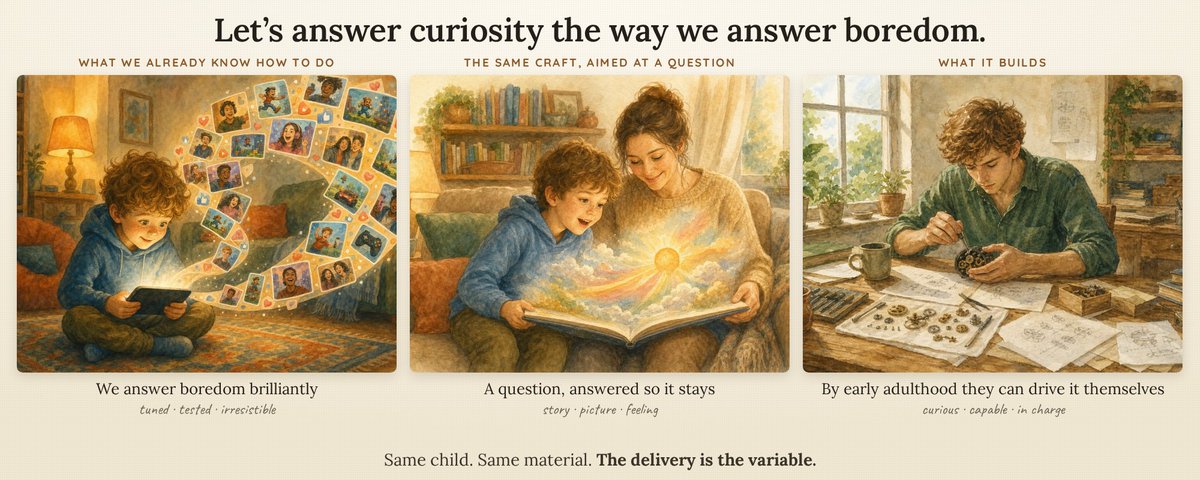
Boredom gets the best engineering ever built. Scientific curiosity is still served bland. Let's fix it.
1
3
968
Your child asks, “Why is the ocean salty?” Follow the answer together, from rocks and rivers to the sea. When water evaporates, the salt stays behind. Read Ocean’s Salt Story, an illustrated explanation for curious kids.
4
Why do leaves change color?
🤖 Made with AI
1
29
In summer, chlorophyll keeps leaves green while they catch light. As days shorten, sap slows and chlorophyll breaks down, so the green mask lifts. Yellow and orange carotenoids were already there under the green. Cool nights help trap sugars that make bright red anthocyanins. Green fades. Colors show.
1
24
Why do shooting stars fill the sky every October? ☄️
🤖 Made with AI
1
1
34
The Orionids seem to fly out of the constellation Orion. They come from dust left behind by Halley's Comet. Specks smaller than a grain of sand hit our air so fast they burn up as streaks of light. Every October, Earth passes through that old trail again.
1
27
Before pumpkins, people carved turnips. Halloween's familiar face has a surprising backstory. 🎃
1
1
44
Before the glowing orange pumpkin came a different face in the dark. In Ireland, people hollowed out turnips, cut frightening features into them, and placed candles inside. Irish emigrants carried lantern-making customs across the Atlantic, where pumpkins were plentiful and easier to carve. No single person invented Halloween. It took shape over centuries from many customs.
1
33
Why is the ocean salty? Rivers carry dissolved minerals from rock to sea. Evaporation removes water but leaves salt behind. Seafloor exchanges and mineral deposits also shape the balance. Four pictures follow the journey.
🤖 Made with AI
1
40
How do six snowflake arms grow such similar patterns? Ice’s structure sets the sixfold symmetry. The arms share nearly the same changing air, so they tend to branch alike. Different paths through a cloud produce different crystals.
🤖 Made with AI
1
1
31
Water absorbs red light more readily than blue. A glass barely changes the light. An ocean gives it a much longer journey. Along that path much of the red disappears, leaving mostly blue. Bring a lamp close to a red shell underwater and its red returns: a shorter trip. Sand, plankton and sediment can tint the water turquoise, green or brown.
24
Tap. Your stick stops. The puck doesn't. Moving things don't need a constant push to keep going. On the ice, gravity pulls down and the ice pushes up: balanced, so it keeps sliding. Friction is the hidden brake. Small on ice, much bigger on carpet. Staying still or gliding straight needs no unbalanced force. Starting, stopping, speeding up or turning does.
27
Why can you see your breath when it's cold?
🤖 Made with AI
1
1
31
Warm breath carries water as vapor: molecules far too tiny to see. Cold air cools it, and the water crowds together into tiny droplets. Millions of droplets make a mini cloud. That puff is your breath. Cold, damp air keeps it lingering. Milder, dry air evaporates it fast.
1
20