






mod retweeted

Excited to bring responsible innovation to the US market in partnership with you @chameleon_jeff

Growing up in the United States, NYSE was synonymous with the story of American capitalism. I vividly remember learning about the Buttonwood agreement in 9th grade history class. 24 stockbrokers met under a tree on Wall Street and formed the beginning of what would become the world's financial center. From pits to computers to now onchain markets, America has always led the way in innovating markets to improve price discovery and capital formation. Today the next chapter begins with ICE, trade[XYZ], and Hyperliquid.
ICE started as an electricity-trading platform in 2000, growing to acquire NYSE itself in only 13 years. It is a key infrastructure provider of America’s energy, bond, and mortgage markets. ICE is a rare story of exponential growth of a financial giant over decades, continually embracing innovation and technology.
trade[XYZ] was the first HIP-3 deployer and responsible for spearheading the flourishing global RWA perpetual market today. Only a year ago, trade[XYZ] launched its first RWA perpetual markets. They took a bet on HIP-3, which had just launched after months of tireless development. Having followed their journey from day 1, I cannot overstate how much Shoku and the team have poured into growing these markets to a genuine source of price discovery for the most important assets in the world.
Over the past three years, Hyperliquid has pioneered onchain infrastructure to house all of finance. Hyperliquid is nothing without its world-class builders. I am honored that trade[XYZ] and ICE have chosen to build on Hyperliquid to bring perpetual contracts to America.
When I first spoke to Jeff Sprecher around a year ago, he asked what success looks like to me. I thought for some time and joked that it would be seeing ICE building on Hyperliquid's technology. I could never have predicted the progress that we've made as a community in a single year to make this come true. Excited to see what we can build together next.


mod retweeted

Joining forces with @tradexyz
Welcome to our community.

trade[XYZ] and ICE, owner of the New York Stock Exchange, are joining forces to bring 24/7 perpetual futures on Hyperliquid to the United States.
In just over a year, our markets on Hyperliquid have surpassed $650 billion in volume. They provide continuous price discovery for stocks, indices, and commodities, and have become trusted reference points for retail and institutions alike when traditional markets are closed. Much of the world trades them. Until now, Americans could only watch.
We intend to change that. Subject to CFTC approval, trade[XYZ] and ICE plan to establish a new, dedicated U.S. market, with novel exchange and clearing infrastructure built on Hyperliquid. Planned contracts span equities, indices, commodities, FX, and crypto, with access through participating brokers and platforms. We’ll share more on products, eligibility, and timing as approvals progress.
ICE brings more than 25 years of experience operating regulated markets, clearing, and managing risk. trade[XYZ] brings the product development, market design, and technology behind the most liquid and robust markets on Hyperliquid.
Innovation and the protections of U.S. regulation shouldn’t be a trade-off. Together, we plan to prove it.
ICE is making a strategic investment in trade[XYZ] and joins us in building towards the future of Hyperliquid. A small group of market luminaries is joining as well, beginning with Stan Druckenmiller. For more than four decades, few investors have anticipated the great turns in markets as often as Stan. We’re proud to have him with us for the next one.
We’re building the U.S. market in parallel with our existing HIP-3 markets, which we’ll continue to expand and innovate on. We expect both to flourish. They each have a long road map ahead, from new asset classes to new ways to trade them.
To the Hyperliquid community, whether you were here before us or came because of us, thank you. You took a chance on new markets and you made them matter. You’ll forever be a part of this story.
Anything. Anytime. On ICE[XYZ].
mod retweeted

Growing up in the United States, NYSE was synonymous with the story of American capitalism. I vividly remember learning about the Buttonwood agreement in 9th grade history class. 24 stockbrokers met under a tree on Wall Street and formed the beginning of what would become the world's financial center. From pits to computers to now onchain markets, America has always led the way in innovating markets to improve price discovery and capital formation. Today the next chapter begins with ICE, trade[XYZ], and Hyperliquid.
ICE started as an electricity-trading platform in 2000, growing to acquire NYSE itself in only 13 years. It is a key infrastructure provider of America’s energy, bond, and mortgage markets. ICE is a rare story of exponential growth of a financial giant over decades, continually embracing innovation and technology.
trade[XYZ] was the first HIP-3 deployer and responsible for spearheading the flourishing global RWA perpetual market today. Only a year ago, trade[XYZ] launched its first RWA perpetual markets. They took a bet on HIP-3, which had just launched after months of tireless development. Having followed their journey from day 1, I cannot overstate how much Shoku and the team have poured into growing these markets to a genuine source of price discovery for the most important assets in the world.
Over the past three years, Hyperliquid has pioneered onchain infrastructure to house all of finance. Hyperliquid is nothing without its world-class builders. I am honored that trade[XYZ] and ICE have chosen to build on Hyperliquid to bring perpetual contracts to America.
When I first spoke to Jeff Sprecher around a year ago, he asked what success looks like to me. I thought for some time and joked that it would be seeing ICE building on Hyperliquid's technology. I could never have predicted the progress that we've made as a community in a single year to make this come true. Excited to see what we can build together next.

Intercontinental Exchange (ICE) and trade[XYZ] have announced their plan to use Hyperliquid as the infrastructure layer to deploy perpetual futures markets for US traders across crypto, equities, commodities, foreign exchange, and other real-world assets, subject to regulatory approvals. ICE operates NYSE and some of the largest exchanges and clearing houses globally.
In this structure:
+ Hyperliquid serves as the underlying technology infrastructure via HIP-3*
+ trade[XYZ] designs and implements the markets
+ ICE operates the regulated market and clearing structure
Existing trade[XYZ] HIP-3 markets will remain unchanged.
Hyperliquid is a neutral infrastructure layer with the goal of supporting large parts of the financial system. As with HIP-3, HIP-3* deployers are independent operators who use Hyperliquid as the onchain infrastructure layer for their own markets, while retaining control and responsibility over their deployment.
mod retweeted

Intercontinental Exchange (ICE) and trade[XYZ] have announced their plan to use Hyperliquid as the infrastructure layer to deploy perpetual futures markets for US traders across crypto, equities, commodities, foreign exchange, and other real-world assets, subject to regulatory approvals. ICE operates NYSE and some of the largest exchanges and clearing houses globally.
In this structure:
+ Hyperliquid serves as the underlying technology infrastructure via HIP-3*
+ trade[XYZ] designs and implements the markets
+ ICE operates the regulated market and clearing structure
Existing trade[XYZ] HIP-3 markets will remain unchanged.
Hyperliquid is a neutral infrastructure layer with the goal of supporting large parts of the financial system. As with HIP-3, HIP-3* deployers are independent operators who use Hyperliquid as the onchain infrastructure layer for their own markets, while retaining control and responsibility over their deployment.
trade[XYZ] and ICE, owner of the New York Stock Exchange, are joining forces to bring 24/7 perpetual futures on Hyperliquid to the United States.
In just over a year, our markets on Hyperliquid have surpassed $650 billion in volume. They provide continuous price discovery for stocks, indices, and commodities, and have become trusted reference points for retail and institutions alike when traditional markets are closed. Much of the world trades them. Until now, Americans could only watch.
We intend to change that. Subject to CFTC approval, trade[XYZ] and ICE plan to establish a new, dedicated U.S. market, with novel exchange and clearing infrastructure built on Hyperliquid. Planned contracts span equities, indices, commodities, FX, and crypto, with access through participating brokers and platforms. We’ll share more on products, eligibility, and timing as approvals progress.
ICE brings more than 25 years of experience operating regulated markets, clearing, and managing risk. trade[XYZ] brings the product development, market design, and technology behind the most liquid and robust markets on Hyperliquid.
Innovation and the protections of U.S. regulation shouldn’t be a trade-off. Together, we plan to prove it.
ICE is making a strategic investment in trade[XYZ] and joins us in building towards the future of Hyperliquid. A small group of market luminaries is joining as well, beginning with Stan Druckenmiller. For more than four decades, few investors have anticipated the great turns in markets as often as Stan. We’re proud to have him with us for the next one.
We’re building the U.S. market in parallel with our existing HIP-3 markets, which we’ll continue to expand and innovate on. We expect both to flourish. They each have a long road map ahead, from new asset classes to new ways to trade them.
To the Hyperliquid community, whether you were here before us or came because of us, thank you. You took a chance on new markets and you made them matter. You’ll forever be a part of this story.
Anything. Anytime. On ICE[XYZ].
mod retweeted

I am excited to be an investor in trade(xyz) as they partner with ICE to bring 24/7 perpetual futures on Hyperliquid to the United States. As a market participant, I am looking forward to to using their innovative product to enhance my investment process.
mod retweeted
trade[XYZ] launched its first market on Hyperliquid 381 days ago. Today, we are joining forces with ICE, parent company of the New York Stock Exchange, to bring perpetual futures on Hyperliquid to U.S. regulated markets.
I don’t usually write long posts, but today merits reflection.
For years, builders across this industry have worked to show that open, onchain markets could support price discovery, manage risk, and withstand stress to the standards of traditional market infrastructure, all while staying open when and where those markets aren’t.
Our achievements stand on the shoulders of those builders. And today, the company that owns the New York Stock Exchange has chosen to build upon the work of every developer, trader, market maker, and user who took a chance on us and our markets. We share this moment with all of you.
Markets are shaped by their participants. A new generation of investors trades from their phones, across asset classes, at any hour of any day. Until Hyperliquid, the right infrastructure for those markets didn’t exist.
Building these markets was hard. It took novel approaches to pricing, funding, and risk, refined with real capital at stake, in markets that don’t close. It also meant earning the trust of the people trading on them. We’re honored that the community recognized that effort and responded in kind.
That trust is what allowed us to grow our volumes to a ~$1 trillion annualized run rate in just over a year, to help pioneer new instruments like pre-IPO perps, and to earn the confidence of storied institutions like S&P Dow Jones Indices. That’s why ICE has chosen trade[XYZ] as its exclusive partner to bring 24/7 perps to the U.S.
Shifts in technology have pushed markets toward greater transparency, better price discovery, and broader access: from the coffee house to the curb exchange, ticker tape to the telephone, the trading floor to digital exchanges.
ICE helped write that last chapter. In 1997, Jeff Sprecher bought a small power-trading technology business for $1. ICE launched as an electronic energy marketplace in 2000, helped digitize major commodity markets, and acquired the NYSE in 2013. It has grown exponentially because of this appetite for innovation. That’s the partner we wanted: a partner that looks forward and embraces progress.
Americans deserve access to the most innovative markets in the world, and the protections of U.S. regulation. With trade[XYZ] and ICE, subject to regulatory approvals, they’ll have both.
The difference isn’t just access. Perps don’t expire, so traders never have to roll positions, and liquidity concentrates in a single deep market for each asset. Cross-margining enhances capital efficiency by letting one pool of collateral back positions across stocks, commodities, and crypto. Underpinning it all are atomic clearing and settlement, real-time risk management that enables continuous markets, and universally applied rules that anyone can verify. This is the next chapter we’ll write together.
My responsibility, our responsibility, is to now build markets worthy of the confidence our partners and our users have placed in us. Our commitments will not waver: to fair and transparent markets, to diverse markets, to low costs of execution, and above all, to market integrity.
All of this in pursuit of one thing:
A universal exchange, open around the clock, coming to the United States.
We’re proud to have deployed more than 100 markets on trade[XYZ]. But measured against the opportunity ahead, we’ve barely started. There is an enormous universe of assets we haven’t reached, alongside things people want to trade that have no established market at all. Wherever there is demand to trade an asset, we want trade[XYZ] to be where its price is discovered.
Global stocks, commodities, bonds, pre-IPO companies, compute, new indices, digital assets, interest rates, equity baskets, volatility products, alt assets… Anything. Anytime. Anywhere.
Ultimately, everything you own should work with everything you trade. Picture a headline breaking on Saturday night. You should be able to post tokenized shares as collateral, hedge your portfolio with an index perp, add exposure to oil, and take a view on a company that has not yet gone public. All in one account, all on one risk engine, before any traditional market opens. trade[XYZ] and Hyperliquid were built for this.
I hope someone opens their first investment account years from now to find that trivial, and to wonder why their predecessors needed so many separate financial relationships. Getting there will take liquidity, reliability, trust, and prices people have reason to believe. It will take years. I’m prepared to spend them.
Finally, a few thank yous.
First to the XYZ team: For the tireless nights and for committing to this vision before it was obvious.
To Jeff Sprecher and ICE, with special thanks to Michael Blaugrund and Trabue Bland who championed us throughout: You’re a world-class, technology-embracing team that proves innovation and scale are in fact not at odds.
To Stan Druckenmiller: For your partnership and helping us turn the next page.
To Hyperliquid Labs: For being the best partners we could ask for. You set an impossible standard, one we continually strive to meet. @chameleon_jeff, @iliensinc, @xulian_hl
And most importantly, to our users: You traded these markets when no one thought it mattered.
Guess what? It did.
trade[XYZ] and ICE, owner of the New York Stock Exchange, are joining forces to bring 24/7 perpetual futures on Hyperliquid to the United States.
In just over a year, our markets on Hyperliquid have surpassed $650 billion in volume. They provide continuous price discovery for stocks, indices, and commodities, and have become trusted reference points for retail and institutions alike when traditional markets are closed. Much of the world trades them. Until now, Americans could only watch.
We intend to change that. Subject to CFTC approval, trade[XYZ] and ICE plan to establish a new, dedicated U.S. market, with novel exchange and clearing infrastructure built on Hyperliquid. Planned contracts span equities, indices, commodities, FX, and crypto, with access through participating brokers and platforms. We’ll share more on products, eligibility, and timing as approvals progress.
ICE brings more than 25 years of experience operating regulated markets, clearing, and managing risk. trade[XYZ] brings the product development, market design, and technology behind the most liquid and robust markets on Hyperliquid.
Innovation and the protections of U.S. regulation shouldn’t be a trade-off. Together, we plan to prove it.
ICE is making a strategic investment in trade[XYZ] and joins us in building towards the future of Hyperliquid. A small group of market luminaries is joining as well, beginning with Stan Druckenmiller. For more than four decades, few investors have anticipated the great turns in markets as often as Stan. We’re proud to have him with us for the next one.
We’re building the U.S. market in parallel with our existing HIP-3 markets, which we’ll continue to expand and innovate on. We expect both to flourish. They each have a long road map ahead, from new asset classes to new ways to trade them.
To the Hyperliquid community, whether you were here before us or came because of us, thank you. You took a chance on new markets and you made them matter. You’ll forever be a part of this story.
Anything. Anytime. On ICE[XYZ].
mod retweeted

trade[XYZ] and ICE, owner of the New York Stock Exchange, are joining forces to bring 24/7 perpetual futures on Hyperliquid to the United States.
In just over a year, our markets on Hyperliquid have surpassed $650 billion in volume. They provide continuous price discovery for stocks, indices, and commodities, and have become trusted reference points for retail and institutions alike when traditional markets are closed. Much of the world trades them. Until now, Americans could only watch.
We intend to change that. Subject to CFTC approval, trade[XYZ] and ICE plan to establish a new, dedicated U.S. market, with novel exchange and clearing infrastructure built on Hyperliquid. Planned contracts span equities, indices, commodities, FX, and crypto, with access through participating brokers and platforms. We’ll share more on products, eligibility, and timing as approvals progress.
ICE brings more than 25 years of experience operating regulated markets, clearing, and managing risk. trade[XYZ] brings the product development, market design, and technology behind the most liquid and robust markets on Hyperliquid.
Innovation and the protections of U.S. regulation shouldn’t be a trade-off. Together, we plan to prove it.
ICE is making a strategic investment in trade[XYZ] and joins us in building towards the future of Hyperliquid. A small group of market luminaries is joining as well, beginning with Stan Druckenmiller. For more than four decades, few investors have anticipated the great turns in markets as often as Stan. We’re proud to have him with us for the next one.
We’re building the U.S. market in parallel with our existing HIP-3 markets, which we’ll continue to expand and innovate on. We expect both to flourish. They each have a long road map ahead, from new asset classes to new ways to trade them.
To the Hyperliquid community, whether you were here before us or came because of us, thank you. You took a chance on new markets and you made them matter. You’ll forever be a part of this story.
Anything. Anytime. On ICE[XYZ].
mod retweeted

🆕Use WSL HYPE <GO> to monitor 24/7 streaming prices for select perpetuals on Hyperliquid and track market signals around the clock:


mod retweeted
Most tech giants in the 2000s built their infrastructure and product as one entangled unit. Amazon had the foresight to separate out AWS as an API layer, of which Amazon retail was the first of many users. Today, AWS generates more profit than all of Amazon's other business lines combined.
Hyperliquid is built with the same philosophy. Housing all of finance requires thoughtfully designed, open financial primitives. Each primitive should obey the Unix principle of "Do one thing and do it well." Talented builders then have the foundation to chain these together to create magical applications.
HyperCore borrowing is an example to highlight this philosophy in action.
Most other platforms implement portfolio margin by marking an account's collateral to market value with an LTV haircut, creating borrowed assets without an explicit lender. This system is simpler to implement, but misses a golden opportunity for composability.
Hyperliquid instead begins with a borrow/lend protocol on HyperCore. Every borrowed asset is sourced from a supplier, so risk is isolated within the borrow/lend primitive instead of platform-wide. HyperCore's portfolio margin system is implemented as an orchestration layer that composes borrow/lend, with other primitives such as perps, spot, and outcome trading.
This decomposition has several nice corollaries:
1. Today's announcement of manual borrowing is not a new feature, but simply an extension of the underlying primitive. Borrowers on day one have access to 400M and growing of supplied liquidity.
2. Portfolio margin users earn interest on their idle stablecoin collateral. This is not a new feature, but a natural byproduct of composing trading with lending.
3. System safety is easier to reason about when perp and borrow/lend margining are independent.
In the same way that math theorems almost prove themselves when the right abstractions are defined, composable designs just feel right.
Manual borrows are live on Hyperliquid
Portfolio margin and manual borrows use the same underlying HyperCore infrastructure, with $269M in assets borrowed today.
Users can supply HYPE and BTC as collateral to borrow quote assets (USDC and USDT). Borrowed quote assets pay interest, and supplied quote assets earn interest, with rates set by utilization.

mod retweeted

Part II is live.
28% of the new users @tradexyz brought to Hyperliquid went on to trade crypto perps, and 40% of those did it within a day.
Read it here: nitter.cf/HansonBirringer/status…

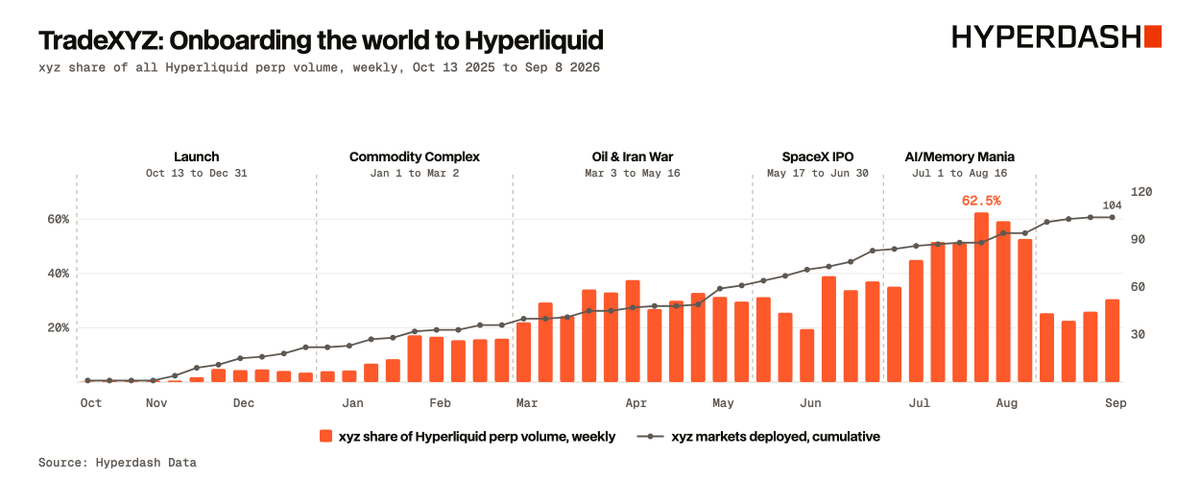
very under-appreciated, but @tradexyz is responsible for almost all of the growth on Hyperliquid this year. of course, this was enabled by the brilliant design of Hyperliquid by the core team, but executed on flawlessly by [XYZ]
mod retweeted
Events by trade[XYZ]
Introducing Events by trade[XYZ].
With Events, we’re advancing our vision of Hyperliquid as the universal exchange—a single, composable system for trading financial assets and real-world outcomes.
A user can deposit spot BTC, borrow USDC through portfolio margin, open a pre-ipo SpaceX perp position, hedge an upcoming SK Hynix earnings event with an events market, and pick the US Open winner—all from a single unified account on trade[XYZ].
Events will span sports, politics, economics, and financial markets, with an expanding range of categories and contract formats.
Our initial Up/Down markets cover equities, commodities, and pre-IPOs, powered by the depth and liquidity of trade[XYZ] perpetuals on HIP-3. These perpetuals provide continuous price discovery and serve as the resolution source, so each contract is grounded in XYZ's liquid market prices rather than an external oracle.
mod retweeted
Introducing Events by trade[XYZ].
With Events, we’re advancing our vision of Hyperliquid as the universal exchange—a single, composable system for trading financial assets and real-world outcomes.
A user can deposit spot BTC, borrow USDC through portfolio margin, open a pre-ipo SpaceX perp position, hedge an upcoming SK Hynix earnings event with an events market, and pick the US Open winner—all from a single unified account on trade[XYZ].
Events will span sports, politics, economics, and financial markets, with an expanding range of categories and contract formats.
Our initial Up/Down markets cover equities, commodities, and pre-IPOs, powered by the depth and liquidity of trade[XYZ] perpetuals on HIP-3. These perpetuals provide continuous price discovery and serve as the resolution source, so each contract is grounded in XYZ's liquid market prices rather than an external oracle.

mod retweeted
Someone recently shared this paper with me, which rigorously studies the execution improvement of visible TWAPs on Hyperliquid: "Trading in the Sunshine or in the Shade: Market Impact and Adverse Selection on Hyperliquid," by Davide Barone and Fabrizio Lillo.
In physics, theorists can say all they want, but the case isn't closed until an experimentalist comes with the cold hard data. So thank you to the authors of this paper for their hard work! The paper demonstrates that liquidity net tightens as onchain TWAPs surface, improving the average execution of the TWAP order.
This has been a deeply personal question for me. Even before building Hyperliquid, I've defended from first principles that transparent trading ought to improve execution for non-toxic flow. This is a corrollary of the efficient market hypothesis, but the amount of pushback always surprised me. I've quote tweeted a previous post where I make the argument in detail.
Transparency and equal access bring improved execution over traditional private venues. It's an honor to build with everyone to upgrade the financial system with onchain technology.
Thank you to everyone who took the time to thoughtfully respond to my post on transparent markets. I understand that the thesis is controversial and that Hyperliquid is at a new frontier as the first fully transparent order book venue of its scale.
I could well be mistaken, and welcome the continuous dialogue on market structure innovation. However, many criticisms I saw stemmed from misunderstandings, with some points actually supporting transparent systems like Hyperliquid. Market structure is notoriously counterintuitive, and novel approaches often challenge established paradigms, leading to understandable skepticism.
For example, Hyperliquid pioneered protocol-level cancel prioritization, which has since been implemented by new DEXs and even inspired novel transaction ordering ideas on other blockchains. But at the time, it was considered controversial because it went against traditional market design. I hope that transparent trading will follow a similar path to adoption.
I may have been too ambitious trying to cover a complex argument in a single post. Given the specific patterns in criticisms, I'd like to take this opportunity to zoom in on nuances that were missed in the high level summary. What follows is an argument for the final state of efficient markets, with the understanding that Hyperliquid is far from fully efficient today. However, inefficiency is opportunity for those hungry to act. Hopefully this post can also be a call to action for traders, market makers, and builders to translate transparent markets into the highest quality execution venue for all.
--
Before delving into specific concerns, let’s crystallize some counterintuitive principles that can form a helpful mental model for market structure:
1. Counterparty principle: Benefits of counterparty curation are misattributed to privacy.
Users ultimately care about execution. As studies have shown though, privacy sells. Alternative trading venues often market privacy as the causal feature for improving execution. In reality, the primary source of benefit for users is the screening of counterparties allowed to participate on the venue. Hyperliquid’s market design provides these same benefits more directly and effectively than patchwork solutions. Hyperliquid’s solution also democratizes access, improving execution for all traders large and small.
Note that transparency does not mean doxxing. Of course, the exact identity of some traders will fundamentally change the value of the asset. But those traders need not dox themselves, e.g. Warren Buffet can buy BTC and benefit from transparent markets, without tying his identity to his address.
2. Competition principle: Maximizing competition is key to improving execution.
Many traders who want to execute in size have some form of alpha. However, the group of informed medium/long term traders in aggregate is difficult to distinguish even over yearly timeframes, as their realized sharpe is too low for statistical significance. It is challenging to distinguish between a trader with solid medium term alpha and a degenerate gambler who got lucky. Therefore, while the desire to minimize market impact and alpha leakage is natural, it’s usually outweighed by the improved liquidity from transparent markets.
Traders therefore see improved execution despite revealing their strategy, as market makers are bound to provide liquidity to the entire range of flows in the market. Competition is the bedrock of capital markets and economics. As an example, the Hyperliquid order books support an onchain TWAP. Such a broadcasted intent to trade is in fact a reasonable proxy for optimal execution. Market makers will immediately fill some size so that the earlier TWAP orders receive worse execution, but will also compete to fill the remaining flow. The competition between market makers ensures near optimal overall execution over the course of the TWAP. Any inefficiency in execution is an opportunity for another market maker to undercut the others.
3. Repeated games principle: Execution improves when one-time games become repeated games.
Market makers evaluate each decision from a game-theoretical framework, as they are in the business of making positive expectancy bets. On Hyperliquid, every account placing more than one order is playing a repeated game. Repeated games have dramatically different optimal strategies from the one-time games of private venues, and the resulting equilibrium is better execution for everyone other than toxic extractors. Competition is essential for the optimal market marker strategy to benefit the end user, which is amplified by the next principle.
4. Full transparency principle: Benefits from transparency are non-linear and only manifest when transparency is at the system level.
When optimizing for execution, “the system knows” > “no one knows” > “some people know.” The worst of the three states is where some insiders have privileged information. Those insiders can act exploitatively to extract profit from end users. Because L3 books are not transparent in tradfi, the “darker” venues often implement systems to unilaterally apply counterparty-specific filtering to trades. Hyperliquid achieves the same effect on a lit venue and therefore maintains the benefits of efficient order book execution.
--
Common criticisms to the initial post, and my responses [I’ve bracketed references to the different principles]:
1. Many large desks in tradfi trade OTC, which is evidence that public venues cannot support large size.
Response: This point actually supports Hyperliquid. In tradfi's L3 books, there is no reliable way to broadcast your identity trustlessly to all counterparties. Using an OTC desk is a compromise, telling a small set of professional counterparties that you are non-toxic. Like trading on an L4 order book, trading OTC is a repeated game where the OTC desk is quick to ban any counterparties that adversely select a small fraction of quotes, or engage in otherwise toxic behavior [repeated games principle]. The OTC desks offer quotes where their own algorithmic execution/hedging costs are below the markup, which is only possible when their fills’ immediate markouts are positive.
A Hyperliquid whale who places an onchain TWAP order is effectively routing their flow to every "OTC desk" plugged into Hyperliquid. When OTC counterparties expand from a select few to all market makers, the competition improves execution for the user compared to the bespoke OTC quote [competition principle]. In summary, execution on Hyperliquid incorporates the efficiency of lit venues with the counterparty signaling of OTC. This high quality execution is available to all users equally.
2. A large percentage of tradfi volume happens on dark pools, retail internalizer systems, etc.
Response: This argument also supports Hyperliquid. The basic idea behind dark pools is that two large whales with a "coincidence of wants" can match immediately and bypass the spread that lit markets charge. Until such a match exists, orders are attempted to be kept private to reduce market impact. While a neat idea at first glance, the privacy of dark pools is unlikely to meaningfully protect intentions or improve execution. For example, sophisticated actors participate in dark pools themselves. At a minimum, their fills are a strong signal on the supposedly private flow. This shares many parallels with the insider information discussed in the following section. Information that will be deduced anyway is better made public [full transparency principle].
As another argument against the effectiveness of privacy properties, dark pools rely heavily on participants having identities known to the pool operator [repeated games principle]. This is necessary because the private information is easily leaked. There are strict requirements for participation, e.g. high fill rate, minimum order size, and negative short term markouts. Offenders with toxic behavior are banned or deprioritized [counterparty principle]. Like OTC desks discussed above, transparent L4 books on Hyperliquid incorporate and improve upon many of these positive properties of dark pools within an open, systematic framework.
3. Public data allows hunting of liquidations/stops.
Response: Most would agree that unlike size information, preserving margin privacy is beneficial for the end user. Perhaps a ZK privacy implementation can accomplish this in the future. However, until then, users are less likely to be successfully hunted if everyone knows liquidation and stop prices than when only the exchange operator knows [full transparency principle]. Two reasons:
a. On CEXs, your position information is far from private. Based on empirical data of insider trading leading up to listings, one should assume that liquidations and stops are also vulnerable to misuse. This can be despite best efforts from management: it is extremely difficult to completely control large organizations from leaking information. When insiders hunt stops and liquidations, there is no public data for other market makers to understand the source of the temporary dislocation. This decreases the required capital to successfully push the price.
b. In the game theoretical equilibrium of transparent data, stop and liquidation hunting are likely unprofitable endeavors on average. Whales are protected by the entire system of market participants acting rationally. People trying to hunt liquidations and stops will be counteracted by people trying to trick them into the hunting. For example, someone who wants to open a large long position can execute half of their position on high leverage, bait the hunters to short, then increase collateral and enter the remaining desired position at a more favorable price. As long as some profit seeking “anti-hunters” exist, all whales benefit from the cover.
While point (b) will take time to play out, markets are ultimately efficient. Even before this equilibrium is reached, the full transparency principle in point (a) suggests Hyperliquid's model offers more robust protection for whales. Liquidity is generally deeper when lit venues are more transparent [competition principle], which further increases the cost of liquidation and stop hunting.
4. Some users have alpha and will not benefit from transparency.
Response: The users that are disadvantaged by Hyperliquid’s system are a very small set of “toxic” participants. These are the same adversarial traders that dark pools, OTC desks, and other solutions try to avoid. A small number of professional HFT firms have alpha on this timescale, and it’s a failing of traditional market structure that these toxic takers have the ability to tax all other users of the system.
As an aside, short term alpha and toxicity is a continuous spectrum, so I’m oversimplifying for sake of argument. For example, there are intraday quantitative strategies that can realize significant sharpe ratios, whose flow could be a reliable momentum signal for market makers. The technical reason this is not a problem is that cost to rotate accounts is proportional to fee sensitivity of the strategy, which is inversely proportional to the time it takes for others to detect the strategy with statistical significance. In other words, the more execution matters to a quant strategy, the less the burden of obfuscation.
Regardless, the vast majority of users on Hyperliquid do not fall remotely close to this category of quantitative, toxic alpha. Note that “toxic” does not mean “informed,” but rather traders who profit non-constructively from slight infrastructural or other structural advantages such as latency. Hyperliquid's cancel prioritization and L4 order book essentially boost the short term liquidity available to non-toxic small and large orders, respectively. As a conservative lower bound, as long as market maker counterparties on Hyperliquid can hedge in time on other venues, the trader benefits from Hyperliquid’s system.
--
I know I’ve missed other points, but will stop here to keep this post digestible. Thanks again to everyone for their thoughtful feedback, especially those who took time to review an earlier version of this post. I look forward to continuing this discussion!
