
work for protein design at https://nitter.cf/t.co/ODnlN6OGef, a previous postdoc with @sokrypton at Harvard
Joined November 2015
- Tweets111
- Following134
- Followers146
- Likes239




haobo wang retweeted

1/4 Lévin™ Harness brings models, tools, data, compute & workflows into one Agent-centered workspace. Let the Agent handle execution — your attention goes back to the science. 🚀
levinthal.design/ github.com/levinthal/levin-h…
#ProteinDesign #AIAgents

haobo wang retweeted

P(all-atom) Is Unlocking New Path For Protein Design
1. Protein design traditionally models sequences and structures separately, limiting accuracy. This study introduces Pallatom, an all-atom generative model that directly learns the joint distribution of protein sequence and structure.
2. Unlike existing methods that use separate backbone and sequence prediction steps, Pallatom employs a dual-track framework integrating residue-level and atomic-level tokenization. This enables end-to-end co-generation of sequences and structures.
3. A key innovation is the atom14 representation, which unifies the description of unknown amino acid side-chain coordinates. This ensures high fidelity between the generated all-atom structure and its physical constraints.
4. Pallatom uses a multi-layer decoding process with a "traversing" representation and a differentiable recycling mechanism, allowing continuous refinement of atomic coordinates and sequence predictions.
5. Experimental results show Pallatom significantly outperforms previous models like Protpardelle and Multiflow in protein designability, structural diversity, and novelty, achieving state-of-the-art performance across multiple benchmarks.
6. The model generates highly ordered proteins with hydrophobic cores and hydrophilic surfaces, closely matching experimentally validated structures. This suggests its potential for designing functional proteins with real-world applications.
7. Pallatom maintains high generalization ability, achieving strong performance even on out-of-distribution protein lengths (150-400 residues), demonstrating scalability beyond training data.
8. Benchmarking against RFdiffusion and ProteinGenerator, Pallatom achieves the highest sequence and structure diversity while preserving protein stability, making it a promising tool for de novo protein design.
9. The study highlights the importance of learning all-atom coordinates directly rather than approximating them through marginal distributions. This approach improves both structure prediction accuracy and sequence coherence.
10. Pallatom opens new directions for computational protein engineering, with potential applications in enzyme design, therapeutic protein development, and synthetic biology.
💻Code: github.com/levinthal/Pallato…
📜Paper: biorxiv.org/content/10.1101/…
#ProteinDesign #GenerativeAI #Bioinformatics #MachineLearning #SyntheticBiology

haobo wang retweeted

Check out Artem's precomputed interactive AF2BIND (small molecule binding site) predictions for the human proteome. 🤩

We’re thrilled to announce the release of one of the most comprehensive databases of small molecule binding sites! 🧬 By using AF2BIND, we have identified over 20,000 unique binding pockets in the human proteome. Explore your favorite protein here: gpubio.xyz/humanproteome
@sokrypton @CasperGoverde @nickpolizzi_ @Jody_Mou

haobo wang retweeted
🤯 Congratulations David Baker @UWproteindesign , @demishassabis and John Jumper!!

BREAKING NEWS
The Royal Swedish Academy of Sciences has decided to award the 2024 #NobelPrize in Chemistry with one half to David Baker “for computational protein design” and the other half jointly to Demis Hassabis and John M. Jumper “for protein structure prediction.”

haobo wang retweeted
1/X Pallatom is an end-to-end all-atom protein generation model that directly learns the distribution of atomic coordinates. We believe optimizing the P(all-atom) may open a new way for de novo protein design.
code(ing):github.com/levinthal/Pallato…
bioxiv:biorxiv.org/content/10.1101/…

haobo wang retweeted
OMG 😱 finally a protein language model that captures coevolution at protein-protein interface(s)!

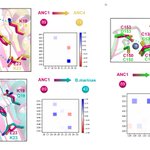
7/ In particular, we showcase gLM2's ability to directly learn coevolutionary signal in protein-protein interfaces with no supervision! The learned contact maps can be extracted using @ZhidianZ et al's categorial Jacobian method.

haobo wang retweeted
Excited to share the work with
@ZhidianZ @HWaymentSteele @garykbrixi @wwwhbpt @matteodp @DorotheeKern
biorxiv.org/content/10.1101/…
(1/7)

"🚀 The Tech Odyssey: With AI and other tech advancements on overdrive, are traditional IP systems (patents & copyrights) sprinting alongside? 💡 Let's navigate the evolving landscape where innovation meets legal frameworks. 🌐⚖️ Are we ready for the next chapter? #TechEvolution
1
150
haobo wang retweeted
I'm excited to share that I'll be joining @MITBiology as an Asst Prof. in Jan 2024! Come join us! 🤓🧪🖥️🧬

haobo wang retweeted
Now everyone can be a protein designer! 😂

The code is available both to download from GitHub, and also, thanks to the wonderful @sokrypton, as a Colab Notebook.
github.com/RosettaCommons/RF…
colab.research.google.com/gi…
haobo wang retweeted

Today we're making RF Diffusion, our guided diffusion model for protein design with potential applications in medicine, vaccines & advanced materials, free to use. The software has proven much faster and more capable than prior protein design tools.
bakerlab.org/2023/03/30/rf-d…
haobo wang retweeted

A single neural network that predicts for protein-DNA complex structures, protein-RNA complex structures, and RNA tertiary structures.
@minkbaek Ryan McHugh, Ivan Anishchenko, David Baker, Frank DiMaio @UWproteindesign
biorxiv.org/content/10.1101/…


haobo wang retweeted

Using AF2 to predict minibinder-target complexes increases experimental success rate 10x over filtering by non-DL in silico metrics. This + ProteinMPNN has totally changed binder design in Baker lab.

1/7 Improving de novo Protein Binder Design with Deep Learning (biorxiv.org/content/10.1101/…) We show that AF2 is an effective predictor of whether a de novo designed miniprotein will bind to the intended target or not.

haobo wang retweeted

ProteinMPNN designed binders work experimentally! Using ProteinMPNN to design miniprotein binders is 6-fold more computationally efficient. Also, the probability that a miniprotein binds the target as designed increases 10-fold when using AlphaFold (or RoseTTAFold) as filters!
1/7 Improving de novo Protein Binder Design with Deep Learning (biorxiv.org/content/10.1101/…) We show that AF2 is an effective predictor of whether a de novo designed miniprotein will bind to the intended target or not.
haobo wang retweeted
Code should be publicly available now! Thanks @sokrypton for making a quick demo on google colab: github.com/dauparas/ProteinM…
haobo wang retweeted
1/5 Robust deep learning based protein sequence design using ProteinMPNN biorxiv.org/content/10.1101/… The high rate of experimental success and applicability to almost any protein sequence design problem has made it the standard approach at the @UWproteindesign github.com/dauparas/ProteinM…

haobo wang retweeted
Excited to see colabfold published!
nature.com/articles/s41592-0…
Special thanks to @thesteinegger and @milot_mirdita (for MMseqs2) without whom I would have never considered to preprint let alone attempt to publish our notebook! (1/3)

haobo wang retweeted

Here’s what we learned from inverse folding on millions of #AlphaFold structures. Exciting time to bring a 800x new scale to #proteindesign. ESM-IF1 more accurately designs sequences to fold into desired structure, also unlocking new design capabilities.
biorxiv.org/content/10.1101/…