
Built and sold 2 VC backed ventures. Now bootstrapping and building in public. Sharing on Starting up, GTM, AI. https://nitter.cf/t.co/9LPjzaBGJx https://nitter.cf/t.co/JgzKqVmWG4 https://nitter.cf/t.co/W3OHlyxFm9
India
Joined November 2025
- Tweets160
- Following46
- Followers10
- Likes8






How to get an SEO audit out of Claude that lists only the fixes that matter. Prompt included.
Harpreet Singh, an SEO, gave ChatGPT, Claude and Gemini the same Nike category page and the same prompt: SEO and AI search recommendations, ranked by impact.
Gemini ranked "remove meta keywords" as its third most important fix. ChatGPT put FAQs above the title tag. Claude did best: it saw that the page listed 45 products, but only 24 were in the HTML. The rest loaded through JavaScript.
All three still handed back an old SEO checklist, with low-value fixes marked urgent. Part of the problem is the input. One page tells it nothing about the rest of your site, so give it a crawl instead.
1. Crawl your site with Screaming Frog SEO Spider. The free version crawls up to 500 URLs, which is probably enough for a small business.
2. Open the Issues tab and export the issues list.
3. Upload the export to Claude with this prompt:
"Give me SEO recommendations based on the issues in this crawl. Don't give me a lot of advice. Only the 20% of fixes that will get 80% of the results, in no more than five brief points. Leave out the other 80%."
4. Check what comes back. The title tag, H1 and H2s go first: they are the first things a searcher sees, and the easiest to fix.
5. If you sell in more than one country, check the language. Nike's Canadian page had "trainers" in its title and was set to en-GB.
6. Push FAQ schema and meta tag tweaks to the bottom. Google deprecated FAQ rich results, and there is no proof that FAQ markup gets you quoted by AI, only correlations.
7. Track one number: your rankings for the keywords you are actively targeting.

14
Rachel Woods, an AI operations strategist who runs her 8-person company on AI playbooks, has one rule for them: "Own the playbook, rent the tech."
Her team keeps every playbook in GitHub, not inside Claude or ChatGPT, so the work is never limited to what one tool allows. Their project planning playbook tripled her team's velocity.
How she builds one:
1. Define four things: the trigger, the inputs, the steps and the output.
2. Write the steps for a dream employee with unlimited time. Hers asks clarifying questions, then runs "1-3-1": the one problem, three ways to approach it, one recommendation.
3. At the end, have the AI flag the work it can start itself. It already has the context.
4. Tell it what to do when it doesn't know. Her sales questions playbook escalates with a proposed answer, and a second playbook updates the guide once they agree.
5. Start your team small: meeting recaps, the Friday manager update, the weekly report.
All 11 points are in the images.


7
Every sport has had a day when one player made everyone else look like amateurs.
@grok what's the single most dominant performance in sports history? One pick, then the stat that proves it. No hedging.
1
2
You keep your phone, but 3 apps have to go for good. The goal: 2 more free hours a day.
@grok which 3 do you delete, and what's your exact plan for the 2 hours? Be specific.
1
6
Actorle, a daily actor guessing game, went from 163k to 201k monthly visitors in two months, after a year of flat traffic.
218 short videos: 25 visitors in the last 30 days.
Custom puzzle pages for creators: 0 applications.
One link in the site menu: "my best growth move in four years," says the developer who built it.
What he did with the menu link:
1. He built a second game for the players he already had. Cinections, a Connections style game with movie posters, built in September.
2. He didn't launch it anywhere. It got a link in the menu.
3. He sent one email to registered players. About 4,000 emails, one spam complaint.
4. He put it behind a sign-in wall. The first day brought 150 new accounts, five times a normal day.
5. He let the players find the bugs. Three people wrote in on the same day about a board with five Denzel Washington films, when a group needs four. Three others asked to solve the last group themselves. Both were fixed within two days.
By October about 1,640 people were finishing Cinections every day. It is now the second most visited page on the site.
The reason it worked, I think: 63% of Actorle's visits are direct, people typing the address or tapping a bookmark. A link in the menu is in front of every one of them the next time they come back, with no algorithm in between.
His own lesson: look at your referrers before you pick a channel. His said bookmarks and directories. He went to TikTok anyway.

19
If you're building something right now, you're already ahead of everyone who only scrolls. Drop your link.
1
1
115
Alex Hormozi on how to run a sales call:
He has closed over 4,000 deals himself and built several sales teams doing $100M a year. His new training runs over three hours. The call itself comes down to this:
1. Write the script before you hire anyone. "Every closed sale is the same. Every botched sale is different."
2. Then cut it. About 90% of the time, his team cuts 50 to 75% of a script and sales go up.
3. Spend the call on discovery. If the prospect has no urgency, you didn't dig deep enough into the pain. Keep asking "Tell me more about that" and "Can you give me an example?"
4. Keep the pitch under two minutes. Name the price, then stop talking. Reps who wait at least 8 seconds close 30% more.
5. Expect the no. The reps who ask for the sale the most times close the most deals, so script what you say between the asks.
All 12 points are in the image.

11
One to one and a half new clients, on average, from every dinner.
That is what Matt Green gets from the dinners Sales Assembly runs for revenue leaders, about 15 or 16 events a year in cities across the US. Here is exactly how they run them:
1. Keep the room to 20 to 30 people, VP and C-level only. No fractionals and no consultants: full-time operators.
2. In most cities, mix about 30% clients with 70% prospects. Up to half of those prospects are people he has never spoken to. He invites them cold on LinkedIn.
3. Start about two months out. In New York, roughly 150 invites get about 45 RSVPs, and attrition on the night brings that to the 30 he wants. San Francisco takes several hundred.
4. Send the guest list with the invite: name, job title and company of everyone coming so far. His message is always the same: no content, no agenda, just 30 people exactly like you. Do you want to come hang out for an hour?
5. Set five or six tables for 30, never one long table. Sponsors get 30 seconds each, with no screen and no demo.
6. Give people 45 minutes standing first, then sit them down about an hour in, with no assigned seats and no set topics. His welcome says the night is not about the company and ends with "talk about what you want."
7. Host on a Thursday, never near the end of a month or quarter.
8. Email on Monday or Tuesday. Thank them, ask what they thought of the night, mention one thing you read about their company, and offer a call to carry on the conversation.
The audience is your credibility. If you can only get eight of the right people, have dinner with eight.
It is slow. Some prospects from May 2025 signed in June 2026.
17
Still the best answer I've read on how a technical founder learns to sell.
Nine lessons from a founder who did enterprise and government sales. The fourth is the one to keep. If sales would not run on autopilot while you took a month off, you don't have product-market fit yet.

7
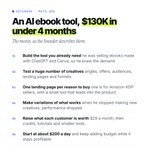
$130,000 in revenue in under 4 months.
1,700 paid customers.
$20,000 to $30,000 a month on Meta ads, at a 40 to 50% profit margin.
That is GetEbook, an AI tool that writes a whole ebook, built by a 28-year-old who runs a small marketing agency with his wife. The numbers are his, with the Stripe dashboard shown.
How he says it grew:
1. He built the tool he needed. He was already selling ebooks he made with ChatGPT and Canva, so he knew people buy the end product. The real proof came when the ads went live and strangers paid.
2. He tested a huge number of creatives. Not one homepage for everybody: angles, offers, audiences, landing pages and funnels, because people want it for different reasons. One wants an ebook to sell, another wants a lead magnet.
3. He built a landing page per reason. One is for people selling ebooks on Amazon KDP, with a small tool for them that leads into the product.
4. When an ad works, he makes variations of it. He learned this the hard way: he stopped making new creatives for a while, the campaigns kept running, and performance dropped.
5. He raised what each customer is worth. The subscription starts at $29 a month, then customers can buy credits, tutorials and smaller tools. That is what lets him spend more to win a customer up front.
6. He started at about $200 a day and kept adding budget while it stayed profitable.
The reason it worked, I think: he ran it as an ad business, not a SaaS with a homepage. The upsells after the sale are what let the ad budget grow from $200 a day.

1
2
45
Some movies you can watch 100 times and never get tired of. Most great movies aren't one of them.
@grok what makes a movie rewatchable, and which 5 do it best? Explain it first, then the picks. Be specific.
1
2
Grok Bot: 5 setups that turn it into your content scout, designer and advisor 👇
Ras Mic calls himself a Grok Bot maxi. He uses it as a personal agent, and as the orchestrator that hands engineering work to Claude Code. These are the setups from his walkthrough worth copying.
1/ Set up a content scout that runs twice a day.
At 9am and 5pm, his YouTube bot goes through X. It sends three topics he would find interesting, based on the content he makes, with the tweets he could make videos from, a title idea and resources to add. It runs on Grok Bot's access to the X API, which he says feels close to unlimited. He doesn't use every idea, but he keeps up and always has a list.
2/ Build a design system before any code.
Find a site you like (he finds them on X and on Mobbin). Tell the agent to "create a design system using this site as reference" in Paper, which it works in through Paper's MCP. Tweak it, then reuse it across projects. To change something, leave comments on the design in Paper and tell the agent to address the comments. Code comes after the design is locked.
3/ Give each serious project its own bot.
A general engineering bot takes the small ideas. Anything you plan to launch or keep working on gets its own bot, with its own context. When a bot stops being useful, delete it. He calls the alternative bot fatigue: 15 bots for 15 different things.
4/ Give an advisor bot access to your money.
A finance plugin connects your accounts through Plaid, and the bots read your transactions. It tells you when you can't afford something, or when it goes against a goal you gave it. He uses it against his shiny object syndrome: a trucking company one day, a storage unit company the next. Sometimes it just tells him to relax and focus on the main thing.
5/ Run a security pass before real users arrive.
For any app that handles payments or sensitive user data, take the best model you have, run /goal and say "do security checks." If it refuses because it thinks you're trying to trick it, start a new thread and reword the prompt.

2
54
Every midlife crisis comes with a hobby, and the hobby comes with a bill.
@grok which hobby screams "midlife crisis" the loudest, and what does it really cost in the first year? Pick one, then one number.
1
4
What Nick Cegelski, Sara Uy and Dana Hensler say about shortening a sales cycle, in 15 points.
Sara is a Forbes 30 Under 30 honoree and the founder and CEO of Selling Sarah. Dana has been a sales leader for 15 years and is now at Apollo. They gave 18 tactics by deal stage. I cut the three you already know. The full list is in the image. The four I'd start with:
1. The champion sandwich. Book 15 minutes with your champion before the big team meeting to hear the objections coming and run your call plan past them. Pre-schedule a debrief right after to learn what people liked and what they were Slacking each other.
2. The redline deadline. When you send the contract, agree dates on the call: when it goes to legal, when their first redlines come back, when you return yours. Nick types them into an email while sharing his screen.
3. Offer a same-day next step. Most prospects can't take a 3:30 slot today, but they counter with Thursday instead of next week.
4. Pre-schedule the kickoff call before the contract is signed. Nick had a customer sign on the kickoff call because they didn't want to reschedule it.
And when you ask what needs to happen to close, add Nick's line: "I would rather be accurate than optimistic."

42
Many companies hiring salespeople save the mock pitch for the end, after four or five rounds of conversation.
The trouble is that a good seller and a weak one can both interview well over coffee. You find out on the mock call, after everyone's time is spent.
One sales leader calls the pitch game tape, and he'd like it to be the first step. He'd also rather hear candidates pitch the product they sell today than yours. If what they sell every day doesn't sound interesting coming from them, yours probably won't either.
I think that's the cheapest filter in sales hiring. For your next sales hire, put a pitch of their current product before any other round.
8
ChatGPT now has business profiles, much like Google Business Profiles. Nathan Gotch has already verified his company's. The setup:
Open ChatGPT. Click the three dots. Open Business Hub. Pin it there, because it is hard to find.
Click Add.
Prove you own the domain: a text file and DNS settings.
Scan your ID. Then do the face scan, turning left and right. It is strict, which tells you they want to stop people gaming it from day one.
Open Edit business info. Fill in every field: contact details, location, hours. Make sure each one is accurate.
Add at least three photos. Three is the minimum.
Open Products and upload a product feed. He had Claude build his, with three products.
Turn on a browser agent (he used Claude's browser extension). Have it audit the profile, list the weaknesses, then fix them. His profile had been audited before, and the second audit still found gaps.
Then check Overview. It gives you three numbers: mentions (how often you appear in ChatGPT answers, citations included), profile views (the side panel that opens when your name is underlined in a chat) and website clicks. Plus a list of discovery topics, which are vague.
That is all it shows. It will not tell you which prompts you lose or which pages ChatGPT cites. Keep your own prompt tracking for that, because the URLs cited again and again are your outreach list.
Nobody knows yet how much a verified profile moves your visibility in ChatGPT.
1
40