

Building @grailcomputer. Writing about AI agents, software factories and how they work in the real world.
Dubai
Joined May 2024
- Tweets219
- Following276
- Followers79
- Likes39
AI companies need to be the horse or the harness.
The LLM supplies horsepower. The harness does the work—and becomes the system of record.
At Grail, we’re building this to manage software for tech-enabled companies, recording the work as we go.

27
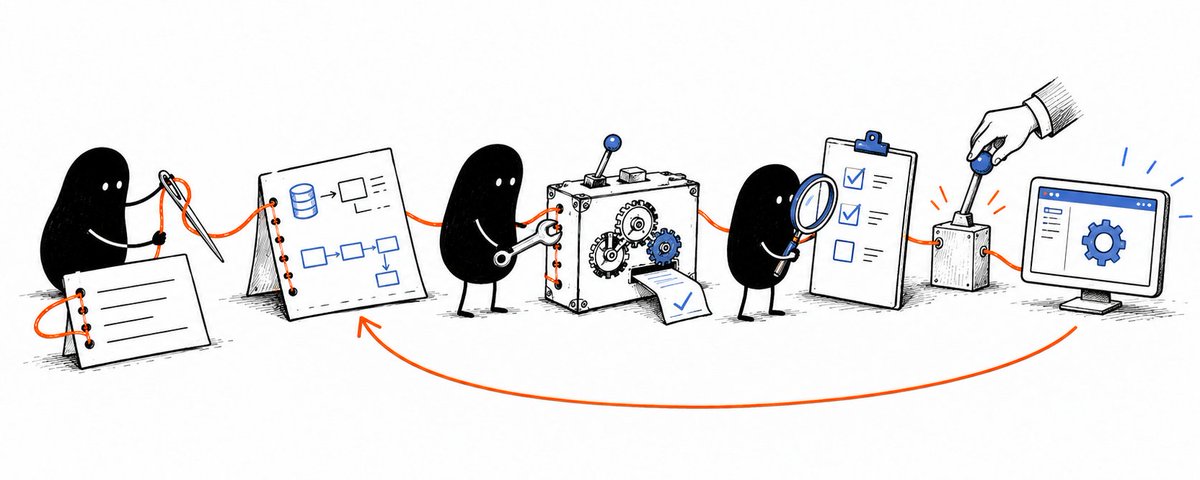
An agent writing code is not an agentic SDLC. The real test is whether a request stays connected to decisions, tests, approvals, and production feedback. Here's how we approach that at Grail.

Yash Agarwal retweeted

Running a company is just context engineering internally.
Now that skill has even more value in the agentic world. Us tech founders have been doing reps to prepare for this.
I’ve been experimenting with a simple question:
What if browsers for AI agents were built differently from browsers for humans?
Most agent-browser workflows today still depend on Chrome and CDP. That works, but it also means agents inherit the weight and assumptions of a browser stack designed primarily for human browsing.
So I built an early experiment: Nickelium.
Nickelium is an open-source, Rust-native, agent-first browser runtime built on top of Servo. The goal is not to replace Chrome for everyday browsing. The goal is narrower and, I think, more interesting:
Build a browser runtime specifically for agents doing real web work.
Right now, Nickelium is most useful for:
authenticated SaaS and admin workflows
DOM-first automation
dashboard audits and extraction
form-driven back-office tasks
proof screenshots
Why this matters:
agents don’t always need the full weight of a consumer browser
browser features should be modular and task-specific
a browser designed for agents can be more controllable, more hackable, and eventually more resource-efficient
if agents are going to operate on the web at scale, the browser itself becomes part of the product surface
This is still early. It is not polished. It is not a universal Chrome replacement. But I think it points toward a real category: browsers built for agents, not just automation layered on top of human browsers.
If this direction interests you, I’d love contributions, criticism, and ideas.
repo in the comment👇

2
2
195

> So this the brev platform which they acquired some time back
> they are giving $6 as free credits ~ 2 days of runtime (with no AI usage)
> Probably half a day with the AI usage, go enough to try out Openclaw if you haven't already
> The model used is nvidia/nemotron-3-super-120b-a12b (NVIDIA Cloud API)
there is NO Nvidia GPU in the mix -- its based a GCP VM
basically a 10-15 click way to deploy an OpenClaw instance with decent one time free usage


Ready to deploy AI agents? NVIDIA NemoClaw simplifies running @openclaw always-on assistants with a single command.
🦞 Deploy claws more safely
✨ Run any coding agent
🌍 Deploy anywhere
Try now with a free NVIDIA Brev Launchable 🔗 nvidia.com/nemoclaw

every time i need a brand logo i end up on some random site downloading a blurry PNG
so i made a skill for it — your AI agent searches for the official SVG, downloads it, done
works anywhere skills [dot] sh runs: Codex, Cursor, Claude Code, Amp
npx skills add Grail-Computer/Logo-Search-Skill

"Open weights" and "open source" are not the same thing.
For a model to be truly reproducible you need the full stack: weights, inference code, training code, training data, and the post-training/RL recipe.
We ranked the main open-model families by how much of that stack they actually expose 👇


Dario Amodei just dismantled the biggest myth in the AI industry.
Open source AI isn’t free. It never was.
Amodei: “It’s not free. You have to run it on inference and someone has to make it fast on inference.”
For decades, open source meant something real. It meant a teenager in a basement could download the same tools as a Fortune 500 company. Could read the code. Could modify it. Could build something that competed with the giants.
That was genuine democratization. That actually happened.
AI is different. Fundamentally. Physically. In ways the ideology hasn’t caught up to yet.
Downloading the weights is the easy part.
The part that actually costs something is turning the weights into a running system. Into responses. Into intelligence operating in real time at scale.
That requires compute. Power. Infrastructure. The kind measured in billions of dollars and years of construction.
Amodei: “These are big models. They’re hard to do inference on. Ultimately you have to host it on the cloud. The people who host it on the cloud do inference.”
The open source debate was never about who owns the model.
It was always about who owns the cloud.
And Amodei goes further. When a competitor drops a new open model, he doesn’t ask whether it’s open or closed. He doesn’t care about the licensing. He doesn’t engage the ideology.
Amodei: “I don’t think it mattered that DeepSeek is open source. I think I ask, is it a good model? Is it better than us at the things that matter? That’s the only thing that I care about.”
That’s the ruthless clarity of someone actually trying to win.
While the media debates licensing frameworks, Amodei is asking one question.
Is it better. Everything else is a distraction.
Amodei: “I don’t think open source works the same way in AI that it has worked in other areas. Here we can’t see inside the model.”
This isn’t Linux. You can’t read it. You can’t fork it. You can’t understand it the way generations of developers understood the tools they inherited.
You can download it. And then you need a data center to run it.
The teenager in the basement who was supposed to be empowered by this revolution needs a billion dollars of infrastructure before the empowerment starts.
The era of the basement coder rewriting civilization on a laptop is over.
The future belongs to whoever commands the compute, owns the power grid, and can actually turn the intelligence on.
Open weights without infrastructure isn’t democratization.
It’s a promise the physics of the universe won’t let us keep.
apps/github repo ~ social media post

Software will proliferate just as videos, music, writing did.
The market structure will shift from a “fat middle” to mega-aggregators and a long tail.
It’ll be a slower process due to network effects, but many traditional vendor lock-ins will get eaten by AI.
1
21
Stateful runtime environments
-- ie. What's required to run Openclaw like agents.

We are excited to partner with Amazon to bring a new generation of products to market, especially around new enterprise products like the stateful runtime environment. We are also very excited to make great use of Tranium.
1
66
My first encounter of a "github repo" as a meme

Deepseek got called out for scraping 150k Claude messages. So I'm releasing 155k of my personal Claude Code messages with Opus 4.5.
I'm also open sourcing tooling to help you fetch your data, redact sensitive info & make it discoverable on HF - link below to liberate your data!

59
Check out @grailcomputer: Your AI workforce
Found Grok 4.20 to be pretty good at funny/witty stuff


You're not hiring a person anymore.
You're hiring their workflow, their agents, and the personal tooling they've built over years.
The individual is now inseparable from their operational setup.
nitter.cf/businessbarista/status…

This guy made 40 Facebook ads, 100 landing pages, booked himself on 4 podcasts, and wrote 3 guest blog posts. In a single day.
People called him a fraud. There was literally a Polymarket bet on whether he's a con artist.
So i asked him to prove it live. And he did.
Here's @codyschneider's actual system for AI-enabled paid marketing:
1) He uses Perplexity to search Reddit for his ICP's actual pain points in their own words. Not what he thinks they care about, what they've literally said online.
2) He feeds those pain points into Claude, which generates 40 ad variations, titles, supporting copy, and the actual creative using React components exported as PNGs via a library called HTML-to-canvas.
3) He tests all 40 variations in a CPC campaign on Meta. $100 over 3 days. Cheapest cost-per-click wins.
4) Winners get matched landing pages. He uses an open-source CMS called Strapi connected to Claude Code via API, so he bulk-generates a landing page for every winning ad angle. Same headline on the ad and the page = higher conversion.
5) Once he finds a winning concept, he scales it — AI avatar UGC via HeyGen, upgraded with V3, and only brings in a human creator if the AI version plateaus.
The whole thing runs on Claude Code + APIs + a .env file with all his keys.
No engineering team. Just him on multiple desktops with multiple Claude agents running simultaneously.
His best line: "you're not just hiring me anymore. you're hiring me and the 30 agents behind me and all the personal software i've built."
2
53
I made Microemployee: Single role employees you can add to your Slack/TG and have them do anything
Onboard them by telling them to read the last 1 months of messages in the Slack channel or give them some docs to read via Slack - Just like you would do with a regular employee
Use your ChatGPT Subscription
Built with Codex CLI App Server + SQLite + Rust
if you need something like this for your business DM for a free consult and if your use case is interesting enough will setup one for you for free.
2
1
35

🚨Turn your ChatGPT subscription into an employee.
Presenting "Grail - Your MicroEmployee"
It is an open-source Rust server that connects Codex CLI to Slack/Telegram and gives it the operational layer to actually work as a service — not just answer questions.
🔑 What makes it different:
Codex is the agent — we didn't build one. You get the best existing agent harness, running as a sandboxed subprocess.
Bring your own ChatGPT sub — log in via device code from the dashboard. No API key, no token bills.
Rust, ~10 MB idle — runs on the cheapest VPS you can find.
⚙️ Every message you send gets queued in SQLite and processed one-by-one in a persistent Codex session. As the agent works, it updates its own instructions and context files. Day one it's generic. Week two it knows your stack, your preferences, your workflows. It trains itself.
🛡️ Guardrails (allow/deny/require approval), cron jobs (agent proposes, you approve), full admin dashboard.
💡 What people can use it for:
Summarize 200-message threads → action items
Review PRs and flag risks
"Every morning at 9am, check our error logs and post a summary"
Run deploys — but ask me first
Triage support tickets
🔗 Fully open-source: ⬇️