

I help professional Web Devs to make tradeoffs and design robust architectures, so they can influence important decisions and lead their team to success.
Joined January 2009
- Tweets1.1K
- Following420
- Followers685
- Likes2K






Pinned Tweet
Want to start your software architecture journey?
It's a good idea to become familiar with some of the most popular architectural patterns and their trade-offs!
Get my Low Hanging Software Architecture e-book and many others for free here!
lowhangingbook.com
Yugo Sakamoto retweeted

@karpathy and I are back! At @sequoia AI Ascent 2026. And a lot has changed. Last year, he coined “vibe coding”. This year, he’s never felt more behind as a programmer.
The big shift: vibe coding raised the floor. Agentic engineering raises the ceiling.
We talk about what it means to build seriously in the agent era. Not just moving faster. Building new things, with new tools, while preserving the parts that still require human taste, judgment, and understanding.

Yugo Sakamoto retweeted

As amazing as LLMs are, improving their knowledge today involves a more piecemeal process than is widely appreciated. I’ve written before about how AI is amazing... but not that amazing. Well, it is also true that LLMs are general... but not that general. We shouldn’t buy into the inaccurate hype that LLMs are a path to AGI in just a few years, but we also shouldn’t buy into the opposite, also inaccurate hype that they are only demoware. Instead, I find it helpful to have a more precise understanding of the current path to building more intelligent models.
First, LLMs are indeed a more general form of intelligence than earlier generations of technology. This is why a single LLM can be applied to a wide range of tasks. The first wave of LLM technology accomplished this by training on the public web, which contains a lot of information about a wide range of topics. This made their knowledge far more general than earlier algorithms that were trained to carry out a single task such as predicting housing prices or playing a single game like chess or Go. However, they’re far less general than human abilities. For instance, after pretraining on the entire content of the public web, an LLM still struggles to adapt to write in certain styles that many editors would be able to, or use simple websites reliably.
After leveraging pretty much all the open information on the web, progress got harder. Today, if a frontier lab wants an LLM to do well on a specific task — such as code using a specific programming language, or say sensible things about a specific niche in, say, healthcare or finance — researchers might go through a laborious process of finding or generating lots of data for that domain and then preparing that data (cleaning low-quality text, deduplicating, paraphrasing, etc.) to create data to give an LLM that knowledge.
Or, to get a model to perform certain tasks, such as use a web browser, developers might go through an even more laborious process of creating many RL gyms (simulated environments) to let an algorithm repeatedly practice a narrow set of tasks.
A typical human, despite having seen vastly less text or practiced far less in computer-use training environments than today's frontier models, nonetheless can generalize to a far wider range of tasks than a frontier model. Humans might do this by taking advantage of continuous learning from feedback, or by having superior representations of non-text input (the way LLMs tokenize images still seems like a hack to me), and many other mechanisms that we do not yet understand.
Advancing frontier models today requires making a lot of manual decisions and taking a data-centric AI approach to engineering the data we use to train our models. Future breakthroughs might allow us to advance LLMs in a less piecemeal fashion than I describe here. But even if they don’t, the ongoing piecemeal improvements, coupled with the limited degree to which these models do generalize and exhibit “emergent behaviors,” will continue to drive rapid progress.
Either way, we should plan for many more years of hard work. A long, hard — and fun! — slog remains ahead to build more intelligent models.
[Original text: deeplearning.ai/the-batch/is… ]

Yugo Sakamoto retweeted

Afraid of taking your AI features to prod and going broke? Check out my post about instrumenting AI #elixir applications using @posthog before deploying to prod!
juanrivillas.com/blog/ai_pro…

Pessoal que estiver em BH e trabalha com #Elixir ou quiser conhecer essa linguagem criada pelo DevBR @josevalim e como implementar #GraphRAG, não deixe essa oportunidade passar!
Meu amigo @jprivillaso vai estrear o Meetup com um projeto sensacional!

Salve galera! Bora falar de Elixir e AI ?
meetup.com/elixir-bh/events/…

Yugo Sakamoto retweeted
Bom dia galera!!
Estou começando a planejar a primeira edição do meetup Elixir BH.
Se alguém tiver interesse em palestrar, por favor me avise.
Vamos divulgar o ecossistema de Elixir que é muito massa!
#elixir #myElixirStatus
meetup.com/elixir-bh/
Yugo Sakamoto retweeted
Salve galera! Bora falar de Elixir e AI ?
meetup.com/elixir-bh/events/…
The assumption that competitors won't also adopt AI technologies is dangerously misguided
Read more 👉 lttr.ai/AhiL5
#HumanPlusAi #LeadingWithAi #LeveragingAi


As AI Agents is gaining serious traction to make artificial intelligence not just responsive, but autonomous and proactive, this kind of questions became more frequent between developers and executives.
Read more 👉 lttr.ai/AgcVz
#AIAgents #LLM #Langchain

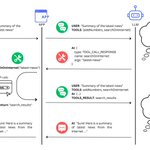
To help anyone diving into the world of AI Agents, here is a quick tutorial of the most important feature you must understand to connect Agents with external world: Tools, also known as Function Calls.
Read more 👉 lttr.ai/AgLSV
#AIAgents #LLM #Langchain

In the context of AI Agents, Tools are external functions or APIs that the agent can “call” to perform specific tasks.
Read more 👉 lttr.ai/AgDFp
#AIAgents #LLM #Langchain


Yugo Sakamoto retweeted

Congrats to Simon Willison (@simonw) on 23 years (!!) of blogging. Really excellent LLM blog, I sub & read everything:
simonwillison.net/
(e.g. I sub via RSS/Atom on NetNewsWire)
+If you consistently enjoy the content like I do, sponsor on GitHub: github.com/sponsors/simonw
Yugo Sakamoto retweeted

Knowledge graphs are infinitely better than vector search for building the memory of AI agents.
With five lines of code, you can build a knowledge graph with your data.
When you see the results, you'll never go back to vector-mediocrity-land.
Here is a quick video:
Yugo Sakamoto retweeted

Anthropic just dropped Free AI courses on:
- Prompt Engineering
- Building agents
- Best practices for Agentic Coding
- Collaborate with AI systems
.... and so much more!
9 best guides you don’t want to miss:

Maintaining a static mindset in a rapidly evolving technological landscape is a risky strategy
Read more 👉 lttr.ai/Aen91
#HumanPlusAi #LeadingWithAi #LeveragingAi

Yugo Sakamoto retweeted
Transformers have dominated LLM text generation, and generate tokens sequentially. This is a cool attempt to explore diffusion models as an alternative, by generating the entire text at the same time using a coarse-to-fine process. Congrats @StefanoErmon & team!

It's an opportunity to redefine productivity, explore new avenues for growth, and stay ahead in an increasingly dynamic and competitive market.
Read more 👉 lttr.ai/AbT3N
#HumanPlusAi #LeadingWithAi #LeveragingAi
