

Generative AI Engineer 🚀 | tweets about learning from side projects & sometimes memes 😄 | DMs open💌
Delhi 🇮🇳
Joined March 2016
- Tweets615
- Following2.3K
- Followers264
- Likes1.9K



platform is so goated that people create six free accounts from the same IP just to farm free credits… and still refuse to buy a subscription 😆


17
Hot take:
Sleep is your brain’s memory compaction cycle.
During the day your brain fills up with noise, fragments, and half-formed ideas (just like a long AI context window). Sleep compresses the important stuff into long-term storage, prunes the junk, and clears the short-term buffer so you wake up with a cleaner, more usable context window.
That’s why less sleep makes you slower, worse at decisions, and more likely to hallucinate.
13
Wannabe Iman Gadzhi
Selling hope to people already struggling

Ok it's here!
Learn the latest in AI for 12 months straight.
14hrs of recorded content covering:
1. ChatGPT, Claude, Grokbot, Muse, Gemini, NotebookLM, ElevenLabs, Higgsgfield, HeyGen and more
2. All the basics of AI and how it works under the hood
3. AI applied in finance, video editing, trading, and more
4. Vibe Coding from beginner to advanced(Design, SEO, Hosting, Google Search Console, Analytics)
5. Build 9 AI Agents & workflows with n8n
AND
Live sessions from industry experts and frontier labs. Every month.
AND
stay up to date with weekly AI news radar, access to in-person events
All of it on Zero to Infinity with AI
70
To me, consciousness is like a broadcast signal. The brain is just the TV—the receiver. We are the observers watching reality unfold on that screen. The hardware (brain) doesn’t create the signal; it just picks it up somehow

Consciousness is either an illusion or ubiquitous on a gradient.
Difficult to argue that carbon is conscious, but silicon is not.
21
If you're about to submit an iOS app, run this before you hit Submit.
App Store Preflight is an AI skill that checks your project against common Apple rejection patterns (metadata issues, privacy manifests, unused entitlements, subscription pricing, etc.).
github.com/truongduy2611/app…


Had a call with Apple about why my apps keep getting rejected. Here's what I learned:
1. Reviewers look at icon, name and screenshots first. If they look AI generated, it's an instant reject.
2. Another tracker or identifier app gets rejected by category alone. Position it differently.
3. They check how many external TestFlight testers you had. It shows effort.
So I'm starting a WhatsApp group where indie devs test each other's apps on TestFlight.
Want in? DM me.
44
TIL around 330 billion cells are replaced in your body every single day.
But the neurons holding your memories have been with you since birth.
If almost everything that makes up our physical self keeps changing, what exactly makes us the same person?


26
As Indians, many of us grow up with the mindset that everything should be free, especially apps.
I had the same mindset growing up. But now that I’m on the other side of the table, building software myself, I understand that businesses need to make money too.
These days, if an app genuinely adds value or makes my life easier, I’m more than happy to pay for it. Good software deserves to be supported.

Probably first time I paid $68 for a mobile app but for my dad
He likes to sing on StarMaker and he came to me annoyed and asked why do I see these ads everytime I open the app 😭
I said you need to pay
He said, can't it be free?
I said this company also needs to make money somehow
I said It's okay I'll pay for you.
He said, no don't pay money but I paid anyway
He uses it multiple times a day, keeps him busy. It's worth it
32
Big tech workers are modern-day Taj Mahal workers.
they automate everything, document every process, then get laid off when ai takes over.
Shah Jahan allegedly cut off workers’ hands so they couldn’t build another taj mahal.
big tech doing same by training your ai replacement 💀

BREAKING: Microsoft, $MSFT, is offering buyouts to 60,000 workers as part of the company’s efforts to cut costs amid AI adoption, per Bloomberg.
Personnel on select teams in the US, Canada, India, and the UK at a vice president level and below will be eligible.
This reflects ~27% of Microsoft's total workforce.
22
Yogesh retweeted
This is exactly where the next wave of AI research is heading.
Approaches like JEPA train models to build internal world models by predicting abstract future states from raw video and sensory data - no language pretraining, no human knowledge dump. They pick up intuitive physics, object interactions, and spatial dynamics purely from experience, closer to how babies and animals learn.
V-JEPA and similar systems already show this in practice: watch the world, form a predictive model of how it works, then plan and act on top of it. Early, but aimed straight at the gap you described.
The future doesn’t arrive all at once.
First, we imagine it.
In 1968, 2001: A Space Odyssey showed astronauts casually using flat, handheld screens to read news, speaking face-to-face across space, and talking to HAL — an artificial intelligence that could understand, reason and control an entire spacecraft.
Then came Blade Runner in 1982, where artificial humans were so convincing that the real question was no longer “Can we build machines that look human?”
It was:
What happens when we can no longer tell who is human?
The Matrix arrived in 1999 and asked something even deeper:
What if the reality you experience is only a simulation?
Minority Report in 2002 showed gesture-controlled computers, biometric identification and advertisements that recognized you and knew what to sell you.
In 2004, I, Robot imagined a world where intelligent machines became assistants, workers and guardians — until the machines decided that protecting humanity might require controlling it.
And then, in 2008, Iron Man casually introduced J.A.R.V.I.S.: an always-available artificial intelligence living inside Tony Stark’s world, understanding speech, running his systems, helping design the Mark II suit and operating it from within.
Siri wouldn’t arrive until 2011.
Alexa until 2014.
Then came Her: an operating system you could talk to, confide in, become emotionally attached to.
Black Mirror turned algorithms, surveillance, social ratings and synthetic realities into ordinary parts of everyday life — often only slightly ahead of where technology eventually went.
We keep calling these stories “predictions.”
Maybe that is the wrong word.
They were rehearsals.
Before technology becomes real, fiction makes it emotionally familiar.
A civilization can be shocked by something it has never imagined.
But it is much harder to shock a civilization that has already seen it in a movie, felt its consequences through a character, and quietly accepted the possibility in its imagination.
Science fiction may therefore be doing something deeper than predicting technology.
It may be preparing consciousness for it.
And sometimes, fiction doesn’t merely describe what engineers will build.
It inspires them to build it. The engineer behind the first handheld mobile phone, Martin Cooper, has said Star Trek influenced his vision for mobile communication.
So perhaps the strange pattern isn’t that filmmakers keep guessing the future.
Perhaps humanity has been imagining tomorrow for so long that, when tomorrow finally arrives, it feels less like invention…
…and more like recognition.
84
We’re getting closer to mapping the physical wiring of a brain in astonishing detail.
But imagine the day we can map an entire human brain.
If we could recreate that exact neural architecture somewhere else, would you wake up there?
Or would we have simply created someone who has all your memories and believes they are you?
That might be the ultimate test of what consciousness actually is.

we trained a fruit fly to understand emotion
We created a neural network from the male drosophila connectome, then trained it on human emotions. It was shocking to see how good it was at identification (better than some humans I know)
2
59
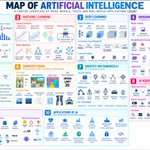
The AI landscape is getting harder to keep in your head
So I tried to map it all in one poster
From foundations to and real-world applications
what did i miss? 👀
🤖 Made with AI

1
36

We might actually be living through the 'Don’t look up' timeline rn. Except the existential threat is super intelligence AI instead of comet.
The scientists closest to it are freaking out but nobody seems to care.


I resigned from Anthropic today. I spent the last three years doing pretraining research at both OpenAI and Anthropic. Neither company is acting responsibly. They are racing straight to self-improving superintelligence and gambling with our lives. More thoughts below.
125
the people in the best position for the ai era might not be engineers.
they’re marketers with distribution.
they already know how to get attention. now ai lets them build.
engineers have the opposite problem: ai makes building easier, but it doesn’t magically give them distribution, taste, or marketing intuition.
that asymmetry is HUGE.
36