

Assistant Professor of Economics @PrincetonEcon and @nberpubs. Faculty Associate @OppInsights. Research tweets on economic mobility and education.
Princeton, NJ
Joined April 2008
- Tweets578
- Following20
- Followers3.4K
- Likes997



Pinned Tweet
New study: The relative wage premium for going to college has halved for low-income Americans since 1960.
What is to blame? Rising selectivity? Tuition hikes? State disinvestment? We decompose changes in the premium since 1900 to find out.
🧵#EconTwitter nber.org/papers/w33797

Zachary Bleemer retweeted

Huge congratulations to @EDerenoncourt for getting a MacArthur ‘genius’ grant @Princeton @PrincetonEcon
princeton.edu/news/2026/09/2…

Zachary Bleemer retweeted

My colleagues and I at @PrincetonEcon are hiring several pre-doctoral researchers to work on topics in labor economics.
Positions start in Summer 2027.
Apply and register for info session here: irs.princeton.edu/senior-res…
@econ_ra

Come present your research at the SOLE annual conference this spring! There will be special consideration for papers on higher education and the labor market.
sole-jole.org/assets/2027/SO…
Have questions about standardized tests and college admissions in the US? Jesse Rothstein has answers: escholarship.org/uc/item/6kx…


Zachary Bleemer retweeted

Forthcoming in AER: Insights: "The Vietnam War and Racial Integration" by Zachary Bleemer. aeaweb.org/articles?id=10.12…

Zachary Bleemer retweeted

New Paper Takes Aim at ‘Meritocratic’ Admissions Policies
Wealthy students w/ high standardized test scores make up the majority of students at the most selective universities, which spend more on student instruction. Where does that leave everyone else? bit.ly/4wWIDmi

ALT Rowers glide along the Charles River near Harvard University's Newell Boathouse.
Zachary Bleemer retweeted

Very pleased to release this paper on meritocracy, in which I continue to develop ways to understand the concept of meritocracy and its relationship to efficiency and to equality.
As famously argued by Amartya Sen, meritocracy and merit are underdetermined as abstract concepts. I answer this challenge in two ways. First, I focus on education and labor markets as specific contexts. Second, I distinguish between retrospective and prospective meritocracy.
Retrospective meritocracy refers to a conception of meritocratic assignments of students to colleges, workers to jobs, that is based on the idea that assignments to schools, jobs, etc. should be rewards for past achievement or be done on the basis of some notion of intrinsic excellence embodied in an individual. As such, the concept is backwards-looking. Prospective meritocracy refers to a conception of assignments in which merit is functionally defined by the objectives of the social planner setting the assignment rules. This means first, merit cannot be defined prior to these objectives, and second, one must account for the social and dynamic consequences of the assignments, which may place the focus on societal consequences as well as the consequences for the organizations for which the assignments apply.
My main arguments involve the implications of prospective meritocracy for evaluating different rules for assignments. Focusing on education, the interactions between students within a school, the consequences for school assignments for the distribution of skills among workers, and the intergenerational consequences of contemporary assignments, mean that efficient assignment rules can be very complex. The idea that meritocracy mechanically implies that students with the highest test scores and grades should be assortatively matched to the most elite universities can break down, even if the social planner does not make egalitarian considerations intrinsic to their objectives. It is possible for affirmative action to be efficiency enhancing and therefore prospectively meritocratic. Further, I argue that dynamic considerations mean that prospective meritocracy requires forms of equality of opportunity because of efficiency considerations. This does not mean that some forms of equality of opportunity cannot be efficient (under some standard criteria), but rather than equality of opportunity and meritocracy should not be understood as in conflict per se.
One conclusion from this type of reasoning is that an environment can be conditionally meritocratic but unconditionally not meritocratic. Static efficiency assignment rules that justify assortative matching at a single point in time, can be dynamically inefficient. By implication, I argue that there is excessive sorting in various environments because of the failure to address dynamic considerations.
Prospective meritocracy places qualitatively greater information requirements on a policymaker than does retrospective meritocracy. This is an important caveat to my arguments, and implies the the need, IMO, to develops ways to understand the design of robust meritocratic policies. On the other hand, to the extent that retrospective meritocracy is claimed to be efficient, for example following the logic of Becker's marriage model, evidence is also weak. See the forthcoming paper by Zachary Bleemer @zbleemer and Jeffrey Rothstein "The Meritocratic Consensus and Stratification in Higher Education,"

A proposals of ways to understanding different views of meritocracy and links them to assignments of students to schools and workers to firms, from @sndurlauf nber.org/papers/w35151

Zachary Bleemer retweeted

Is college still an engine of social mobility?
@zbleemer (@PrincetonEcon) & Sarah Quincy (@VanderbiltU) on changes in the relative wage premium for low-income Americans:
youtu.be/05OUfSKvlUw

*New study* Most Americans today grow up in college. A century ago, most young men grew up in the military.
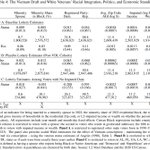
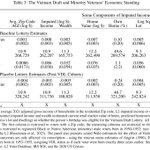
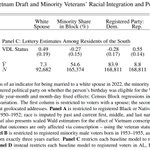
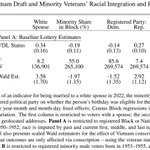
I study the Vietnam draft to see how integrated service affected white and minority veterans: who they marry, where they live, and how they vote.
nber.org/papers/w34900

What's the takeaway?
The Vietnam War happened just as the Civil Rights Movement waned. Military service played an important role in further integrating American society by race.
But that racial integration was one-sided: minority veterans lived more like their white peers.

