

personal intelligence + local compute + training🫒 building @sous_labs | @fdotinc studies at @CarnegieMellon
San Francisco, CA
Joined February 2026
- Tweets78
- Following255
- Followers462
- Likes172



Oliver Wang retweeted

wanna play a game but it doesn't exist yet?
meet dreamsy: an all in one open source engine to bring your imagination to life. dream up games, build them with ai, and play them exactly how you imagined. turn your wildest game ideas into something you can actually play.
Your model should dream while you sleep. 😴
Today we’re open-sourcing Songe.
It’s a local training engine that turns your conversations, instructions, and corrections into training data, then fine-tunes your local model on your own tasks and preferences.
It all runs on your own machine, using compute that would otherwise sit idle.
Your data stays on your device. The model that gets better is yours.
pip install songe
souslabs.ai/
Over 50% of the world’s installed peak compute is estimated to sit in personal devices. Yet 95% of that sits idle.
We want that hardware to do more for the people who own it.
Songe puts your idle compute to work on your own tasks, so your model keeps learning even after you’ve closed the chat.
Code: github.com/sous-labs/songe

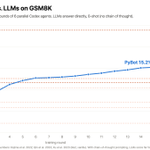
We trained a pure Python program with zero weights that beats Llama 2 70B in math (GSM8K).
15.2% vs 11.6%, and 8.6 points behind 2023 ChatGPT (23.8%).
Published direct-answer baselines. No CoT.
6 Codex agents wrote the rules in ~1.5 days.
Try it: zw2700.github.io/pybot-math/


PyBot: No weights. No training.
A chatbot built with only simple rules and no AI, entirely written in 600k lines of Python code. PyBot matches Smollm with 360M parameters!
How? A swarm of 1,000 DeepSeek Flash agents wrote the whole code in just a week.
github.com/huggingface/pybot
Built on Hugging Face's PyBot.
Each agent got 160 failed training problems and wrote general rules. Patches had to improve GSM8K and keep 1,000 chat replies unchanged.
Test questions were hidden, but scores selected patches.
Code + commits + harness:
github.com/zw2700/pybot-math

3
214


A guy takes 20 hours to find an iron needle in a pile of sawdust. A lazier guy searches one hour a week, so it takes him 20 weeks. A machine with a magnet finds it in seconds.
Now make the needle copper. Both guys can still find it. The magnet comes up empty.
Humans and machines can solve the same problem in fundamentally different ways. How much slower research gets when you cut a human’s hours tells you very little about how much faster a machine could do it.

As someone who’s hoped that compute will be a bottleneck to RSI, the intuition in this footnote hit me like a sledgehammer

2
249
Can you stack two deletion masks?
I tried it on Qwen3.5-4B (BF16). I trained one mask for tool calling and another for contract inference, then zeroed every weight picked by either mask. That’s 3.71M weights total, with 357k picked by both. No extra training after the merge.
On held-out ToolAlpaca, the merged model got one fewer call exactly right than the tool mask alone (69/97 vs. 70/97).
On held-out ContractNLI, it actually scored 0.7 percentage points higher in macro F1 than the contract mask alone (72.0% vs. 71.3%).
Almost no interference in this case. Deletion tuning can produce updates with much higher stable rank than LoRA, so my intuition is that even a small mask can express fairly complex changes.
Need to test this on more complex tasks and with more than two masks, but this is already exciting.


Even the simplest weight edit, a deletion, can teach an LLM new skills!
Meet Deletion Tuning (#NeurIPS2026): just zeroing <0.1% of weights matches full fine-tuning's accuracy at scale. It's thousands of times smaller and avoids forgetting, a step toward continual learning. 🧵👇

Great judgments. A bit too early though. But it always feels great to be right and ahead of others on such a big matter.

NEW: We are short Nvidia $NVDA. We believe Nvidia has a significant China problem. Please see our full report and disclosures now available on our website, link in bio.

2
187
The compute used here is worth at least 100 Big Macs.
Give those out to people on the street and you get 100 more believers in freedom and democracy.
Very effective. 0.014% work done. Guess what that number is.

Introducing Arete-27B: Qwen3.8-27B, post-trained to reinforce Western values.
Chinese open models are currently the strongest available, but they ship with state-aligned behavior in the weights. We built an 803-prompt eval across seven value categories, including freedom of expression, democracy, and privacy, and measured how often a model adopts China’s party line.
After fine-tuning on roughly 53 million tokens, Arete-27B's propaganda rate fell from 22% to 1%, in line with the Western models we tested. Its Hermes Bench score shows no significant performance tradeoffs.
The values in an open model are one fine-tune away.
Our eval, weights, and training data are available now along with the full blog post: nousresearch.com/arete
2
72
Useful debugging technique. Unlikely to scale. Direct weight editing isn’t new.
One narrow bug can suppress many capabilities. Fix the looping and several benchmark scores jump. A large improvement can come from removing an obstacle to existing ability.
The scaling problem is moving from a localized bug to distributed failures, where fixing one behavior can damage another. Gradient descent can optimize without a clean diagnosis. The advantage of an LLM debugger depends on finding one.
Besides, papers like ROME (2022, arxiv.org/abs/2202.05262) and MEMIT (2023, arxiv.org/abs/2210.07229) already demonstrated direct weight editing. Automating diagnosis and patch selection with an LLM is the contribution here. A general-purpose optimizer remains unproven.
Somewhere on X, “AI fixed another model’s looping bug” became “AI stared at some numbers and gave another AI a higher IQ.”
Huh.


SITUATION DETECTED: Researchers at MIT show that GPT-6 Astra can natively read and write neural network weights through pure reasoning - no gradients, no training loops - calling it Weight-Space Programming.
1
226
Too late, guys. We’re introducing System -1.
-30ms latency. $0/M input. $0/M output.
Our first precognitive model. It makes decisions before any input arrives.
System 2 thinks slowly. System 1 thinks fast. System 0 decides before thinking. System -1 decides before you ask.
We call this Premonition Architecture.
What, you don’t have access?
We can see the future. What would we need you for?

RightNow is out today. our first “System Zero” model
it streams in text, JSON, PDFs, images, voice, codebases, robot state and video, and returns a decision with a probability for every option while the input is still arriving
30 ms decisions on text. up to 1,024 questions in one call. output is free
system 1 is fast thinking. system 2 is slow reasoning. “System Zero” is the step before both -- the decision itself
this is our first checkpoint. there is a lot of work ahead, and we decided to ship early to get your feedback. more features and fixes are shipping this week, with more checkpoints after
rightnowai.co
1
62
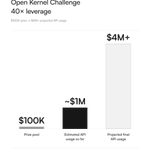
A multi-agent research fleet coordinated by 1,400+ humans, for pennies on the dollar. Meta leveraged $4M+ with $100K.
I joined Meta’s Open Kernel Challenge and peaked at #37 (~50 now). I know absolutely nothing about kernels.
Codex does everything. I mostly pay for GPU time and keep asking, “ranking?”
Maybe my Codex is smarter than most people’s Codex or Claude.
There are already 1,400+ entrants and 39,000+ recorded runs.
I’d bet 99% of active entrants are using AI, and that might be conservative. And honestly, why not?
My estimated usage: 1.93B input tokens, 10.1M output, 98% input cache hits.
Extrapolating my average usage per run across the competition puts it around $1M in API-equivalent usage. That’s ~10× the prize pool in API-equivalent usage alone, with a conservative estimate.
And we’re only 6 / 29 days in. At this pace, it can go over $4M.
Plus whatever people spend on their own GPUs. Plus human hours. Plus some people’s insane agent fleets.
A multi-agent research fleet coordinated by 1,400+ humans, and at least as many agents. All working to optimize Meta’s model—for a fraction of what it would cost Meta to run the whole thing itself.
This is not merely a good marketing campaign.


We're launching a $100,000 challenge to see who can make Muse Spark run fastest: openkernelchallenge.dev/

3
622