




ZK retweeted

NEPTUNE PRIVACY: MANDATORY UPGRADE
XNT Core v0.3.0 is live, bringing a major set of feature upgrades alongside important security enhancements.
All node operators must upgrade before the consensus changes activate at block 97,000.
Updated Android and iOS apps have also just been published. Mobile users: please update your apps ASAP.
Special thanks to @t_allfather for discovering and reporting the security issue addressed in this release. His contribution has helped strengthen Neptune’s security.
This is the final core upgrade before the Leviathan update.
Details below👇

Monero $XMR and Zcash $ZEC have proven that privacy is one of crypto’s most valuable use cases. Both have reached the top 13 by market cap.
Now combine privacy with post-quantum security. That’s where $XNT @NeptunePrivacy gets interesting.
While new chains are popping up with AI tools like Claude making it easier than ever to ship infrastructure, Neptune’s underlying research goes back years, long before AI-assisted coding became mainstream.
The wider Neptune ecosystem has serious technical roots: Thorkil Værge is a physicist, and Alan Szepieniec holds a PhD in post-quantum cryptography.
Neptune Privacy emerged from the Neptune Cash community, building on its established technical foundation while pursuing a distinct approach to emissions, tokenomics and ecosystem growth.
And it doesn’t stop at private digital cash. Leviathan aims to bring programmability to the ecosystem, opening the door to applications built around a privacy-focused, post-quantum foundation.
Privacy. Post-quantum security. Proof of Work. Programmability.
$XNT is targeting a combination that could become increasingly relevant as crypto matures and quantum computing advances.
ZK retweeted
NEPTUNE AMA RECAP: PRIVATE VALUE, PROGRAMMABLE APPLICATIONS, AND CONFIDENTIAL AI
In our latest AMA with @ourcryptotalk, we explored what Neptune Privacy is building and where the ecosystem is heading next.
The discussion centered on three connected priorities: privacy by default, post-quantum security, and programmability. Check out the key takeaways below:
PRIVACY STARTS AT THE FOUNDATION
Neptune’s Layer 1 is secured by proof of work, with privacy built into the protocol for all transactions, including $XNT mining rewards.
Leviathan extends that foundation with programmability. Its account model defaults to private accounts, while allowing users to choose public accounts for applications and integrations that require transparency.
The goal is to make privacy the starting point while giving developers flexibility in what they build.
SECURITY DESIGNED FOR THE LONG TERM
Neptune uses hash-based zk-STARK proofs.
This architecture is central to its approach to post-quantum security: building around cryptographic foundations designed to withstand future quantum threats.
On Leviathan, Falcon-512 signatures extend that approach to wallet authentication.
EXPLORE THE LEVIATHAN PUBLIC TESTNET
The Leviathan public testnet gives users a practical way to explore the ecosystem through a familiar wallet and application experience.
Participants can:
• Set up the Chrome extension wallet.
• Claim test tokens through the faucet.
• Send and receive assets.
• Explore private swaps on NeptuneSwap.
• Provide and remove liquidity.
• Access Private AI using their Leviathan wallet.
You don’t need to be a developer to participate. Testing these workflows and sharing feedback helps improve the experience as development progresses. Testnet assets have no real-world value.
PRIVATE AI BEYOND THE PAYMENT LAYER
The AMA also explored how privacy extends to computation.
Private AI runs open-weight models inside a trusted execution environment, with prompts and responses encrypted between the user and the enclave. Access uses a Leviathan wallet, without requiring an email address or KYC.
The aim is to protect sensitive conversations, including discussions involving intellectual property, development plans, and new ideas.
Early testers are already exploring it as a tool for their own development work.
CONNECTING NEPTUNE AND LEVIATHAN
Another development discussed was the proof-based bridge between Layer 1 and Layer 2.
The bridge enables XNT to move into Leviathan as wrapped XNT and return to Layer 1, connecting Neptune’s private settlement layer with Leviathan’s programmable environment.
That connection allows users to move between private settlement and programmable applications within the same ecosystem.
WHAT BUILDERS CAN EXPLORE NEXT
The broader vision includes private lending and borrowing, additional exchanges, cross-chain connectivity, and other applications built on this infrastructure.
The discussion also touched on research into private key exchange: an approach to exchanging control of digital assets that could extend beyond assets native to Neptune.
These are areas for further development, with builders helping shape what comes next.
A central message from the AMA: privacy is about having control over your financial activity, your information, and how you participate online.
We’re building the infrastructure to make that control usable.
We encourage you to explore the testnet, read the docs, and connect with the Leviathan Pioneers community on Telegram.

GOING LIVE IN 20 MINUTES
We’re joining @ourcryptotalk to talk about what we’ve been building at Neptune.
Tune in and catch up with the team.
nitter.cf/i/spaces/1DGleVgrqWVJL
ZK retweeted

JUST IN: @NeptunePrivacy is bringing post-quantum privacy to DeFi. 🔐
The project is building a chain for private smart contracts, with its public testnet now live.
Users can explore the ecosystem through:
▪️ Chrome and web wallets
▪️ Block and contract explorer
▪️ NeptuneSwap private DEX
▪️ Private AI powered by attested TEEs
Want to try it out? Head to the testnet and explore NeptuneSwap for yourself.
🔗 neptune-privacy.gitbook.io/l…
Testnet assets have no real-world value.
AMA Friday at 16:30 UTC.
🤝 Paid partnership
For more than a decade, @monero $XMR has shown that people want private digital money.
@NeptunePrivacy $XNT is going a step further with private, programmable money built for the quantum era.
By combining Proof of Work, privacy by default and post-quantum cryptography, Neptune builds on the idea of private money.
Leviathan, its Layer 2, takes that foundation further, opening the door to scalable private applications and a broader ecosystem.
The opportunity is real.
Now it's about proving what's possible with Leviathan.
DID YOU KNOW?
You can already access the Leviathan public testnet through both our Chrome wallet and hosted web wallet.
There are two ways to start exploring Leviathan. Choose the Chrome extension or access the hosted wallet directly through your browser.
Both are live, marking two more completed milestones on our roadmap.
The roadmap is becoming reality, one milestone at a time.

ZK retweeted
PRIVATE SMART CONTRACTS ARE LIVE ON LEVIATHAN PUBLIC TESTNET
We’ve been quiet, but development keeps moving forward.
Private smart contracts are live on the public testnet. This marks another completed milestone on our roadmap.
Developers can now build applications that enforce rules for how funds are used while keeping sensitive transaction details private.
Programmable rules.
Verifiable execution.
Private value.
Progress is measured in milestones, not dates.

Starknet $STRK wants to be the first quantum L1, but @NeptunePrivacy is already here.
It stays true to PoW principles, with mining-based distribution and tokenomics that avoid the typical VC-heavy allocations and substantial insider unlocks seen in projects like Starknet (See screenshots).
What makes Neptune so interesting is the combination of Proof of Work, privacy, and quantum resistance in one distinctive Layer 1 architecture.
And Neptune's potential doesn't stop there. Leviathan aims to bring private, programmable applications to the ecosystem, opening the door to entirely new use cases.
$XNT


For reference: "UNLOCKS"

Okay taking profits on $STRK
Heard there is a unlock next week and this could still be a short squeeze
2x while BTC dumps is decent!!


ZK retweeted
“Neptune already built the missing piece, and Leviathan is the practical proof that the technology works.”
The private, post-quantum narrative is coming.
Neptune Privacy and Leviathan is uniquely positioned for what’s ahead.
Watch this clip from @firehustle_net explaining why they deserve attention in the private, post-quantum blockchain conversation.
$XNT
ZK retweeted

neptune-privacy:native


$XNT
Source: @0xchainink

This is the split that matters. Where a system can be hash-based, it should be.
Neptune Privacy already settles that way. Validity is hash-based STARKs on Triton VM. No trusted setup. No ECDSA under the proof. Privacy comes from the Mutator Set, which makes transaction inputs and outputs unlinkable, rather than relying solely on encrypted data staying unreadable while it waits for a better attack.
Leviathan is our L2, bringing programmability to that foundation. The public testnet brings the stack together: private L1, programmable L2, a post-quantum DEX and Private AI inside attested TEEs.
Testnet assets have no real-world value. Find the limits. Help us strengthen the stack.
ZK retweeted
This is the split that matters. Where a system can be hash-based, it should be.
Neptune Privacy already settles that way. Validity is hash-based STARKs on Triton VM. No trusted setup. No ECDSA under the proof. Privacy comes from the Mutator Set, which makes transaction inputs and outputs unlinkable, rather than relying solely on encrypted data staying unreadable while it waits for a better attack.
Leviathan is our L2, bringing programmability to that foundation. The public testnet brings the stack together: private L1, programmable L2, a post-quantum DEX and Private AI inside attested TEEs.
Testnet assets have no real-world value. Find the limits. Help us strengthen the stack.

I don't recommend anyone scramble to move their funds to new wallets today. But we should take the risks to cryptography from AI-accelerated math seriously, and minimize our exposure to not just quantum-vulnerable cryptography, but also potentially AI-vulnerable cryptography.
The core new area of risk from this viewpoint is, unfortunately, ML-DSA / FHE / lattices.
(and it's also another reason, along with quantum, why ECDSA might fall even faster than expected, hence the "fresh address" recommendation)
So far most people have been in the mode of thinking "elliptic curves broken, hashes safe, lattices safe". But there is a good chance that the concrete security of lattices will take serious hits from the next two years of AI math.
The basic threat model is: factoring is something that naively takes 2^(n/2) time, but over decades smart people have found and optimized number field sieves, and degraded that to 2^O(n^(1/3)), which is why RSA keys and signatures need to be ~400 bytes (and not 64 bytes). What if there are skeletons in the closet like that, both for elliptic curves and lattices, that we are simply not smart enough to discover - but bots soon will be?
This is a major part of the reason why for the past year ethereum's lean roadmap has been going in the "hash-only" direction: no lattices, no ML-DSA, no Falcon, no lattice-based commitments inside ZK proofs, etc. Signatures in lean ethereum are all hash-based, either WOTS or SPHINCS-.
For signatures and proofs, we already know how to go hash-only. The bigger challenge is for *public-key encryption* - and this goes far beyond blockchains. Secure communication, anonymizing protocols, lots of things need public-key encryption.
And unfortunately there are long-standing mathematical theorems showing why public-key encryption cannot be done with hashes alone. You have to have some kind of trapdoor object that has at least one form of usable "structure" - either group theory (incl. isogenies) or lattices or code-based or potentially in the future even more newfangled and spooky things (local mixing?). But for anything that has structure, you should assume that AI will make at least some progress in breaking that structure. Here, one reasonable inference is that if you want to make something plausibly long-term secure, multiply the key sizes by 10.
To me that's a very plausible world and something not at all extreme to predict. If AI will bring us 50 years of math in 2 years, then that 50 years of math may very plausibly include a "naive factoring -> GNFS" level of improvement to our ability to break lattices. In that world, lattices will still exist, but they will have to be significantly bigger to guarantee the same level of safety.
And at those new larger sizes, hash-based constructions will beat lattice-based constructions on concrete efficiency in every use case where hash-based constructions are possible at all.
Theoretically, of course it's possible that hashes are broken too (eg. P = NP would imply that). But I think P = NP is very unlikely. And intuitively, it's much more likely that a mathematical object has exactly no exploitable structure (like hashes are intended to), than that a mathematical object has exactly ~3 forms of exploitable structure (for elliptic curves: associativity, Schoof, pairings) and not some secret fourth form of structure we have not yet discovered that greatly degrades its security (for elliptic curves, ECDLP and pairing security). Similar for LWE, SVP, RLWE and the zoo of lattice problems.
For this reason, we do not yet see any reason to worry and start padding the byte size of hashes (if we start to worry more, we would pad the round count first before doing anything to the byte size).
Concrete TLDR, my own personal views:
* Hash-based > lattice-based, in those situations where hash-based is possible at all
* For anything lattice-based, be much more paranoid on param sizes. Remember that blockchains are only a small portion of the cryptography story; this point goes far beyond blockchains and applies to eg. access to websites, secure messaging, Tor / VPNs ...
* For privacy protocols, strongly favor NOT putting encrypted notes onchain. Instead, send them offchain through some third-party mechanism.
* If it's not difficult for you, keeping your funds in addresses which have not yet been used to make a transaction is a good idea. If it's easy for you, do it. **But be careful about migrations; I personally have lost more money in botched migrations than I have lost in all hacks combined**.
* For multisig wallets, doing confirmations offchain is better than onchain, because this way the signatures of signer wallets do not get exposed to the public, so if ECDSA falls to AI much faster than expected, at least the multisig "gracefully degrades" to a 1-of-1 where the 1 is whoever was gathering the signatures - a much better place to be than "anyone can take the money"
firefly.social/post/x/210783…

SafeTrade has a reputation for finding projects early, and Neptune Privacy is another one worth looking into.
At around $750K MC, the combination is pretty unusual:
Privacy + quantum resistance + Proof of Work + private smart contracts + community-driven + >50% of supply already circulating + no major unlocks.
The interesting part isn't just P2P privacy.
Neptune Privacy already supports smart-contract logic at the protocol level, while its next-generation programmable layer, Leviathan, is being developed to enable scalable private smart-contract applications.
Under the hood, Neptune uses zk-STARKs and Mutator Sets as core parts of its privacy architecture, with cryptography designed to be post-quantum secure.
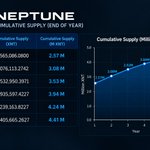
Tokenomics:
~2.5M $XNT circulating.
In 60 months (5 years), the emission curve reaches roughly 4.4M $XNT and transitions to a permanent 1 $XNT per block tail emission.
Privacy and Quantum is an interesting narrative to keep an eye on.
Research: neptune.io


