
1bsv.net retweeted

From the lab: I've been upgrading my on-site testing capabilities. I'm measuring Teranode multicast delivery throughput this morning. The results are encouraging. 2 million TPS on old 8-core AMD machines, without really breaking a sweat. More hardware, and more testing on the way

1bsv.net retweeted
A vault whose hosts never hold a key. bsecret keeps ciphertext only, refuses everything but the re-key once a removal is acknowledged, and lets an auditor verify every grant, version and rotation against block headers alone.
1bsv.net/patterns/bsecret.pd…

1bsv.net retweeted
"The Internet doesn't do multicast." Correct, and it doesn't have to.
Every multicast hop in the fabric is a link between two routers one operator runs. Across the Internet that link is a tunnel, and the Internet sees unicast, which is all it needs.

In case it isn't clear, this is an example implementation of a distributed, competitive, decentralized way to do Identity Access Management (like AWS or GCP IAM), while tying the state to the blockchain, and using SPV.
We're starting to get real cloud service tool capabilities.


Day by day, packet by packet, we continue the work.
A truly American Internet Service Provider for the real bitcoin.
Built on open source network standards.
Bring your miners, services, and applications and truly scale your business with multicast!
1bsv.net


Day by day, prompt by prompt, we continue the work.
A truly American AI research from for the real bitcoin.
Open source and free for the public. Bring your vibes, your codes and build your business.
bOpen.ai


1bsv.net retweeted
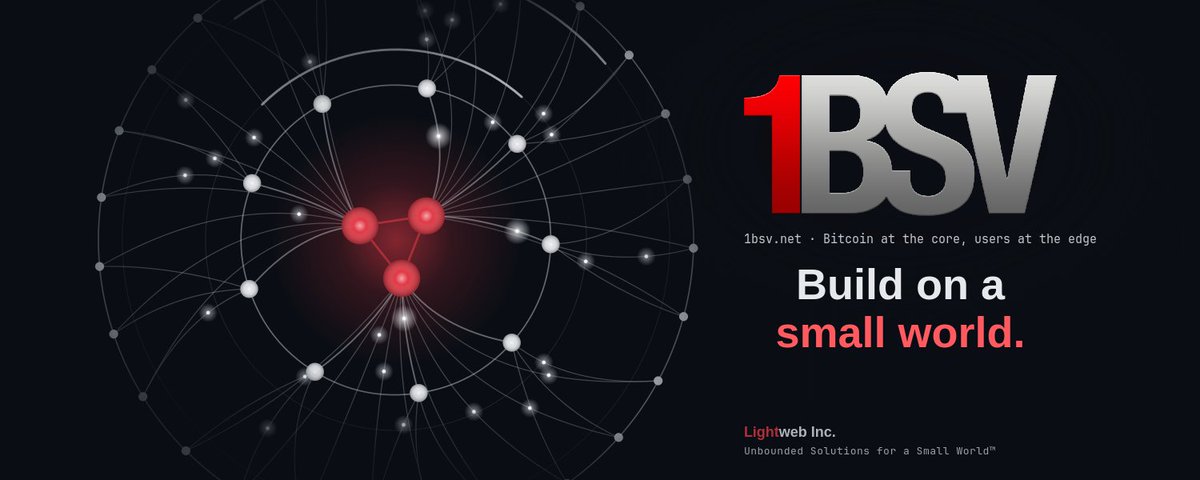
The global Small World Network formed by interconnecting all parties can be modeled as a ring of light encircling a planetary world. The topology brings structure where it previously did not exist. Mesh networks are susceptible to application level flaws. Bitcoin brings sanity.
1bsv.net retweeted
It not only works across the ISP peer boundary, I believe, ultimately, this is what will eventually convince traditional ISPs to adopt MP-BGP extensions supporting Source Specific Multicast for the FFxx::B Global official IANA IPv6 allocation, and therefore supporting multicast.
I designed the entire BSV Layered Multicast stack to be able to be implemented by any Internet Autonomous System (ASN; ISP, network operator, business, govt).
It works across the internet peering boundary.
Nothing is a walled garden.
Compete with me.
github.com/lightwebinc/bsv-m…

1bsv.net retweeted
I designed the entire BSV Layered Multicast stack to be able to be implemented by any Internet Autonomous System (ASN; ISP, network operator, business, govt).
It works across the internet peering boundary.
Nothing is a walled garden.
Compete with me.
github.com/lightwebinc/bsv-m…
Our whole goal is to make the multicast scalability story EASY, and SEAMLESS, while enabling new data distribution patterns at scale, with throughput rates never seen before.
1bsv.net retweeted
Use @1BSVNET Layered Multicast and you don't need CCIE level router knowledge. You don't need to use any advanced network capabilities. Just good, old fashioned PIM (Protocol Independent Multicast), eBGP (with private addressing), and the teranode-bridge solution. It scales.


1bsv.net retweeted
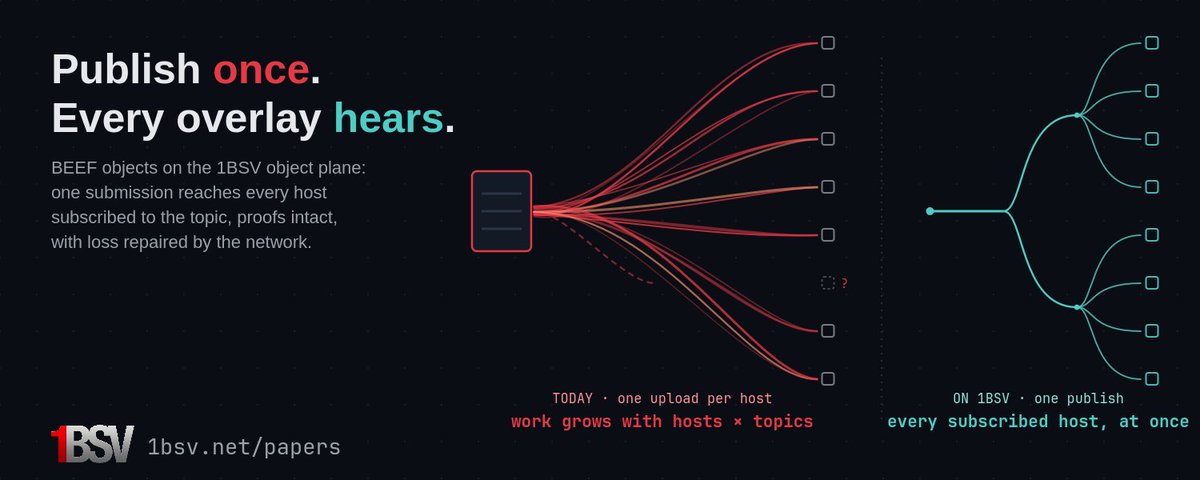
We could have 100+ nodes at 1B TPS easily. It's 2.6 TBits/second, approximately. Importantly, with multicast distribution (such as being tested on @1BSVNET right now), that data arrives O(1) to all participants. Small World Network doesn't necessarily mean small number of nodes.
1bsv.net retweeted

You apes are gonna find out soon!
Better mine about it at GorillaPool.com
🤖 Made with AI

1bsv.net retweeted
The 1BSV Layered Multicast solution is now interfacing directly with Teranode, and it didn't require forking the code. I've built teranode-bridge.
It uses the same functionality in the node, but importantly, leverages the efficiency of the network fabric.
github.com/lightwebinc/teran…