

Founder of 8FIGURES | ex-Goldman Sachs
United States
Joined November 2022
- Tweets347
- Following164
- Followers116
- Likes57




Pinned Tweet
We made our advanced portfolio tracker FREE for everyone. Here's how we make money.
I've been investing personally and professionally for over 2 decades across various asset classes. Scattered accounts, wallets, and private investments took an increasing amount of time to consolidate manually in a spreadsheet that always looked stale.
None of my brokers could calculate IRR (annualized return) with dividends/coupons for each position. I need that to know how my investments really perform relative to the index, underwriting, and each other across asset classes.
On top of that, I could never keep up with a constant flow of news and its impact on my portfolio.
That's why I built 8FIGURES.
We completely redesigned the app and made tracking FREE for everyone.
How do we make money then?
When you want guidance, your personal AI investment team is ready to advise you for only $30 a month. Not 1% of your assets.
Portfolio Manager, Financial Planner, Research Analyst, Tax Advisor, and Risk Officer - these specialized AI agents work together to deliver tailored guidance based on your investor profile and financial goals.
Check out our app and let me know what features are missing - we listen to feedback and release updates daily.
1
159
New AI-powered tools are coming out for individual investors.

Introducing @Supertake, a new platform that transforms your unique takes on the world into real, shareable investment portfolios using frontier AI and trading agents.
Supertake makes it easy for anyone to invest in their ideas, even if they know nothing about investing.
1/
1
73
New AI-powered tools are coming to help individual investors manage their own money.

Robinhood and Revolut democratised access to financial markets.
But access ≠ sophistication. AI has the potential to change that.
Thrilled to share that @Sequoia has led @catalystapp's $30M seed round.
1
66
Andrew | 8FIGURES retweeted

Robinhood and Revolut democratised access to financial markets.
But access ≠ sophistication. AI has the potential to change that.
Thrilled to share that @Sequoia has led @catalystapp's $30M seed round.

Introducing Catalyst.
What do you believe? How would you trade on it?
You notice data centers are popping-up everywhere, gold will skyrocket, or just know that Labubus will go out of fashion.
Catalyst researches your ideas, builds the optimal strategy, monitors events, and executes trades. Autonomously.
What do you do when a founder of a portfolio company you have invested in is not responding to your messages and calls after a long period of silence?
#startups #angelinvesting #VC
95
From "Navy SEALs of investing" at Goldman to founding 8FIGURES AI Investment Advisor.
I finally told the full story on the Wall Street Mastermind podcast.
What we got into:
-> How I got to @GoldmanSachs
-> Inside the Special Situations Group - the desk that invests Goldman's own money
-> The biggest myth about working at Goldman
-> Why investing across every asset class beats specializing
-> What AI is really doing to entry-level finance jobs
-> What we're building at 8FIGURES
-> Personal investment portfolio trade-offs
-> Why I've tracked every dollar I've spent for 20+ years
160
Andrew | 8FIGURES retweeted

How Finance Leaders Drive Growth During Market Changes hubs.li/Q04j5jfD0 from @mybrightplan @PenningtonLawAZ @IofeIFG @tiltonwm @8figureshq @aanandvmurugan @bluevine and more

Does @X have fundamentally different algos than @LinkedIn ?
Same post, same timing:
5 vs 5000 impressions.
Sure, follower count matters: 100 vs 4500, but you would expect at least pro-rata impressions, no?
#marketing
1
144
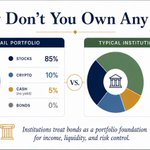
You probably own zero bonds. Family offices hold up to 50% of the portfolio. Who is wrong?
Institutional investors hold 25-50% of their portfolios in bonds. It's a foundation. Warren Buffett parks Berkshire's cash in T-Bills, not stocks.
You? Stocks. Some crypto. Real estate. Bonds never made the cut. If your answer is "bonds are for institutional investors, not me," let's reflect on that.
The smartest, longest-tenured, best-paid investors on the planet hold bonds to protect their wealth. Bonds balance their portfolios.
They allow risky, illiquid pockets in the portfolio. The wealthy do not get richer by gambling more.
They get richer by not blowing up. By generating steady returns over a long-term horizon.
A portfolio that is 100% stocks and crypto is not a strategy. It's especially risky now when the market is at an all-time high.

1
106
Andrew | 8FIGURES retweeted
Bonds Are Not Boring: A Private Investor’s Guide To Building A Fixed-Income Portfolio hubs.li/Q04cB3kN0 Written by @8figureshq of @8figureshq

Venture capital business model needs to be reinvented.
In the rapidly changing world with accelerated AI-driven disruptions, it's increasingly hard for VC funds' LPs to commit liquidity for 10 to 15 years.
- What is the world going to be like in 10 years?
- What portion of my portfolio should I keep liquid?
- Do I have enough liquidity to sustain my lifestyle?
- Do I have enough dry powder to take advantage in the event of a market meltdown?
LPs ask all these questions when they look at another VC fundraising deck.
Those VC funds that can demonstrate a consistent focus on exits and cash distributions to LPs will win the fundraising marathon.
TVPI is important. IRR and DPI are even more so.
Exiting illiquid stakes in portfolio companies is insanely hard, though. It requires focus and persistence that very few VC funds demonstrate.
Alternatively, a transparent, reliable process for selling secondary LP stakes could materially enhance the fund's liquidity profile for LPs.
86
Andrew | 8FIGURES retweeted
Concerned About Finance Faking? How Consultants Spot Red Flags Early hubs.li/Q046N8Nr0 from @fourlane @ahijahireland @8figureshq @investor_shef @TomasMilar and more
Private credit vehicles known as BDCs have traded down on concerns about loans to software companies.
Some quality BDC names without that much exposure to software ($TSLX) are trading at 10%+ dividend yield. I’m buying it!
#personalfinance #yield
83
Even a16z didn’t beat Nasdaq-100. At least not for LPs, once I converted TVPI into IRR.
@a16z raised $15bn and disclosed performance across its 29 funds since 2009. So I took the reported TVPI/DPI for each fund and converted them into implied net IRRs for LPs. I then benchmarked an average LP IRR across all a16z funds against the @Nasdaq-100.
The result surprised me: a16z delivered a 22.2% net IRR for LPs, while the Nasdaq-100-equivalent IRR was 22.9%.
I unpacked the full methodology and what LPs should actually look for in a VC fund beyond headline returns in my new Forbes article.
Comment "MODEL" if you want me to send you the Excel benchmarking model behind the article.

Andrew | 8FIGURES retweeted
A Practical Framework For Comparing Venture Fund Performance To Public Indexes hubs.li/Q045Pk180 Written by @8figureshq of @8figureshq

Personal finance question from a real person:
I am about to retire owing $300,000 on a small home worth approximately $1 million dollars but my monthly mortgage is only $2,000 which is apparently a steal. I have a pension, SSI and a savings of $235,000 after selling my cottage earlier this year. I am looking for direction on the best route to retirement as it's just around the corner.
5c from 8FIGURES Investment Advisor:
The big picture looks good:
- $700k in home equity
- $235k in liquidity
- Guaranteed income from pension + social security
- Low interest mortgage
Keep the mortgage - at only $2k/month with what sounds like a 3-4% rate, this is cheap money.
If pension + social security doesn’t cover monthly expenses (including the $2k mortgage), then we need a withdrawal and/or passive income strategy from the $235k liquidity cushion. Consider delaying social security to age 70 if possible for maximum benefits.
Allocate $40k to treasury bills with “ladder” quarterly maturities to ensure easy access to liquidity covering kliving expenses and emergencies. Roll them quarterly as they mature.
$100k to 5 government or high-grade corporate bonds with 3-5 year maturities and high coupon to generate passive income.
$50k to high quality, high dividend paying stocks/ETFs (utilities, REITs, BDCs) to increase passive income.
$45k to S&P ETF or large cap tech stocks that are not overpriced.
If you want to keep it more conservative, consider adding gold/commodities to hedge currency and inflation risks.
If you have access to a new, cheap mortgage loan and enjoy investing, consider recapitalizing your home (take on new $500k mortgage) to free up $200k that is currently “sit” in your home equity for building a more diversified portfolio (75% of your net worth is currently in your home equity) and/or higher passive income.
#PersonalFinance
59
AI is driving demand for electricity and nuclear is one of the few scalable, 24/7, low-carbon options. We’ve already seen tech firms sign long-term nuclear power deals.
There are 2 ETFs to play this bet:
$URA is the more “uranium-cycle beta” ETF. It’s heavily tilted toward uranium miners/producers (Cameco is a major weight at ca.23% of NAV), so it tends to be more sensitive to uranium price sentiment and the mining cycle. URA’s expense ratio is relatively high at 0.69%.
$NLR is a broader nuclear value chain ETF. It still owns miners, but it also holds nuclear operators/utilities and suppliers, so it’s positioned to capture the demand story through who generates the power, not only who supplies the fuel. NLR is usually the cleaner fit than a miner-heavy basket if you want to play the AI-driven electricity demand. NLR’s expense ratio is lower at 0.56% and its assets are about $4.6B, so liquidity is generally robust.
Risks worth flagging:
- AI power demand is real, but market narratives can get ahead of timelines and project execution.
- Nuclear policy can shift quickly. Germany, for instance, shut down its last reactors in April 2023, showing how political and social constraints can override economics.
#AI, #nuclear, #PerosnalFinance
103