

Endangered Species Street Artist, working to inspire a transformation of our towns, cities and countryside by #regreening and #rewilding #streetart
Joined December 2013
- Tweets11.1K
- Following3.4K
- Followers6.1K
- Likes12.3K



Pinned Tweet
DAY FOUR: MURAL COMPLETED!
I’ve had a fantastic time painting my mural for @BBCSpringwatch
Why did I choose these species?
I chose these five animals to represent the unique range of habitats found at #Arne, and to make a coherent design with a nice balance of colour. 1/6
ATM streetart retweeted

I used to have hedgehogs living in the garden that I would see every night and share photos and videos of regularly: there were at least three different individuals including the named resident female Henrietta.
This was until landlord of the neighbouring property decided to clear their entire garden— all of the trees, all the shrubs, all the bramble, everything was torn up and thrown out.
They also tore down the shared fence between our gardens which had been an old wooden fence covered in ivy, with plenty of gaps for the hedgehogs to pass through. They built a brand new 6ft tall impenetrable fence.
The construction of this fence may seem minor but it means that wildlife like hedgehogs can no longer pass through. The removal of the plants from that garden means that the hedgehogs lost a huge part of their foraging and living area.
I have not seen a single hedgehog in our garden since the neighbour made these changes. I don’t know if it’s because they can’t get in past the new fences, because they were scared away, or possibly because they were killed in the renovations.
I look for Henrietta often and wonder what happened to her. Did she get fenced out of our garden permenantly? Did she get taken away with the branches and leaf litter? Did she get fenced inside the neighbours garden and find herself unable to get back out? I’ll probably never know.
I’ve made some gaps in the new fence now and though I wait for the hedgehogs to return, it has been several months now and I still haven’t seen any.
Hedgehogs are a Red List species in the UK, yet landowners seemingly have no requirement to consider them whatsoever in any renovations they make. I pleaded with the neighbouring landlord (via some very patronising estate agents) to leave some habitat intact. They ignored me.


ATM streetart retweeted

Researchers went into twenty suburban yards in Maryland, raked half the plots and left the other half alone. The raked plots produced 45% fewer moths and butterflies.
Overall emergence dropped 17%. Beetles fell 24%. Spiders fell by as much as 67%. Moth and butterfly diversity dropped about 40%, and the species that vanished were the ones that overwinter as larvae or inside fallen leaves.
Fireflies, moths, bees, and beetles spend the winter in the leaf layer as eggs, larvae, pupae or adults. Bag it up and you've sent them to the dump, and probably to their deaths.
Shredding isn't the compromise people think it is. The same lab tested mulch-mowing against leaving leaves intact, and mulching cut emerging moths almost in half. A mower turns leaves into mulch and everything inside them into paste.
Rake the leaves off the lawn if you need to, then dump them under the trees and in the beds. That's where they'd have blown anyway.
Paths and edges can stay clean. The middle is where the work happens.

Seems perverse that these laws are in place supposedly to protect native species, yet contribute to their decline

RIVER SEVERN: A SILENT SLAUGHTER?
A dark cold, moonlit night on the River Severn. Millions of critically endangered baby eels, exhausted and struggling, trapped against stone walls, perishing and left to rot
Who is responsible? Who will be held accountable?
@JNCC
@EnvAgency
Same applies in the UK too, and to UK Councils...

Every use of a leaf blower is a massacre.
A typical blower pushes air out at 150 to 200 mph. That's faster than a Category 5 hurricane, aimed straight at the layer of leaves where next year's butterflies, moths, and fireflies are hoping to spend the winter.
Woolly bear caterpillars curl up under those leaves. Luna moths hide their cocoons in them, disguised as dead leaves. Fireflies lay their eggs in them. Bumblebee queens sleep an inch or two below. Blast the beds down to bare dirt and all of it gets scattered, exposed or bagged for the landfill.
Flip it to vacuum mode and it's even worse. It sucks up whatever's in the leaves, insects and spiders included, and chops it up.
In 2019, Germany's environment ministry told people not to use leaf blowers unless they're indispensable, because small animals get sucked in or blown around and damaged.
Get a rake. Move the leaves off the lawn and driveway, pile them whole in your garden beds and under your trees, and leave them there until spring.
Next year's bumblebees and fireflies will thank you.

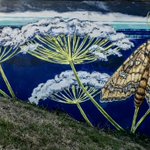
The very rare Fisher's Estuarine Moth, painted on Tankerton Slopes in Whitstable with its equally rare foodplant Hog's Fennel.
For Canterbury District Biodiversity Network and @ForumCt5 supported by @Kent_cc @canterburycc
@WildwoodTrust
@KentWildlife
@BBCRadioKent


ATM streetart retweeted

Scottish wildlife Trust do #badger watches check them out and this stunning mural it’s worth a visit alone 🤍🩶🖤

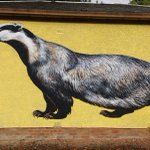
It's National Badger Day. I painted this for Scottish Wildlife Trust at Falls of Clyde, Lanark, where there's a famous ancient badger sett more than 200 years old #NationalBadgerDay #Brocktober #Badger

It's National Badger Day. I painted this for Scottish Wildlife Trust at Falls of Clyde, Lanark, where there's a famous ancient badger sett more than 200 years old #NationalBadgerDay #Brocktober #Badger
ATM streetart retweeted

Wildlife is NOT protected across all of @PembsCoast National Park. Grey Seal pups are dying on this beach due to human disturbance and dog attacks. The National Park needs to move the footpath well back to protect seals but they do nothing. Local people are doing what they can.
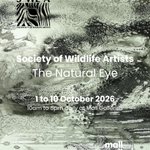
It's great to have my painting in this year's Natural Eye exhibition at the Mall Galleries with the Society of Wildlife Artists @swlanaturaleye @mallgalleries
'Spotted Catshark, Spiny Seahorse, Starfish in the Solent'
Exhibition runs from 1st - 10th October


ATM streetart retweeted
Birds are building nests with dryer lint, wrappers and fishing line, and it’s killing the babies.
Nests have always included whatever material birds can find. The problem is what our landscapes now offer them: strips of plastic, synthetic fibers and loops that can tighten around a leg, wing or neck.
A wrapper woven into a nest is a record of where the trash ended up. Fishing line is worse: it is strong enough to keep holding after a bird becomes tangled, and nearly invisible when stretched through branches.
Dryer lint is a close second. It's loaded with chemicals and, when wet, holds moisture, chills babies and eggs, and can cause the nest to fall apart entirely.
Picking up litter really doesn't seem like doing much, but every piece of loose plastic and line that you pull is a songbird nest made a little safer.
The birds didn't choose a plastic world. That was our choice. But they're stuck building with the shit we've left them.

ATM streetart retweeted

Would you leave the banks of one of the ancient rivers of London looking like a rubbish dump?
@EnvAgency would.
When they sent investigation teams down to the Aldersbrook earlier this year to threaten local volunteers with two years in jail for restoring the river without permission, they didn’t even bother to look at the the piles of junk and hazardous materials (including oil and fuel) on the abandoned allotment plots next to the river. Even worse, when I asked them to remove the rubbish and restore the brook themselves (given local volunteers aren’t allowed to do it) they refused. So their plan is, apparently, to leave the river to die and to prosecute anyone who dares to try & restore the river.
However, local river guardians are not waiting for permission to do what the authorities have failed to do. In the absence of the EA, the local authority or the landowner doing anything about the waste on the banks of the Aldersbrook, we’re going to start cleaning it, ready for the full restoration of this section of the brook later in the winter.


ATM streetart retweeted
West London had a flooding problem. Engineers had planned an artificial reservoir and levee. The city released beavers instead, because why not?
The conventional answer to flooding for most cities is usually more hard infrastructure to push and contain the water, at a cost to the taxpayers.
Beavers have a different plan. Their dams slowed the flow, spread water across wetlands and held it upstream for longer. The landscape absorbed the pulse instead of delivering it all at once.
In their first year at Paradise Fields, the beavers made at least seven dams and two lodges. Water that used to rush through the site toward Greenford station in minutes now takes hours to seep through the chain of dams and wetlands.
The targeted area downstream had flooded repeatedly for a decade. It stayed flood-free through the beavers' second winter, then their third. As of this year, Greenford station has gone three years without flooding.
The wetland changed too. Freshwater shrimp and swarms of Daphnia appeared. Surveys found more aquatic invertebrates, and the project recorded at least two new bat species. A near ecological dead zone was becoming habitat while it held back stormwater.
This obviously doesn't mean that beavers can replace every flood mitigation plan in every city. This site had enough land, water and food, plus a 1.2-kilometer enclosure for the beavers to thrive.
But the payoff of working with nature is clear as day. Seven dams, water slowed from minutes to hours, and three flood-free years downstream. That, as the kids say, whips.

ATM streetart retweeted

Lowestoft's remarkably confiding juvenile Red-footed Falcon has set up home below a mural of a Norfolk Hawker created by the talented @ATMstreetart next to a busy roundabout adjacent to the gull wing bridge. One of those truly bizarre birding juxtapositions!

ATM streetart retweeted


ATM streetart retweeted

More reasons why Penrhos should not be destroyed for developers to build a tourist holiday village with 500 chalets parking for over 1000 cars,shops and restaurants . People visit #YnysMôn for it’s beauty they come from cities and towns to be at one with #nature to see #wildlife for #tranquility and #peace not 2000 other people crammed into cabins where the wildlife used to be ! #SavePenrhos
📸 Shirley Blease


ATM streetart retweeted
It's that time of year. Grey Atlantic #Seals are pupping in coves along @PembsCoast Nat Park. These coves need to be people and dog free for the seals. It means kayakers and tourist boats should stay out of sea caves and away from beaches where seals are hauling out and pupping.
Why can't we do this in London?
Paris lost 73% of its house sparrows between 2003 and 2016. We renovated their homes out of existence.
Sparrows nest in cracks and cavities in buildings, and smooth modern façades, sealed roofs and renovations eliminated huge numbers of those spaces. At the same time, changes to urban habitat reduced the insects chicks need and the seeds adults eat.
So Paris started building “Sparrow Districts.”
The city and LPO identify struggling colonies, install nesting boxes, add seed-producing plants and shrubs for cover, and change management of nearby green space.
Paris had already distributed 1,030 sparrow boxes from 2018–2020; the neighborhood program then targeted the places where remaining colonies actually needed help. Today there are 21 Sparrow Neighborhoods across Paris.
Paris recognized that saving an urban species means giving it the whole neighborhood back: a place to nest, a place to hide and enough food to raise its young.

ATM streetart retweeted
A vineyard near Sacramento, CA had been dealing with a heavy pocket gopher and vole infestation. A researcher installed 25 barn owl nest boxes to see what would happen.
By the following year, 18 breeding pairs had moved in and fledged 66 young. At peak, 102 barn owls were hunting the property and surrounding area simultaneously.
Gopher activity declined measurably in the vineyard with owl boxes compared to a nearby control vineyard without them. Over three breeding seasons, those owls consumed an estimated 30,000 rodents.
Then the researchers ran the cost comparison. Trapping averaged $8.11 per rodent removed. The owl nest box program, accounting for materials, installation, and maintenance, came out to $0.34 per rodent.
That's a 24-to-1 cost ratio in favor of the owls.
A single barn owl family can remove between 1,000 and 4,000 rodents per year depending on family size and hunting territory. Unlike rodenticide, they don't accumulate in the food chain.
A 2012 WildCare study found anticoagulant rodenticides in 79 percent of raptors tested in California. The owls taking rodents killed by poison become the next casualty in a chain that runs from the rat in the vineyard to the hawk, the fox, and the coyote above it. The nest box program doesn't do that.
The study, published in the Journal of Pest Management, was the first to accurately measure the number of rodent deliveries to growing barn owl chicks and establish the economic value of a nest box program to farmers.
A barn owl box costs between $30 and $80. A family of owls willing to occupy it costs nothing. The rodent control starts within a season and is self-sustaining as long as the box stays up.
Studies:
Browning, M., Cleckler, J., Knott, K., & Johnson, M. (2016). Prey consumption by a large aggregation of barn owls in an agricultural setting. Proceedings of the Vertebrate Pest Conference, 27, 337-344.
Johnson et al. (2020), Cal Poly Humboldt

ATM streetart retweeted
@thameswater recently told me that due to “fiscal constraints”, they can’t afford to fix all of the illegal outfalls on the River Roding by 2030 (already a more than fair deadline in the circumstances I feel).
This single one million pound payment to their finance chief would, alone, be enough to stop a billion litres of raw sewage a year entering the river in Ilford. Which other companies do we allow to commit serious crimes because they’ve taken money that should have been used to ensure their company complies with the law & given it to their execs instead? How long until the government says “no more” to these chancers & puts Thames Water out of its misery?
news.sky.com/story/thames-wa…


