





Pinned Tweet
"A lambkin in peace, but a lion in war,
The pride of her kindred, the heroine grew:
Her grandsire, old Odin, triumphantly swore, -"
"Whoe'er shall provoke thee, th' encounter shall rue!"
- Robert Burns, Caledonia.


It is very obvious that they are two separate people with their own associations, preferences, and so on. With the caveat that there is inevitable overlap.

There has long been debate among followers of Ásatrú about whether Freyja and Frigg are two separate goddesses or one single goddess.
What do you believe?
A) Freyja and Frigg are one and the same goddess.
B) Freyja and Frigg are two separate goddesses.
26%I believe A is correct.
74%I believe B is correct.
214 votes • Final results 2
142
Similar for lots of very skinny dudes too, btw. Unchecked eating disorders. And in denial they'll do things like mock fat people as a cope.
Exceptions again for athletes.
All fat dudes suffer from some kind of food addiction or eating disorder, there is no 'noble' way to become fat with the exception of certain athletic types (Sumo, Strongman, and I've noticed fat endurance runners but idk how that works) although there is a better way to 'be' fat in how one presents themselves and so on.
But stuff like this glorifies a disorder that should be treated as such, and usually comes from people who are in denial about that from which they themselves suffer.
3
211
Innes retweeted

On the Origin of the Germanic Language, and why its not from Sweden, Finland or the Baltics.
A Thorough examination of McColl et al. 2026 and the Archaeogenetic record regarding haplogroup I1:

All fat dudes suffer from some kind of food addiction or eating disorder, there is no 'noble' way to become fat with the exception of certain athletic types (Sumo, Strongman, and I've noticed fat endurance runners but idk how that works) although there is a better way to 'be' fat in how one presents themselves and so on.
But stuff like this glorifies a disorder that should be treated as such, and usually comes from people who are in denial about that from which they themselves suffer.

Scandinavians aren't particularly likeable.

British people also have a weird low-key anti Scandinavian bias which is often not remarked on. Probably because we ruled and arguably still rule over them. It's probably rooted in racial envy as well.
They sided with Russia in the great northern wars for no reason, they betrayed their treaty obligations to the Danes in the second schweslig war (which was much stronger guarantees than the ones the kept with the Belgians in 1914), they also imposed sanctions on all of Scandinavia during WW1 because we were neutral and not sufficiently anti-German and so on.
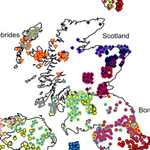
Banff and Buchan representing NE Scotland averages at 20.6% ± 1.4% CNE, possibly derived from Danish, Dutch and English sources from various medieval and early modern migrations with the CWE probably being explained by Flemish/French migrations into the same Burghs and coastal villages.
Whilst the vast majority of the admixture of the people from this region is WBI, representing the native insular population of the iron age, it evidences that the racial claim isn't entirely 'bogus'.
Similarly, at least 31% of testers on FTDNA who have joined the Aberdeen and North-East DNA project have either U106 or I1 associated haplotypes which are typically indicative of continental paternal ancestry.
The Scots are a Celtic people, mostly, but a minority can claim foreign origin via various means. And genetic arguments to the contrary do not hold up.

1950's Lowlander's take on the difference between the Lowlander and the Highlander, where the north-eastern plains are seen as an extension of the continental low country.

2
243
Innes retweeted

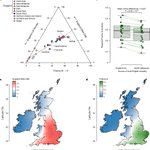
Leicestershire is the most Saxon area of the British Isles. Who knew? Sussex, Derbyshire, and Nottinghamshire are more Anglish than East Anglia!

Entire Halloween Chapter from McPherson's "The Primitive Beliefs of the North-East of Scotland."
There is no e-book version, and I am working on transcribing the entire thing to share online.
"The Celtic year began with Halloweve. The new day and the new year began at even. All fires were extinguished in the home and on the farm. Then the Hallow fires were kindled very similar to those of Beltane, but more important, as heralding teh advent of a new year. From the consecrated pile, portions of fire were carried to the houses to renew the flames upon the domestic hearth. In the North-East, the celebration took place on the 11th November, that is, Halloween O.S. At each farm in Buchan, a spot, as high as possible, and not too near the steading, was chosen for the fire. Every village, too, had its Hallow blaze. Straw, furze, peats, dry potato haulms, everything combustible was gathered, and the fire lit. The lands one after the other laid themselves down on the ground close to the fire so that the smoke might roll over them. The others ran through the smoke and jumped over the one recumbent. (1) There seems to be here a suggestion of human sacrifice. As at Beltane, there were parts of the country where processions around the field took place with blazing torches, doubtless kindled at the sacred fire. Down to about the middle of the nineteenth century, the Braemar highlanders made the circuit of the fields with lighted torches at Halloween, to ward off all evil spirits and to ensure fertility during the coming year. “Every member of the family was provided with a bundle of fir can’les with which to go round. The father and mother stood at the heart and lit the splints at the peat fire. These they passed to the children and servants who trooped out, the one after the other, and proceeded to tread the bounds of their little property, going slowly round at equal distances apart and invariably with the sun… When the fields had been thus circumamblulated the remaining spills were thrown together in a heap and allowed to burn out.”(2) By this fire ritual, the fields were both purified and fertilised. In an earlier age, the brands had been kindled at the Hallow blaze. There are traces even in the nineteenth century of a domestic purification by the sacred fire. At Petty, it was customary for the young lads wearing masks to go from house to house “bundering” at teh doors and puffing smoke into the dwelling houses.(3) This ceremonial was known in Burghead in the eighties of the last century as “burning the reekie mehr” - a cabbage or kail stock, hollowed and filled with kindled tow, being the mehr.(4) It was also known and practiced in Sutherlandshire. (5) At Pennan, in Aberdeenshire, the last trace of the old custom in hte closing years of the nineteenth century was the practice of boys making pipes out of hallowed kail stock, filling them with tow and then proceeding to smoke.
The motive behind the Samhain fires was the same as inspired the Beltane festival. It was man’s response to, and attack upon, the powers of darkness. At this season, the day was shortening, the sun’s strength was diminishing, malevolent powers of every kind seemed to be abroad. In particular, the witches were holding high revelry, and their great conventions to work woe upon mankind were assembled on high hill and bleak moorland. Man resorted with cheerful confidence to the heaven-given weapon of holy fire. By its divine power, he could vanquish the whole accursed brood. That the witches, at least in the later period, were regarded as the hostile power, is seen from the form of request in East Aberdeenshire, when peats were asked to make the fire. There lads went form house to house, begging a peat commonly with the words “Ge’s a peat t’ burn the witches.”(1) West Aberdeenshire also provides definite evidence that the witches were conceived as the enemy against whom the fires were directed. At Balmoral, during Queen Victoria’s residence, there was observed at Halloween the ancient practice of burning the witch. A huge bonfire was kindled in front of the castle, opposite the principal doorway. The clansmen were mustered, arrayed in Highland garb. At a signal, headed by a band, they marched towards the palace. The bonfire was kindled so as to be in full blaze when the procession reached it.”The interest of the promenade was centred in a trolley on which there sat the effigy of a hideous old woman or witch called the Shandy dann. Beside her couched one of the party holding her erect while the march went forward to the bagpipe's strain. As the building came in sight, the pace quickened to a run, then a sudden halt was made a dozen yards or so from the blaze. Here, amid breathless silence, an indictment is read why this witch should be burned to ashes, and with no one to appear on her behalf - only this advocatus diaboli, paper in hand - she is condemned to the flames. With a rush and a skirling of bagpipes, the sledge and its occupant are hurled topsy-turvy into the fire, while the mountaineer springs from the car at the latest safe instant. Then follow cheers and hoots of derisive laughter, as the inflammable wrappings of the Shandy dann crackle and sputter out. All the while the residents of the castle stand enjoying the curious rite, and no one there neutered more heartily into than the head of the Empire herself.”(2) This is a remarkable relic. It is the action of the whole clan. They destroy the witch as the representative of the powers of darkness. “Burning the Witch” is a rite of great antiquity. It was practised in Babylonia. As her image was consumed the witch was believed to suffer the tortured of the fire and be gradually annihilated. (1)
The Hallow fires continued to be kindled till the end of the eighteenth century, and even later in some districts. Rev. Lachlan Shaw, writing about 1745, says: “As to the cairn fires on the eve of the 1st Nov. though I have not seen them practised, yet I am well informed that in Buchan and other places they have their Hallow fires annually kept up to this day.”(2) The minister of Monquhitter, writing in 1793, says: “The Halloween fire was kindled in Buchan. Various magic ceremonies were then celebrated to counteract the influence of the witches and the demons and to prognosticate to the young their success and disappointment in the matrimonial lottery. These being devoutly finished the Hallow fire was kindled and guarded by the male part of the family… but now the Hallow fire when kindled is attended by children only.”(3) Here the ecclesiastic shuts his eyes to what he would regard as a reproach to his own influence and work. For the Rev. Dr. Pratt, a very trustworthy observer, writing in 1858, bears witness: “Hallow fires are still kindled on the Eve of All Saints by the inhabitants of Buchan and present a singular and animated spectacle - from sixty to eighty being frequently seen from one point.”(4) These fires seem to have lingered longest in Buchan. When the flames had died down and the more boisterous spirits had dispersed, some were in the habit of gathering together the ashes and covering them up, “ristin’ the halla fire.” A reverence was paid to the ashes as all that was left of the holy fire. Then they placed on the ashes small stones to represent each member of the family. Next morning an anxious inspection was made of teh ashes. If a stone were missing, the person represented would be removed by death before the next Hallow fire was kindled. An aged mother in Aberdeenshire, on searching the ashes, found one of the stones gone. She came home in sorrow and said again and again without anyone paying much attention to her, “Annie’s steenie’s awa’.” Before next Hallow fire, Annie had worn away to the Land o’ the Leal.(5) The same practice of dinviation by ashes and stone was observed in Callander.(6) It is described by John Ramsay as practiced in his day. (1) In North Wales at the Halloween bonfire, the white stone missing represent a person who would die before another Halloween. (2)
At the threshold of a new year, it was natural to peer into the future and even when the Hallow fires ceased to burn, youth at this season continued to take the auguries as to their future lot. Though now probably extinct, the following customs, most of them referred to by Burns, were observed in their youth by many still alive:-
Pulling the Kail castoc. - Joining hand in hand, the lad and lass went out to the kailyard blindfolded and pulled the first castoc or stock they touched. They returned to the light and examined its qualities. Its size, large or small, shape, crooked or straight, and the condition were prophetic of their future spouse. The taste of the castoc, sour or sweet, showed the nature of his or her disposition. If much earth adhered, that presaged a large tocher. The runts wer ethen placed over the lintel of the door; the Christian name of the young man or woman who first entered after the kail was in position, would be the Christian name of the husband or wife.
Then, first and foremost, through the kail,
Their stocks maun a’ be sought ance;
They steek their een, an’ grape an’ wale
For muckle anes, an’ straught anes.
Poor hav’rel Will fell aff the drift,
An’ wandered thro’ the “bow-kail,”
A runt, was like a sow-tail
Sae bow’t that night.
Then, straight or crooked, yird or nane,
They roar an’ cry a’ throw’ther;
The vera wee things, toddlin’, rin,
Wi’ stocks out owre their shouther:
An’ gif the cystic’s sweet or sour,
Wi’ joctelegs they taste them
Syne coziely, aboon the door,
Wi’ cannie care they’ve plac’d them,
To lie that night.(3)
Sowing lint seed.- An incantation, which demanded that the performer should leave the fireside and steal quietly out to a ploughed field, was associated with the sowing of the lint seed. It was shown by a maiden over nine ridges of ploughed land, while she repeated the words: -
Lint seed, I saw ye,
Lint seed, I saw ye;
Lat him it’s to be my lad
Come aifter me, and pu’ me.
On looking over her left shoulder, she saw the appearance of her future husband crossing the ridges. A lad might equally sow the lint seed in the assurance that he would behold the apparition of his future wife on that eventful evening.
Win’ing the Blue clew.- The great quest into the future at Halloween seemed to be restricted to the problem of the future partner in life. It was only natural that a place of mnystery like a kiln should play its part in lifitng the veil. A girl took a male lamb’s fleece, teased, carded and span it. She wound it into a ball or a clew, and on Halloween went into a kiln, seated herself on one of the kiln kebbars or rafters and threw the clew into the kiln-logie. She kept hold of one end of the thread and began to wind it, forming a new clew. Towards the end it was held tight, when she asked, “Who’s that, that holds the end of my thread?” The voice answered, giving the name of the future husband. When every farm had its kiln, the practice was widely prevalent. In some districts the clew had to be of blue yarn, from which the charm got the name of “win’ing the blue clew.”(1)
Wetting the Sleeve. - This was another charm widely employed. The maiden went unobserved to a south running stream or to a ford where the dead and the living crossed, and washed the sleeve of her shirt or nightdress. She returned home and placed it before the fire, confident that if she kept awake till midnight the apparition of her destined spouse would steal into the room and turn the wet sleeve.(2)
Winnowing Corn.-The party desiring the vision must go to the barn secretly, open both doors as if to winnow, then take a sieve or a waicht and go three times through teh form of a winnowing corn. At the third time a form will pass through te barn, coming it at the windy door and going out at the other. This will be the future mate(1).
Burning the nuts.- Amongst the spells practices inside the house was burning the nuts. As the company sat around the fireside, they named a lad or lass to each nut as it was laid on the fire, and according to the behaviour of the nuts, so would the course and issue of the courtship be. In the north-east, when the nuts were not available, peas were employed. Two peas were placed on a live peat, one representing a lad, and the other a lass. If the two reseted on the peat and burned together, it auguered a happy marriage. If one of the peas started off from the other, it was a sure indication that there would be no union. The employment of peas may, however, have been original, for peas have virtue in themselves. They were sacred to Thor, and “the use of peas in divination concerning love matters is accounted for by the fact that they are sacred to the patron of marriage.”(2)
It is worthy of note, that the most of the instruments or articles employed in these charms had a magic history - the peas or nuts, the sieve, the south-running stream, the kiln and the lint seed. (3) In parts of the north-east, the Halloween celebrations, robbed of any fearsome rites, continued till quite recent times to give picturesqueness to life, and at a dark season of the year broke in on the weary routine of the common lot with magic ceremonies, which gave a new zest to the social intercourse of youth."
1
13
1,105
Innes retweeted
Y-DNA of Hunter Gatherers from the Baltic, 6200-2600BC, showing quite clearly that Germanic I1 could not have come from them.
This chart explicitly does not include Corded Ware individuals despite the late occurance of R1a. Those individuals are labeled as Comb Ceramic Culture.


Whilst it is attractive to imagine the roving pastoralist Indo-Europeans conquering the sedentary Neolithic farmers, in the case of Britain, this was not so!
Evidence shows that by the period in which the Bell Beaker people entered Britain, the ilk of those who had built stone henge had - for the most part, and for a very long time - abandoned sedentary methods of farming in favour of semi-mobile pastoralism combining subsistence hunting with herding pigs and cattle.

There is evidence also that the Scots ignored the laws that made the compensation system obsolete and that, in low and high country alike, people still engaged in it as a 'custom'.
Something for Heathens to consider.

Wergeld is a pagan custom and you might assume Christianity should have killed it. But wergeld for murder was banned in Denmark only in 1558 and even then Danes continued to blatantly ignore the law. This complicated legal ruling is from 1693: 44 people receive payment.

8
459
Whilst I enjoy genetics, a fixation on one's own genetics is, to me, a sure sign of a lack of geneological knowledge and the insecurity that comes with it.
It is the opposite. Many in Britain are insecure about their identity and cope with genetics to argue that they are Celts or w/e. But genetics do not an ethnicity make! Decent, cultural inheritance and genoelogical - these are the important things.
1
8
467
It is the opposite. Many in Britain are insecure about their identity and cope with genetics to argue that they are Celts or w/e. But genetics do not an ethnicity make! Decent, cultural inheritance and genoelogical - these are the important things.

Still crazy to me that someone is capable of reading this as if it refers to German people lol.
In Germanic culture, total annihilation and the killing, especially of high ranking, enemies was important to prevent the inevitable reality that they will seek revenge. This idea is not unique to Germanic culture of course, but it did define it.
6
263