
CS PhD @UCBerkeley | Senior Applied Scientist @AmazonLab126 | Ex. - Deepmind, Microsoft Research | Research area: Efficiency, Continual Learning, Discovery
Sunnyvale, CA
Joined February 2022
- Tweets59
- Following441
- Followers249
- Likes57



Pinned Tweet
Check out this post by my amazing co-author @chandavidlee with more details on Lafa!

Can flow language models scale to billions of parameters and handle real generative tasks?
Introducing 🌊 Lafa (Large flow language model), a flow LM scaled up to 8B that matches AR quality, with 🚀 2.5× AR throughput at 7B.
Co-led with @ArnavChavan6 @UdbhavBamba.
Joint work with @wognsfjq96 @hongseu33 @AdtRaghunathan @jw9730
Arnav Chavan retweeted

Some new work where we tried to understand how much changing the optimizer can reduce forgetting when training on offline data 👇

How can LLMs learn new skills from offline data without losing what they already know?
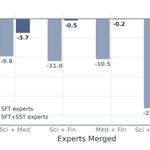
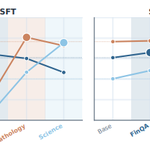
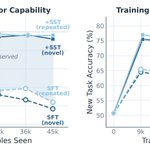
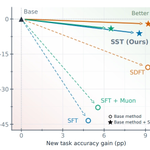
Introducing Subspace Tuning (SST): a simple approach that improves the learning–forgetting trade-off by controlling where weight updates happen.
Paper: arxiv.org/abs/2610.22293
Blog: app.notion.com/p/ac-notes/To…
🧵 1/8

Arnav Chavan retweeted

Just read a fun paper where they adapt off-the-shelf Qwen models with under 30B training tokens, and the result runs at 2.54× the throughput of a same-size autoregressive model at comparable quality.
The idea is to have an LLM write the way image generators draw: it still goes left to right, but a chunk at a time, and each chunk starts as random noise that gets refined into real tokens all at once. Everything else works like a normal LLM, which is why they could just convert an existing model instead of training one from scratch.
Each token in a chunk gets cleaned up at its own pace, and the model learns those paces itself during training. What it ends up learning is that earlier tokens should come into focus first. Nobody told it to write left to right. It figured that out on its own.
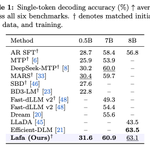
Learning all this also made it a better normal LLM. Compared with the same Qwen model fine-tuned the usual way on the same data and budget, its average score across six benchmarks went up at every size (0.5B: 28.7 → 31.6, 7B: 58.4 → 60.9, 8B: 56.8 → 63.1). The authors think it's a multi-token prediction effect: practicing on whole chunks makes it better at predicting the next token too.
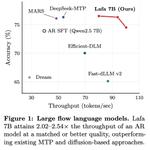
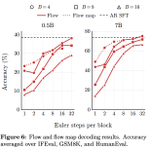
That normal-LLM side is also what makes it fast, because the model can check its own drafts. It takes one quick shot at a whole chunk, then checks it the normal next-token way and keeps everything up to the first token it disagrees with. Since every token gets checked, the output is exactly what it would've written one token at a time (greedy decoding), just faster. With the 7B model on a single H100, that's about 2× faster and a bit more accurate with 4-token chunks, or 2.54× faster at about the same accuracy with 16-token chunks.
For comparison, other speedup tricks they tested, like DeepSeek-style multi-token prediction and MARS, keep the quality but top out at 1.4×. The diffusion LLMs they compared against all lose quality, and lose more the faster you push them.

Next step: Scale to strong models such as Qwen3.8-27B!

"Large Flow Language Models"
What if we could turn existing LLMs into diffusionLMs that generate multiple tokens in parallel without losing accuracy?
So this paper Lafa converts pretrained LLMs into continuous flow language models that generate multiple tokens together by progressively denoising their embeddings. Instead of replacing autoregressive decoding entirely, it uses these parallel predictions as drafts, then verifies them using the same model's original next-token prediction capability.
The researchers scaled Lafa to 8B using fewer than 30B training tokens. At 7B, it achieves up to 2.54x faster generation than a comparable autoregressive model, while maintaining similar accuracy.
alphaxiv.org/abs/2610.28559

Arnav Chavan retweeted

Large Flow Language Models
Lafa shows continuous flow models can scale to 8B parameters by adapting pretrained autoregressive models with under 30B tokens, matching autoregressive quality across instruction following, reasoning, and coding benchmarks.
arxivb.org/abs/2610.28559

Arnav Chavan retweeted

Another blockwise continuous diffusion language model at 8B scale, adapted from a pretrained autoregressive model, with flow map distillation and self-speculative decoding for faster inference. Cool😎
nitter.cf/chandavidlee/status/21…
Can flow language models scale to billions of parameters and handle real generative tasks?
Introducing 🌊 Lafa (Large flow language model), a flow LM scaled up to 8B that matches AR quality, with 🚀 2.5× AR throughput at 7B.
Co-led with @ArnavChavan6 @UdbhavBamba.
Joint work with @wognsfjq96 @hongseu33 @AdtRaghunathan @jw9730
Saying solved is a stretch :) but we are excited to identify the failure cases of SST and push continual learning ahead.

wonder if anyone noticed that @ArnavChavan6 @Devvrit_Khatri et al solved catastrophic forgetting
1/ Continous Flow Models power image and video generation. Can they scale to language?
Introducing Lafa: to our knowledge, the first continuous flow LM scaled to 7B with AR-competitive results on coding, math, and instruction following.
Up to 2.54× AR throughput via self-speculation. 🧵
9/ Key Takeaway: continuous flows can scale to billions of parameters and tackle complex tasks at AR-level quality.
Lafa also shows that learning a flow can improve next-token prediction and enable faster parallel generation at scale.
Paper: arxiv.org/abs/2610.28559
Code: github.com/lafa-gh/large-flo…
Checkpoints: huggingface.co/lafa-hf/model…
Thanks to my amazing co-authors - @chandavidlee @UdbhavBamba @wognsfjq96 @hongseu33 @AdtRaghunathan @jw9730

Arnav Chavan retweeted

This is some really great work on training large scale flow based language models.
They show you can adapt an existing autoregressive backbone, like Qwen, and turn it into a non autoregressive flow model.
Can flow language models scale to billions of parameters and handle real generative tasks?
Introducing 🌊 Lafa (Large flow language model), a flow LM scaled up to 8B that matches AR quality, with 🚀 2.5× AR throughput at 7B.
Co-led with @ArnavChavan6 @UdbhavBamba.
Joint work with @wognsfjq96 @hongseu33 @AdtRaghunathan @jw9730
How can LLMs learn new skills from offline data without losing what they already know?
Introducing Subspace Tuning (SST): a simple approach that improves the learning–forgetting trade-off by controlling where weight updates happen.
Paper: arxiv.org/abs/2610.22293
Blog: app.notion.com/p/ac-notes/To…
🧵 1/8
Key takeaway: controlling update geometry can make learning from offline data more reliable.
With SST, we want the community to explore works that carefully align the update space and not only restrict to data on-policyness (via self-distillation) to mitigate forgetting. Try SST on your fine-tuning tasks and let us know what you find - github.com/Arnav0400/SST
8/8

Thanks to my amazing advisor @Devvrit_Khatri!
And lead collaborators @KushaSareen @rish2k1 and @ChandraAbhranil @johanobandoc @KurtKeutzer @scottniekum @inderjit_ml to bring SST to life.
We are also grateful to @agarwl_ @jainprateek_ and Nathan Srebro for their fruitful discussion!
Arnav Chavan retweeted

Also check out the lead author @ArnavChavan6's explanation!
nitter.cf/ArnavChavan6/status/21…
Tagging some people who might be interested:
@sedielem @PatrickPyn35903 @jdeschena @zhihanyang_ @ArashVahdat @ArnaudDoucet1 @iNikitaGushchin @osclsd @FEijkelboom @WeiGuo01 @pengzhangzhi1 @rohit_dilip_ @ssahoo_ @linluqiu @JeongjaeLee0