
Chanhyuk (David) Lee. CS @kaistpr . studying generative modeling.
South Korea
Joined July 2022
- Tweets163
- Following365
- Followers343
- Likes603




Pinned Tweet
Can flow language models scale to billions of parameters and handle real generative tasks?
Introducing 🌊 Lafa (Large flow language model), a flow LM scaled up to 8B that matches AR quality, with 🚀 2.5× AR throughput at 7B.
Co-led with @ArnavChavan6 @UdbhavBamba.
Joint work with @wognsfjq96 @hongseu33 @AdtRaghunathan @jw9730
Chanhyuk Lee retweeted

This will change how LLMs are trained: Parallel Language Models predict several tokens in parallel at autoregressive quality. Add a parallel decoder at pretraining, get 5.7x speedup after posttraining.
🧐 → arxiv.org/abs/2610.26693
ℹ️ → justuswill.com/plm/
Read on: 🧵 1/4
Chanhyuk Lee retweeted

Just read a fun paper where they adapt off-the-shelf Qwen models with under 30B training tokens, and the result runs at 2.54× the throughput of a same-size autoregressive model at comparable quality.
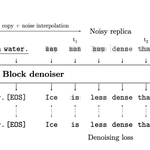
The idea is to have an LLM write the way image generators draw: it still goes left to right, but a chunk at a time, and each chunk starts as random noise that gets refined into real tokens all at once. Everything else works like a normal LLM, which is why they could just convert an existing model instead of training one from scratch.
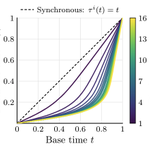
Each token in a chunk gets cleaned up at its own pace, and the model learns those paces itself during training. What it ends up learning is that earlier tokens should come into focus first. Nobody told it to write left to right. It figured that out on its own.
Learning all this also made it a better normal LLM. Compared with the same Qwen model fine-tuned the usual way on the same data and budget, its average score across six benchmarks went up at every size (0.5B: 28.7 → 31.6, 7B: 58.4 → 60.9, 8B: 56.8 → 63.1). The authors think it's a multi-token prediction effect: practicing on whole chunks makes it better at predicting the next token too.
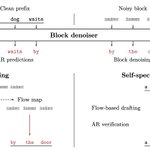
That normal-LLM side is also what makes it fast, because the model can check its own drafts. It takes one quick shot at a whole chunk, then checks it the normal next-token way and keeps everything up to the first token it disagrees with. Since every token gets checked, the output is exactly what it would've written one token at a time (greedy decoding), just faster. With the 7B model on a single H100, that's about 2× faster and a bit more accurate with 4-token chunks, or 2.54× faster at about the same accuracy with 16-token chunks.
For comparison, other speedup tricks they tested, like DeepSeek-style multi-token prediction and MARS, keep the quality but top out at 1.4×. The diffusion LLMs they compared against all lose quality, and lose more the faster you push them.

Chanhyuk Lee retweeted

🚨 New paper alert!
Despite recent advances in reward fine-tuning for diffusion and flow models, achieving high rewards remains challenging without sacrificing sample diversity or substantially drifting away from the pretrained distribution.
We address this with DFR: Distributional Functional Rewards, a framework that balances reward optimization with preserving desirable properties of the generated distribution! 🧵
Chanhyuk Lee retweeted

🔥 Diffusion LMs promise what autoregressive models can’t: fixing their mistakes.
But new ones often change the noise and the sampler at once. Which matters?
We tested it on the hypersphere. Noise: 0.8 points. Sampler: 25.
We introduce Spherical Brownian Diffusion 🌐 👇🧵
Chanhyuk Lee retweeted

"Large Flow Language Models"
What if we could turn existing LLMs into diffusionLMs that generate multiple tokens in parallel without losing accuracy?
So this paper Lafa converts pretrained LLMs into continuous flow language models that generate multiple tokens together by progressively denoising their embeddings. Instead of replacing autoregressive decoding entirely, it uses these parallel predictions as drafts, then verifies them using the same model's original next-token prediction capability.
The researchers scaled Lafa to 8B using fewer than 30B training tokens. At 7B, it achieves up to 2.54x faster generation than a comparable autoregressive model, while maintaining similar accuracy.
alphaxiv.org/abs/2610.28559

Chanhyuk Lee retweeted

Large Flow Language Models
Lafa shows continuous flow models can scale to 8B parameters by adapting pretrained autoregressive models with under 30B tokens, matching autoregressive quality across instruction following, reasoning, and coding benchmarks.
arxivb.org/abs/2610.28559

Chanhyuk Lee retweeted

Another blockwise continuous diffusion language model at 8B scale, adapted from a pretrained autoregressive model, with flow map distillation and self-speculative decoding for faster inference. Cool😎
nitter.cf/chandavidlee/status/21…

Can flow language models scale to billions of parameters and handle real generative tasks?
Introducing 🌊 Lafa (Large flow language model), a flow LM scaled up to 8B that matches AR quality, with 🚀 2.5× AR throughput at 7B.
Co-led with @ArnavChavan6 @UdbhavBamba.
Joint work with @wognsfjq96 @hongseu33 @AdtRaghunathan @jw9730
Chanhyuk Lee retweeted

Hi all, I have a new result I'm excited to share. It turns out that *all existing implementations* of softmax and cross-entropy (that's JAX, PyTorch, textbooks, etc) have a subtle bug --- two bugs, actually. A simple rewrite fixes both, and eliminates "slingshots" when grokking:


Chanhyuk Lee retweeted

Another great work on large-scale continuous diffusion LLMs 👀
Also huge thanks for sharing our work Sigma arxiv.org/abs/2610.02665 in your post! I learned a lot from the insightful discussion with @chandavidlee and @wognsfjq96 during ICLR 2026 on flow language models

Can flow language models scale to billions of parameters and handle real generative tasks?
Introducing 🌊 Lafa (Large flow language model), a flow LM scaled up to 8B that matches AR quality, with 🚀 2.5× AR throughput at 7B.
Co-led with @ArnavChavan6 @UdbhavBamba.
Joint work with @wognsfjq96 @hongseu33 @AdtRaghunathan @jw9730
Chanhyuk Lee retweeted

This is some really great work on training large scale flow based language models.
They show you can adapt an existing autoregressive backbone, like Qwen, and turn it into a non autoregressive flow model.
Can flow language models scale to billions of parameters and handle real generative tasks?
Introducing 🌊 Lafa (Large flow language model), a flow LM scaled up to 8B that matches AR quality, with 🚀 2.5× AR throughput at 7B.
Co-led with @ArnavChavan6 @UdbhavBamba.
Joint work with @wognsfjq96 @hongseu33 @AdtRaghunathan @jw9730
Chanhyuk Lee retweeted

🎊 Excited to give a tutorial on diffusion LLMs at @NeurIPSConf 2026 with @StefanoErmon @JCJesseLai @mittu1204
📆 Mon, Dec 7, 9 AM AEDT
📍 TikTok Ent Centre (Sydney, Australia)
Topics covered:
> A beginner friendly introduction to diffusion-LLMs
> Designing frontier diffusion-LLMs
> Using Continuous diffusion for LLMs
Chanhyuk Lee retweeted

Excited to announce the follow-up to our NeurIPS 2026 Oral: Improved Training of Strong Stochastic Flow Maps!
We improve the training of SSFMs by unlocking derivative-based losses!
Joint work with @antoniofrancaib @rmincam @ChristianKoke @Niklas_TR and @AlexanderTong7
Chanhyuk Lee retweeted

Super excited about this work! 🌊 Lafa takes flow-based LMs to 8B scale with competitive generation quality and faster decoding. Check out our paper!
Can flow language models scale to billions of parameters and handle real generative tasks?
Introducing 🌊 Lafa (Large flow language model), a flow LM scaled up to 8B that matches AR quality, with 🚀 2.5× AR throughput at 7B.
Co-led with @ArnavChavan6 @UdbhavBamba.
Joint work with @wognsfjq96 @hongseu33 @AdtRaghunathan @jw9730
Chanhyuk Lee retweeted

Announcing FlashMap: a new speculative decoding algorithm based on flow maps! >6x faster inference on Qwen3-8B 🧵
Project page: jshen.net/flashmap
arXiv: arxiv.org/abs/2610.24365
w/ @Jay41969851 @_ryantlee @jonathanmay @cosmo_shirley
Chanhyuk Lee retweeted

@chandavidlee did it again!
buried the lede a little bit, 4.9 tok on specdec is sick. the progress in continuous dlms is so rapid right now. fantastic job by the whole team!
Can flow language models scale to billions of parameters and handle real generative tasks?
Introducing 🌊 Lafa (Large flow language model), a flow LM scaled up to 8B that matches AR quality, with 🚀 2.5× AR throughput at 7B.
Co-led with @ArnavChavan6 @UdbhavBamba.
Joint work with @wognsfjq96 @hongseu33 @AdtRaghunathan @jw9730
Chanhyuk Lee retweeted

Check out this post by my amazing co-author @chandavidlee with more details on Lafa!
Can flow language models scale to billions of parameters and handle real generative tasks?
Introducing 🌊 Lafa (Large flow language model), a flow LM scaled up to 8B that matches AR quality, with 🚀 2.5× AR throughput at 7B.
Co-led with @ArnavChavan6 @UdbhavBamba.
Joint work with @wognsfjq96 @hongseu33 @AdtRaghunathan @jw9730
Chanhyuk Lee retweeted

It was inevitable: Large Flow Language Models.
We scale flow LMs to 8B with blockwise flow training, improving pretrained AR via an MTP effect. We use this for self-speculative decoding that verifies flow drafts autoregressively, which is quite fast at batch size one regime.
Can flow language models scale to billions of parameters and handle real generative tasks?
Introducing 🌊 Lafa (Large flow language model), a flow LM scaled up to 8B that matches AR quality, with 🚀 2.5× AR throughput at 7B.
Co-led with @ArnavChavan6 @UdbhavBamba.
Joint work with @wognsfjq96 @hongseu33 @AdtRaghunathan @jw9730
Tagging some people who might be interested:
@sedielem @PatrickPyn35903 @jdeschena @zhihanyang_ @ArashVahdat @ArnaudDoucet1 @iNikitaGushchin @osclsd @FEijkelboom @WeiGuo01 @pengzhangzhi1 @rohit_dilip_ @ssahoo_ @linluqiu @JeongjaeLee0
Also check out this amazing concurrent work, Sigma (arxiv.org/abs/2610.02665) from @zhihanyang_ and @WeiGuo01 ! I'm very excited about the potential of continuous LMs, and we're finally making them work at scale.
Check out also the post about Lafa from @ArnavChavan6 with more details!
