

Developer Advocate Intern at Voiden 👨💻 | API & Developer Tools Enthusiast | Learning, Building & Sharing 🚀 | Simplifying API Workflows with Voiden
Ludhiana, Punjab
Joined October 2026
- Tweets325
- Following401
- Followers47
- Likes578


Running .void files one by one gets old. 😅
Stitch in @VoidenMD :
→ Sequence: Run dependent requests in order; stop on failure.
→ Parallel: Run independent tests together.
Do you share variables between files or keep them isolated?
voiden.md/download
#Voiden #APITesting

Login works. Cart works. Checkout fails.
Each endpoint passes alone. The bug is in the flow.
In @VoidenMD the flow is one .void file. The login token feeds the next steps, and Run All shows the error under the step that broke.
Do you organise requests by endpoint or by flow?

POV: Monday morning 📷
Your AI agent has been calling a broken API since Friday.
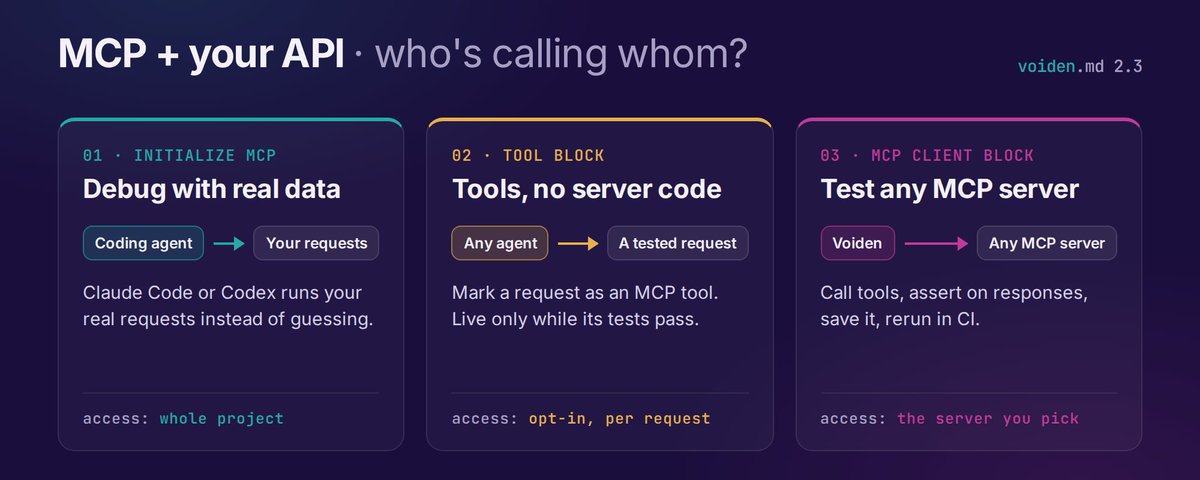
In Voiden, each tool's tests re-run on a cadence: hourly to monthly.
Pass → served
Fail → withdrawn
Keys stay in your env files
Hide failing tools, or flag them?
#MCP voiden.md/download

Tired of API tools forcing cloud dependencies for local work? @VoidenMD goes offline-first.
✓ No accounts
✓ No sync required
✓ Git as source of truth
Your API work, your way. Open source. Opinionated.
#OpenSource #Git #LocalFirst #Voiden
Aryan Bulandi retweeted
Aryan Bulandi retweeted
Everyone tests their REST APIs. Almost nobody tests what happens when a WebSocket drops mid-conversation. 👀
A WebSocket connection stays open, and both sides can send messages at any time. That's what makes it great for chat apps, live dashboards, and multiplayer games.
It's also what makes it weird to test. There's an ongoing conversation happening, and the message you are checking might arrive three messages later, triggered by a completely different user.
So most testing stops at "connect, send, it works." The real bugs live past that point: the reconnect path, two clients talking over each other, handshakes that only break on TLS.
This is why we added WebSocket testing to Voiden early on, as a plugin you install only if you need it. Type /wss in a file, connect, and the whole exchange lives in the same Markdown file as your notes and your other tests, versioned in Git.
The five rules that catch most WebSocket bugs are in the graphic below. Did we miss one?

Aryan Bulandi retweeted
Most developers live in the terminal, so now #Voiden does too. 🥳
Your .void workflows are no longer tied to the app. Run them anywhere: local machines, Docker containers, CI pipelines, or cron jobs.
It’s the same workflows, just headless: request chains, runtime variables, and assertions all execute exactly as they do in the UI.
🔮 Key capabilities:
- Run anywhere: From dev machines to CI runners — .void files become portable execution units.
-Multiple outputs: Human-readable by default, or switch to JSON, CSV reports, or HTML.
- Runtime variables: Just like in the app, the runner keeps a persistent session of runtime variables between requests.
- Core plugins as in the app: scripting, assertions, faker, auth, GraphQL etc.
- REST, WebSocket, gRPC, GraphQL fully supported.
Install once, run anywhere. The Voiden app is where you build API workflows. The CLI is where you automate them.
The Voiden Runner is available with the new beta release and looking for people to try it:
More info : docs.voiden.md/docs/develope…
Download Voiden: voiden.md/download
#developers #apis #cli #testing