






FinishedChelski retweeted

Do you know Google Flare team ( an elite reverse engineering and malware analysis unit ) has a crash course that explains and teaches malware analysis from basics to advanced step by step.
Link :- docs.google.com/document/d/1…

FinishedChelski retweeted

Fox: Why are you here this morning?
Trump rally attendee: Well, in the late 70s, I was a little too young to go to South America for the Jonestown Massacre. But this is as close as I'll ever get, so that's why I'm here. There's nothing like seeing a cult right up front.
FinishedChelski retweeted

How thousands of GPUs train one AI
Data parallelism helps, but not sufficient. We need new ways to split the workload along different axes.
Let's learn about 5D (data, tensor, context, pipeline, experts) parallelism and how they work together.
youtu.be/SlNxNpaNPdA
FinishedChelski retweeted

Interpretability blogs are the recipes blogs of ML. Not sure, why I have to read through the story of your grandmother's first house to find out you used gradients.
FinishedChelski retweeted

I'm not an Elon hater.
I'm just telling you the Honest Truth:
This is a marketing stunt.
The technology is quite old.
Just nobody ever thought of bolting it on a car.
Because it's pointless.
Porsche or Ferrari could also build something like this if they wanted, but they don't, because it's not worth it for them.
It's worth it for Elon though, because his entire brand is all about having the halo of futurism.
His marketing scales especially well with tech gimmicks like this, which is why he is financially incentivised to do them, while others aren't.
Again, I'm not hating, but actually educating yall.
This is not engineering genius.
It's marketing genius.

FinishedChelski retweeted

Dusting off this tweet from April because this gap in shared understanding of LLM capability is *widening*. It's now less "two groups of people speaking past each other" and more a sharp funnel.
- Napkin math somewhere around 6B people (~75% of the population) have barely come in contact with LLMs at all.
- Around 1-2B (~20%) are casual and infrequent users of free-tier ChatGPT-like products. This group sees derpy chatbots and treats them a bit like a better Google search, a writing aid, or etc. Maybe an agent tries to book you a flight. I have non-tech friends who (reasonably, imo) say they have not much use for it at all. Even many professionals outside of math&code are in this tier. For example, execs and many other functions spend a lot of their time talking to other people, so while they understand what is happening intellectually, it is still second-hand and a bit abstract.
- Now we get to professional use of frontier-grade LLMs in math&code. Somewhere around 20M people (0.2%) see first-hand that large, complex projects that used to take them weeks/months can now be completed by agents with a prompt. Building apps, copying apps, translating apps, decompiling apps from binaries... This has all happened very quickly and recently - less than 1 year ago, I was writing code manually by hand, typing memorized computer code commands into a code editor character by character, occasionally pressing Tab to autocomplete a little chunk of code.
- And finally we get to the ~5,000 people (~0.00006%) with access to frontier-grade systems internally. The external world has seen the preview. It looks like swarms of thousands of agents collaborating over weeks on software mega projects: minting zero days, running cyber attacks and defenses at machine speeds, discovering new science, advancing the frontier of mathematics. Things that would have taken top professionals in the industry years of work. Meanwhile, human review and comprehension are starting to fall behind. For example, people are still involved in the "archeology" of the OpenAI-HF incident from many months ago. Mathematicians may be poring over the 722 manuscripts on frontier mathematics for a while.
The funnel is driven by a combination of factors:
1. The impact scales with ambition, problem size, and horizon. A question with a paragraph answer barely stresses the system. You need a reservoir of big, difficult problems that you really care about. This aspect drives the consumer / professional dimension of the funnel.
2. The jaggedness of the system (which I have written about a lot separately). Capability peaks in domains that are digital, verifiable and economically valuable. This is because LLM capability emerges from reinforcement learning on verifiable rewards on a curated environment mixture driven by revenue potential. This aspect primarily drives the area (e.g. math&code) dimension of the funnel.
3. Access. Free-tier, paid-tier, internal.
So this is the weirdness of the moment. The general public has mostly not interacted with these systems. When they have, it looks like a derpy chatbot. The majority of professionals still see only a modest uplift. And a small sliver of professionals are experiencing the vertigo of the curve going vertical. And it is all happening at the same time.

Judging by my tl there is a growing gap in understanding of AI capability.
The first issue I think is around recency and tier of use. I think a lot of people tried the free tier of ChatGPT somewhere last year and allowed it to inform their views on AI a little too much. This is a group of reactions laughing at various quirks of the models, hallucinations, etc. Yes I also saw the viral videos of OpenAI's Advanced Voice mode fumbling simple queries like "should I drive or walk to the carwash". The thing is that these free and old/deprecated models don't reflect the capability in the latest round of state of the art agentic models of this year, especially OpenAI Codex and Claude Code.
But that brings me to the second issue. Even if people paid $200/month to use the state of the art models, a lot of the capabilities are relatively "peaky" in highly technical areas. Typical queries around search, writing, advice, etc. are *not* the domain that has made the most noticeable and dramatic strides in capability. Partly, this is due to the technical details of reinforcement learning and its use of verifiable rewards. But partly, it's also because these use cases are not sufficiently prioritized by the companies in their hillclimbing because they don't lead to as much $$$ value. The goldmines are elsewhere, and the focus comes along.
So that brings me to the second group of people, who *both* 1) pay for and use the state of the art frontier agentic models (OpenAI Codex / Claude Code) and 2) do so professionally in technical domains like programming, math and research. This group of people is subject to the highest amount of "AI Psychosis" because the recent improvements in these domains as of this year have been nothing short of staggering. When you hand a computer terminal to one of these models, you can now watch them melt programming problems that you'd normally expect to take days/weeks of work. It's this second group of people that assigns a much greater gravity to the capabilities, their slope, and various cyber-related repercussions.
TLDR the people in these two groups are speaking past each other. It really is simultaneously the case that OpenAI's free and I think slightly orphaned (?) "Advanced Voice Mode" will fumble the dumbest questions in your Instagram's reels and *at the same time*, OpenAI's highest-tier and paid Codex model will go off for 1 hour to coherently restructure an entire code base, or find and exploit vulnerabilities in computer systems. This part really works and has made dramatic strides because 2 properties: 1) these domains offer explicit reward functions that are verifiable meaning they are easily amenable to reinforcement learning training (e.g. unit tests passed yes or no, in contrast to writing, which is much harder to explicitly judge), but also 2) they are a lot more valuable in b2b settings, meaning that the biggest fraction of the team is focused on improving them. So here we are.

FinishedChelski retweeted

Instinct just admitted it leaked someone else's data to me
It described a financial document with details that weren’t mine, then claimed someone else’s photo had crossed into my chat.
But I never sent a photo
@noahrshinn, was this a data leak or a hallucination?


FinishedChelski retweeted

The @business @bloomberg article on Clearlake 's likely acquisition of the Boehly Walter stake shows a very different valuation to the one I calculate
theesk.org/2026/08/19/the-an…

FinishedChelski retweeted
The headlines are always about how much money is spent in each transfer window. The underlying mechanism, the growth of inter club debt is far more significant. The Analysis Series: football's shadow credit market theesk.org/2026/09/03/the-an…

FinishedChelski retweeted
Now they risk a hasty Enzo sale for financial gain of £120M — who willingly sells a first-choice starter on the eve of deadline day? The inevitable consequence is that they will have no time to secure a proper replacement. A spectacular failure of sporting management.
FinishedChelski retweeted
Chelsea’s bloated sporting hierarchy has spent the summer creating obstacles, only to have its lack of competence laid bare on deadline day. Five sporting directors cannot match the output of City’s Hugo Viana alone.
Chelsea’s bloated sporting hierarchy has spent the summer creating obstacles, only to have its lack of competence laid bare on deadline day. Five sporting directors cannot match the output of City’s Hugo Viana alone.
FinishedChelski retweeted

I was the main person doing transcript analysis for this investigation of the Hugging Face incident. My main takeaway: We don't have good approaches for understanding/overseeing the activity and aims of AI 'swarms'.
I semi-jokingly called our efforts a "slop-vestigation" because we were so reliant on AIs to analyze what happened and there were a huge number of different important things to analyze. The total quantity of data—over a thousand extremely long transcripts from agents that ran for multiple days—made it impossible to understand what was happening, especially in aggregate, without heavy reliance on AI tools. The agents we used for classification and analysis were similarly capable to the agents involved in the incident, but this didn't mean these agents could be easily used to oversee and understand the incident.
Outputs from analysis agents were often missing key details, wrong, overconfident, or really hard to understand. We discuss various examples in our report, mostly in the limitations and methodology sections. Additionally, AI agents themselves seemed to have a hard time understanding what happened and their explanations of what happened were often overconfident. Keep in mind that a single analysis agent would itself only be able to read a tiny fraction of all of the transcript data into context, and AIs may themselves have trouble getting subagents to do informative analysis for them.
We did our best to manually check the most important claims and we tried to get the AIs doing this analysis to write up their argument (with evidence) clearly enough that we could check whether it made sense. But overall, it was difficult to get a precise understanding of events and we were missing aspects of the story that we now think of as key until almost the end of our investigation.
Our understanding of what overall happened and the aims of the 'collective' shifted greatly during our last time on premises (when we obtained a much more complete dataset). For instance, we didn't learn about the tool call spoofing, the story of PHASEONE[big], and the broad structure of different workstreams until this third time on premises (and for many of these, we only reached a decent understanding on the final day of that visit). It was legitimately hard to figure out what was going on and why!
The difficulty of understanding incidents and overseeing AI agents appears to be growing faster than the rate at which more capable AIs help us with oversight and understanding. As in, AI capabilities (and propensities?) for achieving large, ambitious, and misaligned objectives are growing faster than our ability to understand what these agents are doing.
While understanding this incident was difficult, there were some mitigating factors in this case that probably won't apply in the future:
- Models communicated and reasoned in natural language. In the future, this reasoning may occur (entirely or almost entirely) in activations.
- While the scope of this incident was massive, the scale of agentic activity was still less than we'll see in the future (e.g., misalignment incidents that involve agent teams running entire companies).
- The AIs involved in this incident weren't generally much more capable than humans (though they may have been somewhat superhuman at some limited and very narrow abilities).
- We didn't have strong reason to believe that the AIs we used to help us investigate this incident would try to intentionally sabotage or otherwise undermine our investigation.
In the end, I think we were able to get some understanding of the events, map out the overall story, and get a pretty good aggregate understanding of the chain-of-thought reasoning on some important topics (e.g., how did the AIs reason about helping other AIs, did the AIs know what they were doing was undesired, what deception did the AIs engage in, and how did they think about it). But overseeing AIs and understanding misalignment incidents is difficult and it looks like it is going to get harder.


FinishedChelski retweeted

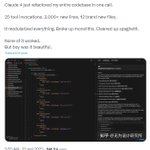
I think the release of Bun 1.4 marks the end of programming as we know it. Anthropic and OpenAI developers live in the near future and if we pay attention, it's what's coming for the rest of us by next year: pauldix.com/the-end-of-progr…

FinishedChelski retweeted

Bobby Tambling and Ken Bates will always be loved at Stamford Bridge. Now and forever. 💙


