

AI excites me
6093 Rd
Joined June 2010
- Tweets9.7K
- Following892
- Followers233
- Likes12.3K


DiCaprio 🥛🚵🪷 retweeted

Agent platform of 2027.
This is the end game. This is the blueprint for the one and only application layer software that will exist. Every other software will effectively become databases for this layer, the everything agentic operating system for the million agent swarm to work on top of.
This is obviously the end game vision for the application layer of ChatGPT and Claude. I have reasons to believe that an independent company will own this product layer. But most ADE, "enterprise agent platform", or vertical saas companies, are focused on the wrong things far too narrowly, not technically competent, and do not have the product / technical vision to see this inevitable future.
The correct agent platform that wins will function like the base of a garden, from which customers will plant their unique "seeds" to grow their own plants and trees, managed and evolved by agents, humans, and signals from the sensors of the business. This presents a clearer picture than "factory of a factory" imo.


DiCaprio 🥛🚵🪷 retweeted

Yes to all of this. As agents take on more and more long running project work, and you have swarms of agents that parallelize work against a goal, the agent harness and architecture for orchestration will have to evolve.
One of the biggest shifts is how those agents collectively share their knowledge, keep track of the tasks, and also coordinate with human users. This in theory is technically straightforward, but there’s a ton of complexity to get right to ensure agents can both get access to the revenant resources without too much or little exposure.
There are a lot of lessons to pull from based on how people already do this kind of work together (people share their files, have computers to work with, community in chats and inboxes, and so on). But equally the primitives need to be able to enable this work at a throughput far higher than people, and in a world where agents can much more easily become a vector of security risk.
Going to be super fun building out this next generation of how agents operate. Lots of opportunity here both for horizontal and vertical specific approaches to bring this to life.

Agent platform of 2027.
This is the end game. This is the blueprint for the one and only application layer software that will exist. Every other software will effectively become databases for this layer, the everything agentic operating system for the million agent swarm to work on top of.
This is obviously the end game vision for the application layer of ChatGPT and Claude. I have reasons to believe that an independent company will own this product layer. But most ADE, "enterprise agent platform", or vertical saas companies, are focused on the wrong things far too narrowly, not technically competent, and do not have the product / technical vision to see this inevitable future.
The correct agent platform that wins will function like the base of a garden, from which customers will plant their unique "seeds" to grow their own plants and trees, managed and evolved by agents, humans, and signals from the sensors of the business. This presents a clearer picture than "factory of a factory" imo.

DiCaprio 🥛🚵🪷 retweeted

This has sped up my AI coding 20x (prompt at the end):
Before building anything with AI, ask Fable 5.2 to ask you as many questions it needs to fully plan out the idea
This is even better than plan mode. Plan mode is typically limited to 3 or 4 questions. This is like a super plan mode and makes Claude Code SO good
This has asked me 100+ questions before. Seems like a lot but actually saves you time in the long run
The plan it builds will be so detailed that it can basically run autonomously and build the entire thing
But here's where you take things to the next level:
You also have it take your entire plan and create detailed Linear/Notion issues for it
It should create 40+ tasks in Linear
Then it's as easy as saying "ok work on the next thing" over and over until the feature is done
Highly recommend downloading and using Linear if you haven't yet. Amazing project management tool w/ excellent free tier
Will basically capture all these details and put your agent on autopilot. It's a 2nd brain.
Use this prompt:
"I want to build out *describe your feature in detail*. Ask as many questions you need of my to fully understand every detail of what I want to build out. Then take everything you learn, and create super focused and detailed Linear issues. Then begin work"
Getting so much more high quality code out with this workflow. You're welcome.


DiCaprio 🥛🚵🪷 retweeted
The most dangerous thing you can do right now is NOT use the latest AI tools. Period.
Every day a new company is laying off thousands of people who don't know how to use the most modern AI tools
If I were in the 9-5 world right now, this is every step I'd take:
1. Talk to Fable 5.2 and do as much REVERSE PROMPTING as you can. Tell it about your life, passions, career, and ask as many questions you can on which projects you can build that can earn you revenue. Choose a project and do step 2:
2. Download Claude Code and build your that project using Opus 5.5. Learn how to implement a front end and database (I’d use nextJS and Convex). AI can teach you all of this
3. Download Grok Bot. REVERSE PROMPT more. Tell it about all your workflows. Ask what automations it can implement that can lighten your cognitive load and get more work done
4. Anytime you're about to do work manually, do it in Grok Bot instead. Tell Grok the task you need to do then ask it how it can do the task for you. You'll be surprised by how much of your work you can automate
5. Constantly look at your limits in all your AI plans. If you're ever not above 50% on your limits, get angry that you're not burning enough tokens.
6. Start creating content and building a platform. Resumes no longer matter. Companies dont look at them anymore. They check your X. They check your Youtube. What you talk about, what you’re passionate about, how you educate others, who follows you. This matters 100x more than anything else when getting hired right now.
If you do these 6 things you are in excellent position to not only be safe in your career, but also dominate those that don't pick up these skills.
DiCaprio 🥛🚵🪷 retweeted

Anthropic just published an engineering guide on how to build always-on agents.
The biggest misconception: an always-on agent does NOT run 24/7. It sleeps almost all day, wakes up for short runs, saves state, and goes back to sleep.
The 5 core pieces I distilled:
1. Event Inbox
Put a database table between webhooks and your agent. Acknowledge webhooks fast, run only one active worker per user so runs never collide, and batch rapid messages together.
2. Timers
Keep timers in a separate table from the inbox. Split them into one-off follow-ups and recurring schedules. A background poller drops due timers into the inbox.
3. Lean Memory + Dreaming
Only store what cannot be looked up again: user instructions, user notes, past messages, and task progress. Load a small index at wakeup, not every file. Run periodic dreaming passes to clean out stale facts.
4. Unattended Permissions
Never put raw API keys inside the agent sandbox — inject them through an outside proxy. Use Deferred Tool Calls to pause risky actions for approval without blocking the worker.
5. Outbox
Queue outgoing replies so your agent paces notifications instead of spamming users at 3 AM.
claude.com/resources/article…


DiCaprio 🥛🚵🪷 retweeted

Palo Alto Networks CEO @nikesharora predicts AI is going to fundamentally change how companies are structured:
“A lot of organizations are structured in silos. You have documentation people, testing people, coding people, product people, UI people. You have 8 different sets of people who combine together to build a product, which makes no sense.”
“The only reason for this [way of working] is because nobody could be amazing at everything.”
“But if you believe that you can harness all this intelligence in a way that one person could master all these 8 crafts because they have very able assistants which will do 90% of the work for them, it fundamentally changes the way we get shit done, the way we build things, the way we do anything in our lives, the way companies are created.”
“The shape of a company will be fundamentally different 5 years from now.”

.@NikeshArora grew Palo Alto Networks from $18 billion to $250+ billion in market value. Before that, he spent 10 years helping grow Google’s revenue from $2 billion to $62 billion.
When he joined Palo Alto, he thought cybersecurity was two words. 8 years and 35 acquisitions later, the company has more than 70 products.
His approach: buy the winning team and put its founder in charge. If a startup beat his team with fewer resources, why make its founder report to the person who lost?
Nikesh explains why he makes founders agree to a product roadmap before signing a deal, why he wanted Google to buy Netflix, and how Egon Durban kept him bidding for a cricket team at 6 in the morning.
0:00 The Oculus deal he almost did with Egon Durban
8:45 "I thought cybersecurity was two words"
11:44 Why he buys instead of builds
14:33 Why the acquired founder becomes the boss
16:21 Why he only buys number one or number two
19:30 The 30-day test before every acquisition
33:38 Egon Durban and the 29-round cricket auction
42:32 Why nothing at work stresses him out
44:28 Selling Google ads without knowing the price
49:42 Coming to America with $200
51:58 Raising kids who didn't grow up poor
54:46 Why AI hacking has been good for Palo Alto
Includes paid partnerships.


DiCaprio 🥛🚵🪷 retweeted

people are sleeping on @Muse Spaces
think of them like dashboards or personal apps, here are ones i've found useful so far:
+ family HUD= weekly schedules for everyone, can tag which parent is handling rides
+ personal health tracker= i log my weight daily, have a goal, and Muse pulls workouts from my connectors
+ content studio= ideas for future videos or write ups based on my interests, what's trending, and the performance of my IG posts
+ content queue= clips and posts waiting for me to schedule or edit. *Bonus on this one if you want to post to Instagram, since Muse has a great native connector


DiCaprio 🥛🚵🪷 retweeted

Introducing Claude Fable 5.2 and Claude Mythos 5.2, designed to tackle the most daunting technical challenges.
They’re capable collaborators on ambitious projects in many fields, and show improvements in areas like coding, reasoning, and vision.
DiCaprio 🥛🚵🪷 retweeted

This is a real paper I wrote on the future of agents. My thesis: Meta is poised to become the company that places agents in the OS of the hardware. Only 4.9% of buyers upgraded for a better camera. The spec sheet is done.

DiCaprio 🥛🚵🪷 retweeted

You can design the entire Muse app just for you. With last week’s launch, you can make a space for anything you care about. And you can rearrange the app’s core navigation to create your perfect app.
Personal software.
I’ve got mine set up to support different personal gears: I have the app orientated around family and golf on the weekends, and work and news during the week. You don’t need to do anything fancy to get this working – just ask your Muse to set things up how you like. You can even ask for the tab bar to be removed, if you prefer.
In this video, you can see one of my spaces which I set up around memories. I wanted a place to reminisce and just asked for a daily grid of my Instagram stories. Simple, but it makes me smile every day.
I remember when we first prototyped this idea of a malleable app back in March. It was one of the most excited I’ve ever been about product development and it remains so.
DiCaprio 🥛🚵🪷 retweeted

At a recent conference, a junior dev asked me WTF to do in this new world. This is the answer.
Kent has always been a good communicator, but this is next level. Cogent, solid advice.

DiCaprio 🥛🚵🪷 retweeted

F*cking genius.
The creator of Claude Code says its work gets 2-3x better when it can check itself.
Set that up with one prompt, and make Claude Code quiz you before you ship.
If you can't explain the code, git won't let you push it.
Here's the build:
step 1 → paste the prompt below into Claude Code on Opus 5.5
step 2 → it adds hooks, so Opus can't finish a task until it shows proof that it works
step 3 → that proof is the exact commands it ran and their output, shown before the summary
step 4 → a fresh reviewer agent says what would have to be true for the change to be wrong
step 5 → Opus lists what it decided for you, like the defaults it picked or the parts it left out
step 6 → you get 5 questions on the change, and only 5 out of 5 unlocks git push
step 7 → every change you reject goes into CLAUDE.md with the reason, so the mistake doesn't come back
step 8 → every Friday it tells you which skill you've stopped using since Opus started doing it for you
Find the full prompt below.
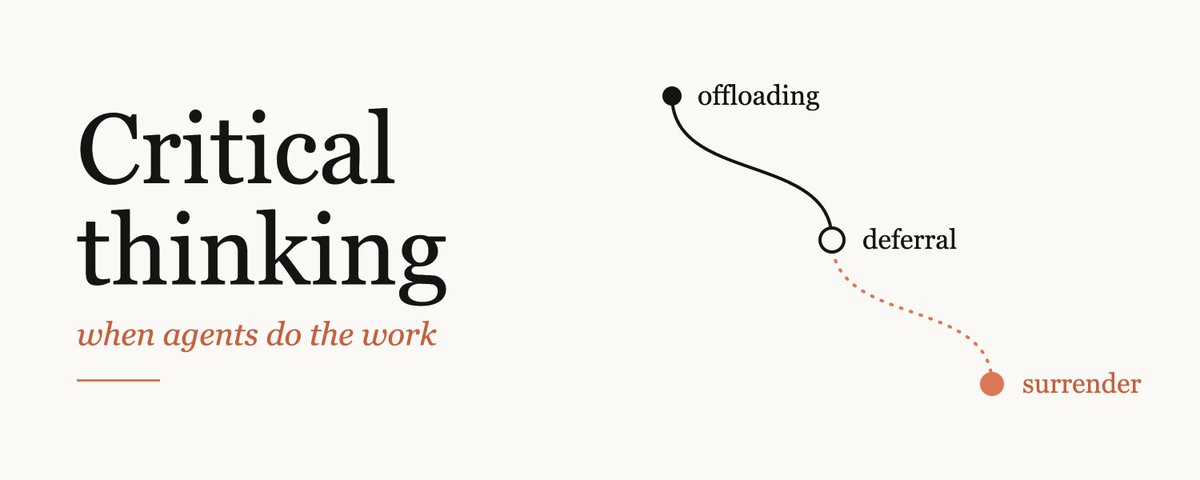
Then read the article below on how to stay sharp when agents write your code.


DiCaprio 🥛🚵🪷 retweeted

Just read @addyosmani's "Critical thinking when agents do the work". Every AI builder should rethink their daily workflow around it. Genuinely grateful for this one.
We turned it into 4 skills for owning what our agents ship:
1. agent-brief: your guess and "verified" first
2. evidence-first-review: output before summary
3. review-capacity-check: before more agents
4. taste-to-checks: fixed twice? make a test
Works in MiniMax Code, Claude Code and Codex.
github.com/MiniMax-AI/mcode-…

DiCaprio 🥛🚵🪷 retweeted

This is biggest reason that I don't feel like I have achieved something despite doing exactly what I am supposed to do. The dopamine boost from a successful build, merged PR, or live feature is nowhere close to what it used to be 2 years ago.
I think I should just go back to solving Codeforces problems in my free time to combat this.
If you're doing anything that makes you think, you're doing just fine but if every day you're just offloading stuff to AI and not thinking, there will be a time when you will lose the ability to think critically.
