

Research: monetary policy expectations, micro- & macro-econometrics, forward guidance. Views my own. @OxfordEconDept @ExeterCollegeOx .
@chrissutherland10.bsky.social
Joined January 2010
- Tweets1.9K
- Following915
- Followers624
- Likes10.7K




Pinned Tweet
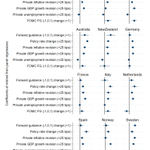
New JAE data available for those working on monetary policy. The panel data includes central bank projections, as well as forward guidance (FG), QE, & ELB periods for the @FedResearch @ecb @BoE_Research @bankofcanada @RBAInfo @ReserveBankofNZ @NorgesBank @riksbanken 1/N
Chris Sutherland retweeted

Suppose rated need to go up by 50bps, but you have a philosophical aversion to forward guidance. Does that mean the usual 25bp then 25bp next meeting doesn't work and you have to just do 50bp all at once?
Chris Sutherland retweeted

Very excited for Thursday's seminar with Vincent Sterk of @EconUCL on optimal monetary policy when inflation hits essentials like food & energy.
📅 Nov 5 · 8am PT / 11am ET / 17:00 CET
A @cepr_org & @sffed series
👉 Register: ow.ly/4Yms50Z2zqW


Join us online for the next session of the Virtual Seminar on Monetary Economics.
Vincent Sterk @EconUCL will present the paper "Optimal Monetary Policy during a Cost-of-Living Crisis".
5 November 2026 | 17:00 CET
🔗 ow.ly/4Yms50Z2zqW

Chris Sutherland retweeted
New paper alert!
New CEPR Discussion Paper - DP21965
Risk Appetite and Monetary Transmission
@michaelbauer_hh @sffed, @MaikSchmeling @goetheuni, @SchrimpfAndreas @BIS_org
ow.ly/tFow50ZPHZX
#CEPR_MEF #CEPR_AP #EconTwitter

Chris Sutherland retweeted
Christensen and Rudebusch have a new paper on "how has r* changed and why". They estimate r* has risen 1ppt since 2020, but that news about AI and fiscal/debt do not explain this increase.
@sffed WP: frbsf.org/research-and-insig…
Brookings writeup & WP: brookings.edu/articles/can-f…


Chris Sutherland retweeted
We're excited to kick off the 2nd year of the VSME this Thursday with a presentation by @SSchmittGrohe!
You can register for the Zoom webinar here: cepr-org.zoom.us/webinar/reg…

Join us online for the next session of the Virtual Seminar on Monetary Economics.
Stephanie Schmitt-Grohe (@Columbia) will present the paper "Central Bank Information or Neo-Fisher Effect?".
3 September 2026 | 17:00 CEST
🔗 ow.ly/4Yms50Z2zqW

Chris Sutherland retweeted

Kevin Warsh wants the Fed to say less. But does he also want it to be less precise? Our new paper takes up exactly how precise the Fed should be. And shows why clearer guidance may not always be better. A short thread on the idea and some evidence. #EconTwitter #FOMC
Chris Sutherland retweeted
Kevin Warsh says he wants to see "direct" and "unfiltered" signals from markets. This is a rationale he gives for offering less guidance about future policy actions than his predecessors. He says that, as a consequence, markets have started to “play the ball, not the referee”. He points to the increase in bond yields over the past 6 weeks as a useful direct and unfiltered signal from markets.
I find this confusing. Bond yields are fundamentally tied to expectations about future short rates. The Fed controls the short rate. So, bond yields are fundamentally governed by market expectations about what the Fed will do going forward.
In this sense, I don’t understand what direct and unfiltered signals from markets mean.
Perhaps it means the bond market’s current understanding of the Fed’s reaction function (in addition to expectations about fundamentals). But why would the Fed be interested in observing this in a direct and unfiltered manner?
When Warsh speaks, it sounds like he thinks he is learning something else. But this is what I don’t understand. What does he think he is learning from the direct and unfiltered signals?
It is quite likely that markets don’t have a completely correct view of the Fed’s reaction function. Especially in this case, the rationale for speaking less and observing direct and unfiltered signals from markets seems problematic.
Chris Sutherland retweeted

Curious to learn everyone's wisdom:
If you teach core econ PhD classes (especially econometrics), how are you adapting to the use of AI by the students?
- Problem set content & structure (for both theory and coding)?
- Assessment/grading?
- Lecture structure?
- AI use policy? Etc
Chris Sutherland retweeted

Come join @mcmahonecon and me for a week of learning about Applied Monetary Economics in Oxford this September! 🤩
The @OxfordEconDept Summer Schools run from 7-11 Sep and there’s so much on offer!
👇
economics.ox.ac.uk/september…
✉️
[email protected]

Chris Sutherland retweeted
After the June FOMC meeting, both statement/SEP and press conference led to significant intraday increases in interest rates. Our USMPD is updated after every meeting and reports changes in these rates and various other instruments. frbsf.org/research-and-insig…

Chris Sutherland retweeted

Are your shocks exogenous? 🤔
An updated “Causality versus Serial Correlation: an Asymmetric Portmanteau Test” is now out: arxiv.org/abs/2606.07715
A package implementing the test will be available soon.
Stay exogenous, stay tuned!
#EconTwitter #Econometrics #TimeSeries

Chris Sutherland retweeted

📢 The call for papers for the 12th BdF-BoE-BdI International Macro Workshop just dropped!
This year's theme: "New Risks in International Macro and Finance" 🌍⚖️🛢️🤖💵
Make sure to send us your papers by 28 June👇

📢 Excited to share the Call for Papers for the 12th BdF-BoE-BdI International Macro Workshop 📢
🌟 Keynote: Oleg Itskhoki @itskhoki
🗓️ Date: 13 Nov 2026
⏳ Deadline: 28 June
Details & submission: bankofengland.co.uk/events/2…
@RicDegasperi
@marco_pinchetti

Chris Sutherland retweeted

A great conference by top central banks, and a wonderful team of organisers!
📢 Excited to share the Call for Papers for the 12th BdF-BoE-BdI International Macro Workshop 📢
🌟 Keynote: Oleg Itskhoki @itskhoki
🗓️ Date: 13 Nov 2026
⏳ Deadline: 28 June
Details & submission: bankofengland.co.uk/events/2…
@RicDegasperi
@marco_pinchetti
"UK monetary policy surprises are relatively large and getting larger" ft.com/content/60c8a265-4252… @JoelSuss @FT which references the @_SiLviA_mA paper bankofengland.co.uk/-/media/…
2
124
Chris Sutherland retweeted

One day, mathematician Shizuo Kakutani was teaching a class at Yale University.
During the lecture, he wrote a lemma on the blackboard and told the students that its proof was obvious.
A student hesitantly raised his hand and said that the proof was not obvious to him. He politely asked if Professor Kakutani could explain it.
Kakutani paused for a moment and tried to think through the argument. After a while, he realized something surprising—he could not immediately prove the lemma himself.
Smiling a little awkwardly, he apologized to the class and said he would return with the proof in the next lecture.
After the class ended, Kakutani went straight to his office and began working on it.
He spent a long time trying different ideas, but the proof would not come. The problem kept bothering him.
Eventually, he decided to search the library for the original source of the lemma.
After some effort, he finally located the paper where the lemma first appeared. The statement was written clearly.
Then he looked at the proof.
Instead of a detailed explanation, it simply said: “Exercise for the reader.”
At that moment, Kakutani realized something amusing—the paper had been written years earlier… by himself.
It was a gentle reminder that even great mathematicians sometimes forget the details of their own work.

Chris Sutherland retweeted

I took a UCLA class on causal inference taught by @yudapearl more than 10 years ago. Recently together with my co-author Egor we applied causal DAGs to persuasion. I believe it is worth a read: causality.pdf share.google/XFwcoxZMdlHmiEl…
Chris Sutherland retweeted

Uniform asymptotic theory for local projections with unknown/infinite lag order. LPs can achieve semiparametric efficiency and support robust IRF inference.
New paper by Xu:
restud.com/local-projection-…
#REStud
#EconX
#EconTwitter

Chris Sutherland retweeted

An MIT professor taught the same math course for 62 years, and the day he retired, students from every country on earth showed up online to watch him give his final lecture.
I opened the playlist at 2am and ended up watching three of them back to back.
His name is Gilbert Strang. The course is MIT 18.06 Linear Algebra.
Every machine learning engineer, every data scientist, every quant, every self-taught programmer who actually understands how AI works learned the math from this one man. Most of them never set foot on MIT's campus. They just opened a free playlist on YouTube and let him teach.
Here's the story almost nobody tells you.
Strang joined the MIT math faculty in 1962. He retired in 2023. That is 61 years of standing at the same chalkboard teaching the same subject to 18-year-olds.
The interesting part is what he did when MIT launched OpenCourseWare in 2002. Most professors were skeptical. They worried that putting their lectures online would make their classrooms irrelevant. Strang did not hesitate. He said his life's mission was to open mathematics to students everywhere. He filmed every lecture and gave it away.
The decision quietly changed how the world learns math.
For decades linear algebra was taught the wrong way. Professors started with abstract vector spaces and proofs about field axioms. Students drowned in the abstraction. Most never recovered. They walked out believing they were bad at math when they had simply been taught in an order that nobody's brain is built to absorb.
Strang inverted the entire curriculum.
He started with matrix multiplication. Something you can write down on paper. Something you can compute by hand. Something you can see. Then he showed his students that everything else in linear algebra eigenvectors, singular value decomposition, orthogonality, the four fundamental subspaces was just a different lens for understanding what the matrix was actually doing under the hood.
His rule was strict. If a student could not explain a concept using a concrete 3 by 3 example, that student did not actually understand the concept yet. The abstraction was supposed to come last, not first. The intuition was the foundation. The proofs were just confirmation that the intuition was correct.
The second thing Strang changed was the classroom itself. He said please and thank you to his students. Every single lecture. He paused mid-derivation to ask "am I OK?" to check if anyone was lost. He never used the word "obviously" or "trivially" because he knew exactly what those words do to a student who is one step behind. He treated 19-year-olds learning math for the first time the way he treated his own colleagues. With patience. With respect. With the assumption that they belonged in the room.
For 62 years.
The result is something that has never happened in the history of education. A single math professor became the default teacher of his subject for the entire planet.
Universities in India, China, Brazil, Nigeria, every country with a computer science department, started telling their own students to just watch Strang's lectures. The University of Illinois revised its linear algebra course to do almost no in-person lecturing. The reason was honest. The professor said they could not compete with the videos.
His final lecture was in May 2023.
The auditorium was packed with students who had never met him before. He walked to the chalkboard, taught for an hour, and at the end the entire room stood and applauded. He looked confused for a moment, like he genuinely did not understand why they were cheering. Then he smiled and waved them off and walked out.
His written comment under the YouTube video of that final lecture was four sentences long. He said teaching had been a wonderful life. He said he was grateful to everyone who saw the importance of linear algebra. He said the movement of teaching it well would continue because it was right.
That was it. No book promotion. No farewell speech. No legacy management.
The man whose teaching is the foundation of modern AI just thanked the audience and went home.
20 million views. Zero ego. The entire engine of the AI revolution sits on top of math that millions of people learned for free from one quiet professor in Cambridge.
The course is still on MIT OpenCourseWare. Every lecture, every problem set, every exam, every solution. Free.
The most important math course of the 21st century is sitting one click away from you. Most people will never open it.


Chris Sutherland retweeted
📢We're launching the Policy Calibration Tool based on Barnichon & Mester 2023. Basic idea: Given forecasts of inflation and unemployment, and your weight of price stability vs. employment, what is the optimal policy rate path? Check out! CMR website: sffed.us/CMR


The San Francisco Fed’s Center for Monetary Research just released a new tool that lets users calibrate the hypothetical monetary policy rate path based on their own views of the economy and interpretation of the dual mandate. frbsf.org/research-and-insig…
