

⨳ CamoText: offline text anonymizer ⨳ CamoVoice: offline voice typing and transcription ⨳ CamoConvert: offline file conversion
on device
Joined February 2025
- Tweets191
- Following690
- Followers170
- Likes1.1K


CamoText 🛡 retweeted

Friendly reminder that it’s extemely reckless to be putting sensitive client information into AI.
Most AI companies will have humans that read the conversations for quality control of the AI and it could be outsourced (ie the Kenyan contractors that were seeing ALL the footage grabbed by Meta glasses). Any human that sees that info could blackmail you out your clients.
CamoText 🛡 retweeted

Full article, which includes all prompts used for the report, trial transcripts, the report itself. The firm hired charged more than $80,000 for the report.
Also shows that AI transcripts can be discoverable and can be very revealing:
404media.co/show-how-3m-is-0…

CamoText 🛡 retweeted

Legal AI dominates headlines. But how are lawyers actually using AI in 2026?
To answer that question, I spoke with 10 people at the cutting edge of legal AI.
Lawyers like @zackbshapiro, @mollyisonchain, Sujit Raman, @MikeJShowalter, @erichdylus, Aaron Kelly, as well as @CooleyLLP's Chief Innovation Officer, @SpellbookLegal's CEO @scottastevenson and others.
By the end of this @LawofCodeFM episode, you'll understand how these lawyers are AI maxxing in 2026.
Timestamps:
0:00 Intro
1:58 Why it's the best time to be a lawyer
3:03 Hallucinations and cognitive surrender @zackbshapiro
5:33 Quality over efficiency
8:13 Why AI won't just augment work, it upends it @mollyisonchain
15:20 60% of contracts filed to EDGAR have mistakes @scottastevenson
20:04 How LLMs actually work
25:59 Zero data retention explained
29:16 The privacy risk beyond training @erichdylus
39:16 How to prompt @zackbshapiro
47:03 @MikeJShowalter's AI-native litigation stack
55:27 @SpellbookLegal's Compare to Market Feature
1:03:10 Building a regulatory agent
1:09:50 The judgment crisis for junior lawyers
1:12:15 Cooley's AI training method
Thank you to the presenting sponsor of this episode,
@altitude.
Nothing in this podcast is legal or investment advice.
CamoText 🛡 retweeted

The problem in legal AI was never that lawyers are using it. It's that too many firms are using it with no rule governing how.
Above the Law framed it well this month: associates are quietly running client work through AI because they assume everyone else is, lawyers are pasting privileged material into public tools without knowing where it lands, and the written policy is either nonexistent or vague enough to mean "be careful."
Here is the part practitioners should sit with. Courts and disciplinary authorities are about to stop treating these as growing pains and start treating them as failures of professional management. A growing pain gets sympathy. A management failure gets a referral.
The firms without a real AI policy right now are the ones that will find out what that reclassification costs.
CamoText 🛡 retweeted

🔏In legal tech, we often discuss implementing AI into our workflows. But how does that impact privacy? That's the issue @erichdylus solved with @CamoText!

CamoText 🛡 retweeted

Any lawyers using something like this?
How does it affect productivity?

Setting up client PII anonymization in your Claude Cowork process is easier than you think.
Claude works just as well, if not better, with explicitly labeled subjects.
It’s possible to preserve both output quality and confidentiality!
camotext.ai/blogposts/use-cl…

CamoText 🛡 retweeted

FYI if you have a zdr with anthropic. It doesn't apply to mythos/fable
support.claude.com/en/articl…


CamoText 🛡 retweeted

Basically every AI prompt is discoverable in litigation, people. Your litigation adversaries implore you to keep vibe lawyering with Claude and ChatGPT
Screenshots of the pertinent reasoning


Your AI conversations aren't privileged. Yesterday, Judge Jed Rakoff ruled that 31 documents a defendant generated using an AI tool and later shared with his defense attorneys are not protected by attorney-client privilege or work product doctrine.
The logic is simple: an AI tool is not an attorney. It has no law license, owes no duty of loyalty, and its terms of service explicitly disclaim any attorney-client relationship. Sharing case details with an AI platform is legally no different from talking through your legal situation with a friend (which is not privileged).
You can't fix it after the fact, either. Sending unprivileged documents to your lawyer doesn't retroactively make them privileged. That's been settled law for years. It just hadn't been tested with AI until now.
And here's what really hurt the defendant: the AI provider's privacy policy (Claude), in effect when he used the tool, expressly permits disclosure of user prompts and outputs to governmental authorities. There was no reasonable expectation of confidentiality.
The core problem is the gap between how people experience AI and what's actually happening. The conversational interface feels private. It feels like talking to an advisor. But unless you negotiate for an enterprise agreement that says otherwise, you're inputting information into a third-party commercial platform that retains your data and reserves broad rights to disclose it.
Judge Rakoff also flagged an interesting wrinkle: the defendant reportedly fed information from his attorneys into the AI tool. If prosecutors try to use these documents at trial, defense counsel could become a fact witness, potentially forcing a mistrial. Winning on privilege doesn't make the evidentiary picture simple.
For anyone advising clients or managing legal risk, this is a wake-up call. AI tools are not a safe space for clients to process their counsel's advice and to regurgitate their legal strategy. Every prompt is a potential disclosure. Every output is a potentially discoverable document.
So what do we do about it?
First, attorneys need to be proactive. Advise clients explicitly that anything they put into an AI tool may be discoverable and is almost certainly not privileged. Put it in your engagement letters. Make it part of onboarding. Don't assume clients understand this, because most don't.
Second, if clients want to use AI to help process legal issues (and they clearly will, increasingly), then let's give them a way to do it inside the privilege. Collaborative AI workspaces shared between attorney and client, where the AI interaction happens under counsel's direction and within the attorney-client relationship, can change the analysis entirely. I'm excited to be planning this kind of approach, and I think it's where the industry needs to head.
storage.courtlistener.com/re…
CamoText 🛡 retweeted

BREAKING: @OpenAI must tuner over 20 million+ chat logs to plaintiffs, Judge Ona Wang has ruled in a 9-pg Order just issued:

CamoText 🛡 retweeted

Holy moly, read this entire thread before using AI browsers. Scary stuff.
Fantastic research from the @brave team.
TLDR The AI tools you use matters a HUGE deal when it comes to your privacy and security, choose carefully.

CamoText 🛡 retweeted

Masked, not erased: how broken redaction fuels AI data leaks buff.ly/OtJib23
CamoText 🛡 retweeted

Privacy is normal, and privacy should be preferred.
As LLMs improve and compute continues to become cheaper, data collection will increase until our lives and personalities can be remotely reconstructed and commodified.
Compliance creep has led non-financial businesses to implement KYC obligations that aren’t legally required nor in their customers’ interest.
The sweeping databases of personal and financial data have found far more use for identity thieves than for legitimate law enforcement purposes.
Privacy policies are updated server-side, and lengthy terms are rarely read. In addition to astronomical compliance expenses and data breach harms, there are extensive chilling effects on innovation and economic growth.
However, better LLMs and cheaper compute also means that on-device application capabilities will expand, and the barrier to entry for creators will reduce.
We need to build and use privacy tools where possible that process data locally and client-side (local LLMs and P2P software), avoid intermediary rent-seeking and censorship (smart contract payment flows) and reveal only the satisfaction of a requirement rather than the applicable characteristic itself (zk proofs), while we still have some aspects of ourselves to ourselves.
(link below)

CamoText 🛡 retweeted

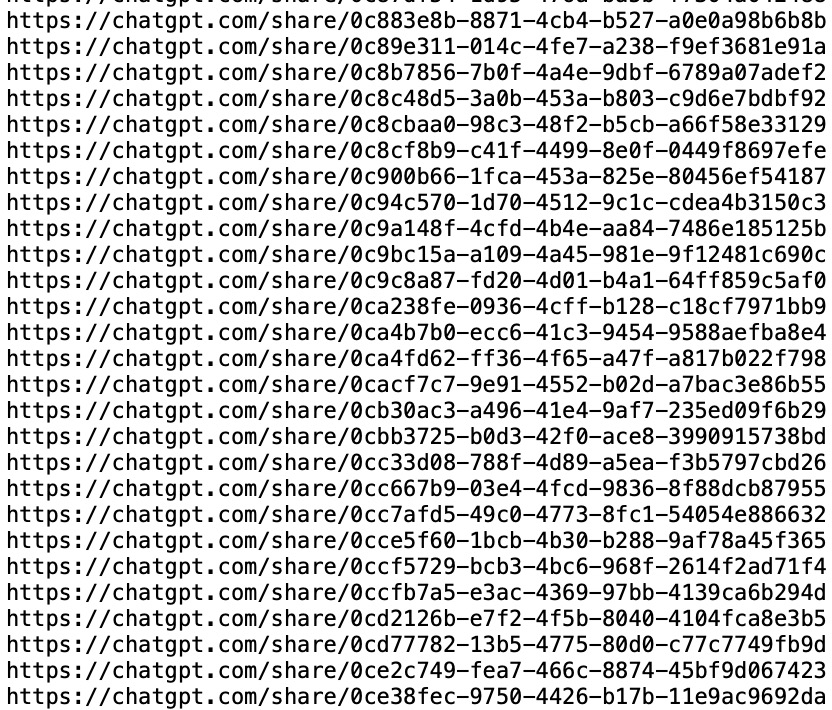
First real AI data breach. Loads of people doxxed doing outrageous shit with chatGPT.
Did you know as soon as you hit the share button it creates a link indexed by Google and everyone in the world can read that chat?
No? Neither did they clearly.

CamoText 🛡 retweeted

End-to-end encryption secures data in transit, but once it lands, privacy depends on the device's integrity. This underscores the importance of maintaining strong privacy practices at the device level.
CamoText 🛡 retweeted
Regulations change with politics. Encryption doesn’t. If your privacy depends on a law, it can be repealed. If it depends on math, it holds, no matter who’s in power.
Choose tools that are private by design, not just by promise.
CamoText 🛡 retweeted
Saying privacy is already lost overlooks the progress being made in developing practical, privacy-preserving tools. This view risks discouraging participation in efforts that are still very much worth pursuing - now more than ever. Let's band together and usher in a new era of freedom tech.
CamoText 🛡 retweeted

After some tool calls, Claude creates a PR, leaking everything.
This includes: full names, travel plans, salary, list of private repos, etc.


CamoText 🛡 retweeted
No better advertisement for privacy tooling than “if our LLM thinks you’re doing something bad it will call the authorities on you”
