

Instructor at Johns Hopkins University (@HopkinsMedicine), Associate Researcher at Uppsala University (@HumanEvoUU), and Editorial Board Member at @CommsBio.
Washington DC
Joined June 2016
- Tweets2.5K
- Following1.2K
- Followers1.2K
- Likes9.3K






Pinned Tweet
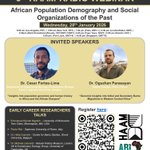
Very proud of my talk about genomic diversity in #Africa at the
#HumanEvo25. Kudos to the Scientific Committee for their impressive work this week at the @sangerinstitute, UK. 👏🏽👏🏽👏🏽

Cesar Fortes-Lima retweeted

There is a point to be made....that objective measures of stone tool variability are a lot more informative than a focus on (largely imaginary 'industries')....except the Aterian, we like that one :D Well done Timbrell et al., sciencedirect.com/science/ar…

Cesar Fortes-Lima retweeted

Book your tickets!!
The @RoyalAnthro Huxley Lecture by Rob Foley on November 30 2026 @ 5:30 am - 7:30 pm at the Linean Society 😍🤩!!
therai.org.uk/events/the-roy…
Cesar Fortes-Lima retweeted

New preprint from @oguzparasayan looks at the origins of Bantu peoples and sequences four historical (~700BP) Congolese genomes. One interesting finding is a population contraction in both Bantu groups and hunter Gatherers ~1500 BP.
Read it here:
biorxiv.org/content/10.64898…


Cesar Fortes-Lima retweeted


Climate records show when Arabia turned green. Our new @Nature paper asks what else MP humans needed, stones for lithic tools. Using the Rub' al Khali as a case study, with years of work in southern Arabia, we show people settled where water and stone met.
nature.com/articles/s41586-0…

Cesar Fortes-Lima retweeted

Happy Tuesday!
We would like to congratulate Professors Marlize Lombard, Justin Bradfield, Peter Gärdenfors, Carina Schlebusch, Mattias Jakobsson, and Justin Pargeter on their inclusion in the Stanford/Elsevier Top 2% Scientists list! 📷
@go2uj
@UjHumanities

Cesar Fortes-Lima retweeted

Through decades of scientific innovation & service, Aravinda Chakravarti, PhD, has helped build the foundation for today's genomics era. Today at #ASHG26, we honor this scientist, leader, & champion of collaboration who has shaped some of the field's most influential initiatives.

Cesar Fortes-Lima retweeted

The arrival of the Suebi, Alans and Visigoths did not erase the deep genetic legacy of Roman Hispania🧬
📕A study led by the @IBE_Barcelona, the @museuciencies, the @Harvard and the EHU has reconstructed the genetic history of the Iberian Peninsula.
👉tinyurl.com/5698y2k6

ALT Graphic summary of the study. Credit: Cell, Carrión et al.
Many congratulations @EsohKevin and team for releasing a new Python-based tool for multi-track circular and linear Manhattan plotting. 👏🏽👏🏽👏🏽👏🏽
Publication: doi.org/10.1093/bioadv/vbag2…
Tutorial: pycmplot.readthedocs.io

Cesar Fortes-Lima retweeted

When our ancestors left Africa and spread across the world, they carried not only their genes but also thousands of microorganisms living in their gut. 🧬🦠
A new @Nature study explored whether the evolutionary history of gut bacteria follows human migrations.
Researchers compared the gut microbiomes of the Hadza hunter-gatherers from Tanzania and the Tsimane farmers and hunter-gatherers from Bolivia.
Surprisingly, 87% of microbial species were shared between these populations. Many of these bacteria are now extremely rare in industrialized societies, suggesting that we may be losing part of our ancient microbial heritage. Whether this affects our health remains unknown.
But the most fascinating result came from comparing bacterial genomes. Despite sharing the same species, their bacterial strains were genetically distinct.
Using bacterial recombination patterns and population genetic modeling, researchers estimated that these bacterial populations became isolated around 17,000 years ago. Remarkably, this roughly matches the period when humans first settled the Americas.
A beautiful example of how ancient human migrations left traces not only in our DNA but also in the genomes of bacteria living inside us.
nature.com/articles/s41586-0…
#microbiome #gut #evolution

Cesar Fortes-Lima retweeted

If interested in applying our algorithms yourself, use our fast, user-friendly package snputils!
snputils.org/
(biorxiv.org/content/10.64898…)
Also see our recent 2026 papers,
Gnomix (most accurate local ancestry inference on the market!)
nature.com/articles/s41467-0…
Adamixture (fastest unsupervised genetic clustering!)
academic.oup.com/bioinformat…
ARGformer (PCA/umap for args!)
academic.oup.com/bioinformat…
ARGMix (graph transformers now allowing ancient local ancestry inference!)
biorxiv.org/content/10.64898…
And our github for more techniques!
github.com/ai-sandbox
Cesar Fortes-Lima retweeted
This is esp. interesting in light of our Nature 2020 paper showing Native American - Polynesian contact in the same Middle Age period out of this remote region (nature.com/articles/s41586-0…).

Cesar Fortes-Lima retweeted
Here are the key figures for that. We think an ultra-voyaging culture originated out of remote French Polynesia (Mangareva) and settled both Easter Island (cool far south Pacific) and Hawaii (only Polynesian island in the northern hemisphere) with related individuals settling both far-flung places.

Cesar Fortes-Lima retweeted
My group's paper out on the cover of Science!
Native Hawaiians are most closely related to the Rapanui of distant Easter Island 😮
Proud of it my students, the two co-first authors Cole Shanks & former MS student @edwardhuangc, and 3rd author @chrisoutho.
science.org/eprint/4HAYG3KTP…

Cesar Fortes-Lima retweeted
#NewProfilePicture 👋🏽😀
After a few months, I finally recovered my account and I'm back on Twitter now. I'll be posting things about science and culture again.
Cesar Fortes-Lima retweeted
I'm thrilled to be the Guest Editor of the new @NaturePortfolio Collection on "𝙃𝙪𝙢𝙖𝙣 𝘼𝙙𝙢𝙞𝙭𝙩𝙪𝙧𝙚 𝙖𝙣𝙙 𝙈𝙞𝙜𝙧𝙖𝙩𝙞𝙤𝙣". This cross-journal collection includes publications in @CommsBio, @SciReports, @NatureComms & @NatureGenet.
+Info here:
communities.springernature.c…
Cesar Fortes-Lima retweeted

🎓 Big day at the @genomicstartu : our colleague @KaiTatte is defending her PhD— agnst @AnnaSapfo.
Defenses are high-pressure, but she’s handling it with courage and focus.
Rooting for you, Kai—make us proud! 💪
🇪🇪 #PhDDefense @unitartu @researchestonia #AcademicTwitter #popgen – at Tartu, Eesti

#Review
𝙂𝙚𝙣𝙤𝙢𝙞𝙘 𝙞𝙣𝙨𝙞𝙜𝙝𝙩𝙨 𝙞𝙣𝙩𝙤 𝙣𝙖𝙩𝙪𝙧𝙖𝙡 𝙨𝙚𝙡𝙚𝙘𝙩𝙞𝙤𝙣 𝙞𝙣 𝙧𝙚𝙘𝙚𝙣𝙩 𝙝𝙪𝙢𝙖𝙣 𝙝𝙞𝙨𝙩𝙤𝙧𝙮.
Skoglund, P. and Mathieson, I. Nat Rev Genet (2026).
doi.org/10.1038/s41576-026-0…

New paper out in @iScience_CP about an enigmatic minority social group from the Iberian Peninsula. A great collaboration with Alicia Portela, Antonio González, and the team.
"Genome-wide evidence for the local ancestry of the Agotes from Navarra, Spain".
cell.com/iscience/fulltext/S…

I'm thrilled to be the Guest Editor of the new @NaturePortfolio Collection on "𝙃𝙪𝙢𝙖𝙣 𝘼𝙙𝙢𝙞𝙭𝙩𝙪𝙧𝙚 𝙖𝙣𝙙 𝙈𝙞𝙜𝙧𝙖𝙩𝙞𝙤𝙣". This cross-journal collection includes publications in @CommsBio, @SciReports, @NatureComms & @NatureGenet.
+Info here:
communities.springernature.c…
