

Brain has 47 tabs open. Built different.. mostly by football and unresolved FF7 trauma.
Midgar
Joined August 2021
- Tweets796
- Following492
- Followers1.7K
- Likes3.1K





Pinned Tweet
When you follow $SIVE closely over time, one thing that stands out is how many parallel tracks the company is advancing simultaneously. It rarely feels like a story built around a single product or market. Instead, it is a platform company where the same core photonics technology is applied across large and growing domains.
One update that highlighted this breadth came on March 11, 2026, when $SIVE announced that a strategic LiDAR customer had chosen to integrate its photonics technology across all platforms. Production ramp is scheduled to begin in Q4 2026, targeting automotive and industrial applications.
This is not a limited component agreement. $SIVE is supplying high-power continuous wave DFB laser diode arrays together with optical amplifiers integrated throughout the customer’s portfolio. Estimated cumulative lifetime revenue potential is $53–138 million, based on known volumes today, with clear upside as the customer scales.
All indications point to this customer being $AEVA. Their 4D FMCW LiDAR technology, used in Atlas and X1, is engineered for long range, precise velocity measurement, and high resolution — capabilities required for real-world autonomous systems where safety and reliability are critical. $SIVE’s lasers help enable that performance, and their implementation across all platforms demonstrates the strength of $SIVE’s III-V photonics platform.
It is worth stepping back and reflecting on what this means. The same technology stack powering highly efficient 1.6T transceivers with Jabil for AI data center infrastructure is now also finding its way into LiDAR sensors for trucks, passenger vehicles, robotics, and industrial automation. This ability to leverage one core competence across end-markets is one of the most compelling aspects of the $SIVE investment case. It lowers development risk, creates multiple growth engines, and allows ramps to mature at their own pace.
$AEVA already has notable commercial momentum. They are integrated into $NVDA DRIVE Hyperion with volume production targeted for 2028 and have a partnership with Daimler Truck. As more OEMs, fleet operators, and robotics companies adopt similar LiDAR solutions, each new design win or deployment can drive higher shipment volumes. Automotive platforms often run for 8–10 years or longer, while industrial and robotics applications can create more stable long-term revenue streams. That gives $SIVE substantial room to grow beyond today’s base-case estimate.
In the current market discussion, much focus is understandably on nearer-term opportunities — FWA and mmWave with Tachyon, or SATCOM progress through ALL.SPACE and $YSS. Those areas are important and may generate revenue momentum earlier. But the LiDAR ramp is a meaningful and underappreciated building block for 2027 and beyond. It does not begin as a small proof-of-concept. It starts with a strategic customer embedding $SIVE technology deeply from the beginning.
This kind of multi-domain execution is what gives $SIVE its resilience and long-term potential. Photonics is the common thread connecting AI infrastructure (CPO), wireless connectivity (mmWave/FWA), satellite communications, and autonomous perception systems (LiDAR). With a reported pipeline exceeding $453 million and several parallel ramps in different stages of maturity, the company is not overly dependent on any single market or customer.
The LiDAR opportunity still feels underappreciated. It may not dominate the daily discussion, but it starts contributing real production volumes already in Q4 this year. And as $AEVA expands in automotive and industrial markets, $SIVE’s participation across all platforms positions the company to capture a growing share of that opportunity.
It is a reminder of why the longer-term thesis around $SIVE remains compelling: a specialized photonics capability that can scale across multiple high-growth verticals, creating revenue streams with significant long-term compounding potential.

ItsSmacky retweeted

I found the technical discussion helpful, but investor messaging to be way too conservative.
If you look at how $NVDA CEO describes CPO, Jensen states scale up is increasing optical volumes by 15x. $LITE and $COHR are quantifying that by describing $5-$20B agreements spanning 3-5 years out.
Having this question, and not talking about Ayar, O-Net, Poet, or ELS partnerships. Then redirecting the question to near term pluggables seems off.
The vision also needs work, “communications and sensing” semi company is very unexciting.
It’s technically true, but there’s no vision being communicated on being the next $40B optical giant or what Sivers is going to be in the next 5 years that would attract long term holders.
The core valuation Sivers gets is from optical opportunities, I also personally disagree that it’s helpful to loop back to former cellular relationships when talking about future $GFS volumes
I disagree when you portray the company as “small” when Sivers 100m CW DFB capacity is coming online, alongside large foundry partners.
Which is a material % of the world’s annual laser capacity.
Investors want to hear about future economic opportunities and how you fill the gap with more qualifications during a bottleneck.
Sivers has a tremendous opportunity for CPO/NPO/Pluggables but I’m afraid it’s not being communicated properly.
It’s understandable here since EETimes is more technical oriented, but I hope this messaging gets communicated better in the next earnings call.
ItsSmacky retweeted

$SIVE at 20 SEK is one of the most asymmetric setup I see in photonics right now.
The InP laser bottleneck thesis, with rising demand and rising ASPs, looks like a really good opportunity for investors.
The company raised ~$85M this year, including a multiple-times oversubscribed SEK 700M round in July at SEK 57 per share. Institutions paid nearly 3x today’s price.
With the US listing coming in 2027 (probably early H1), they could get a lot more liquidity from US markets. That’s clearly been the missing piece. Otherwise how does the street ignore Morgan Stanley naming them alongside Lumentum and Coherent in CPO laser supply, and Goldman seeing the AI optical networking TAM growing ~9x to $154B in about two years?
Good thing is there’s still time. The listing lines up with when the major ramps begin, according to their CEO. That should bring in a lot more institutional ownership from major funds. I think it’s inevitable.
On customers, the mapping has been done across the AI data center supply chain, through hyperscaler programs and the $AMD / $NVDA ecosystem, with GlobalFoundries, Ayar Labs, Jabil and POET as the four major AI partners today. On top of that they have wireless, defense, LiDAR and biosensing, which is great diversification.
Demand is clearly there. $LITE, $COHR and $CIEN all said on their latest calls that demand exceeds supply. Transceiver roadmaps are going past 3.2T, NPO is still to come, and CPO probably lands in 2028 (or 2029). Compute got a lot better over the years, but networking and memory didn’t keep up, and that’s the gap.
So it’s on them to get qualified with a great product, keep expanding through M&A, and turn this into as many POs as possible. The capacity is in the bag, and they can make substantial revenue over the next few years at the 65% gross margin target their CEO has mentioned. Management has been disciplined and sensible. If anything, I’d like to see them be more aggressive.
The equation is simple.
- Glasgow alone adds >100M CW DFB lasers a year from Q4 2027, ~300M in annual laser capacity combined with foundry partners
- On ASP, I’m assuming $50-75 per 8-channel laser array, or ~$6.25-9.38 per laser, rising with utilization as supply tightens
- At 15% utilization that’s ~$281M in laser revenue, at 35% ~$820M, at 65% ~$1.83B
Now is one of the best times to position. Surprised it has gone this low and so few are talking about buying it. Conviction grows by the day. Positioned accordingly.


When you follow $SIVE closely over time, one thing that stands out is how many parallel tracks the company is advancing simultaneously. It rarely feels like a story built around a single product or market. Instead, it is a platform company where the same core photonics technology is applied across large and growing domains.
One update that highlighted this breadth came on March 11, 2026, when $SIVE announced that a strategic LiDAR customer had chosen to integrate its photonics technology across all platforms. Production ramp is scheduled to begin in Q4 2026, targeting automotive and industrial applications.
This is not a limited component agreement. $SIVE is supplying high-power continuous wave DFB laser diode arrays together with optical amplifiers integrated throughout the customer’s portfolio. Estimated cumulative lifetime revenue potential is $53–138 million, based on known volumes today, with clear upside as the customer scales.
All indications point to this customer being $AEVA. Their 4D FMCW LiDAR technology, used in Atlas and X1, is engineered for long range, precise velocity measurement, and high resolution — capabilities required for real-world autonomous systems where safety and reliability are critical. $SIVE’s lasers help enable that performance, and their implementation across all platforms demonstrates the strength of $SIVE’s III-V photonics platform.
It is worth stepping back and reflecting on what this means. The same technology stack powering highly efficient 1.6T transceivers with Jabil for AI data center infrastructure is now also finding its way into LiDAR sensors for trucks, passenger vehicles, robotics, and industrial automation. This ability to leverage one core competence across end-markets is one of the most compelling aspects of the $SIVE investment case. It lowers development risk, creates multiple growth engines, and allows ramps to mature at their own pace.
$AEVA already has notable commercial momentum. They are integrated into $NVDA DRIVE Hyperion with volume production targeted for 2028 and have a partnership with Daimler Truck. As more OEMs, fleet operators, and robotics companies adopt similar LiDAR solutions, each new design win or deployment can drive higher shipment volumes. Automotive platforms often run for 8–10 years or longer, while industrial and robotics applications can create more stable long-term revenue streams. That gives $SIVE substantial room to grow beyond today’s base-case estimate.
In the current market discussion, much focus is understandably on nearer-term opportunities — FWA and mmWave with Tachyon, or SATCOM progress through ALL.SPACE and $YSS. Those areas are important and may generate revenue momentum earlier. But the LiDAR ramp is a meaningful and underappreciated building block for 2027 and beyond. It does not begin as a small proof-of-concept. It starts with a strategic customer embedding $SIVE technology deeply from the beginning.
This kind of multi-domain execution is what gives $SIVE its resilience and long-term potential. Photonics is the common thread connecting AI infrastructure (CPO), wireless connectivity (mmWave/FWA), satellite communications, and autonomous perception systems (LiDAR). With a reported pipeline exceeding $453 million and several parallel ramps in different stages of maturity, the company is not overly dependent on any single market or customer.
The LiDAR opportunity still feels underappreciated. It may not dominate the daily discussion, but it starts contributing real production volumes already in Q4 this year. And as $AEVA expands in automotive and industrial markets, $SIVE’s participation across all platforms positions the company to capture a growing share of that opportunity.
It is a reminder of why the longer-term thesis around $SIVE remains compelling: a specialized photonics capability that can scale across multiple high-growth verticals, creating revenue streams with significant long-term compounding potential.
Most people look at an AI data center and see GPUs.
That is like looking at a city and only seeing the skyscrapers.
The buildings don’t work without roads. And the roads are where the $SIVE story gets interesting to me.
At an electrical switch, incoming optical data becomes electricity, gets processed, then becomes light again for the next optical link. Imagine unloading every truck at every intersection, checking the boxes, then loading them back on. It works. It also costs power and time.
A mirror-based optical circuit switch leaves the load on the truck. A mirror turns. The beam stays a beam. Heavy traffic gets a direct optical path, while electrical switches keep handling the jobs that need individual packet decisions.
But keeping the data optical does not make signal loss disappear. Not every link needs amplification, but where losses become a constraint, semiconductor optical amplifiers can help keep the signal strong enough to reach its destination.
This is the part that keeps bringing me back to $SIVEF.
Its indium phosphide platform already supports both lasers and optical amplifiers. The company has more than twenty-five years of experience designing and manufacturing these devices. It isn’t starting from scratch because AI suddenly made optics fashionable.
I think that distinction matters. There is a big difference between spotting an attractive market and already having relevant technology when customers start looking.
That is also why “pluggables or CPO?” feels like too small a question. Sivers’ platform supports light sources for both, as well as devices that amplify the signal. Those are different jobs, and I see more than one way for the company to earn its place.
In its Q2 presentation, Sivers identified a $4 billion addressable market for semiconductor optical amplifiers in optical circuit switches. That is management’s estimate, and the OCS opportunity is still early. What interests me is that Sivers can pursue it from an existing technology base rather than having to invent one.
Separately, its approximately $3.4 million development program with #SemiNex targets next-generation light sources for CPO and other optical interconnects, including amplifier stages that extend optical reach. That gives the amplifier discussion something concrete beyond a market-size slide.
Sivers does not need to own the city for this to become a much larger business. A handful of successful customer programs could matter enormously. That is the opportunity I am looking at, not an assumption that every optical architecture will use a Sivers part.
I still want to see qualifications turn into production orders, and those orders turn into repeat shipments. But I don’t need every application to reach volume in the same quarter to be bullish.
Roads get built before the convoys arrive. Some routes fill sooner than others. The useful question is whether the company is making progress toward carrying that traffic, not whether every junction is busy today.
What I like about $SIVE is that the amplifier opportunity adds to the laser business. It does not have to replace it. I’m not waiting for one architecture to win and hoping Sivers ends up on the right side.
Architectures will keep being redrawn. My bet is that Sivers has more ways to become useful in them than the usual “pluggables versus CPO” debate gives it credit for.
Once you notice the junction, the skyline stops being the interesting part.

People keep calling $1.2 billion a fantasy because they have never watched a semiconductor socket form. Let’s break it down.
That number is not next year’s revenue. It is the map of who already decided $SIVE belongs inside their product. While the market argues about the label, customers have been raising forecasts, qualifying parts, and starting to order. The fiction, if there is one, is the idea that this much qualified demand appears by accident.
The pipeline is not an order book, not backlog, and not next quarter’s sales. It is a filtered lead indicator of identified customer opportunities with estimated revenue potential over 2026–2030, non-binding, and subject to timing and customer decisions. The disclaimer tells you what kind of number it is. It does not make the number imaginary.
In semiconductors this is standard language. You do not wait for a purchase order to know whether a socket is forming. Design-in is long. Qualification is long. Field trials are long. By the time the revenue line moves, the work has already been done. Companies that only talk about booked revenue in that phase are not more honest. They are later.
Sivers does not put raw leads in the figure. CEO has been explicit about the gate. A conversation becomes a qualified opportunity only after several discussions, after conviction in the customer’s product and ability to ship, after a real technology fit, and after the customer has given line of sight to launch plus early volume forecasts. Only then is the opportunity quantified and entered. That is not a list of people who took a meeting.
The funnel then moves. Qualified. Design-in, once the customer has tested the part and the performance holds. Design win, once it is heading onto the bill of materials. Production, once orders start and then repeat for years. Custom work used to burn 18–36 months in the middle. Standard products exist to shorten that stretch. The shift from NRE to product is conversion speed.
The numbers only make sense in that frame.
End of 2024: $276 million.
End of 2025: $453 million, +64 percent, product portion +90 percent.
May 2026: ~$799 million, +77 percent year to date.
July 2026: $1.2 billion, +268 percent from December 2025, +52 percent in two months.
In Q1 there were 109 qualified opportunities and beyond: 71 Wireless, 38 Photonics. Design-in and later stages grew 70 percent. That is the line that matters. Growth after customers had already worked with the technology is not early chatter. Photonics was catching Wireless in value then. By Q2, management said it could overtake it. The mix is moving toward the part of the story the market still treats as optional.
Nobody serious expects 100 percent of $1.2 billion to land in 2027. A semiconductor funnel is coverage: more qualified demand than you convert in any single year, so the programs that do convert can run for several. The window itself rolls forward. At year-end 2026 it becomes 2027–2031. Measuring a five-year stack against one quarter of sales is how you manufacture disappointment.
The right edge is already moving. ALL.SPACE placed $8.2 million of production for 2027 and started a multi-year cycle. Jabil goes to beta in Q4, then qualification, with production orders anticipated in H1 2027. That is conversion while the rest of the stack is still travelling left to right.
IRIS² sits in Wireless as more than $80 million through 2030. The strategic LiDAR customer $AEVA is larger than a five-year slice suggests. Across the full automotive and industrial life cycle the program is $53–138 million, with $SIVE lasers and amplifiers already designed across the customer’s platforms and production due in Q4 2026. One socket. Not the whole $1.2 billion. Proof that the total is a stack of different programs, timings and durations. Wireless has the longer tail. Photonics has fewer names and more torque per name.
What they still do not give you is a probability-weighted pipeline. No 20/40/70/90 by stage. No published conversion history. That absence is real. You cannot haircut $1.2 billion into a precise revenue bridge without inventing precision you do not have. It does not make the demand fake. It makes the figure a measure of qualified work, not a cash-flow model.
The cheap reading is that nothing counts until it hits the income statement. That is how you stay late to every cycle in this industry. By the time the invoice is public, the socket is already won and the only debate left is allocation. A real funnel does not wait for that moment. Forecasts get revised up. Standard products clear the gate. Production peels off the right side while new work is still entering on the left.
I am not treating $1.2 billion as a destination. I am treating it as evidence that the work has thickened. Forecasts up. Programs moving right. Capacity following behind them. If that sequence holds, the debate about whether the pipeline is “real” will look small in hindsight. Sequences like this usually do.


ItsSmacky retweeted
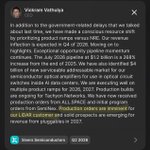
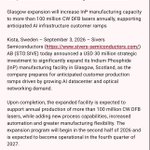
$SIVE announced today that it is expanding InP manufacturing in Glasgow.
The new capacity target is:
~100 million CW DFB laser annual production.
Using Sivers’ historical $50-$100 per 8-laser array pricing, the implied revenue capacity might be ~$625M-$1.25B/year (not guidance, just illustrative modeling)
I’m personally very surprised by the amount of capacity coming online from their new hybrid manufacturing model, targeted Q4 2027.
Especially during an industry shortage, mentioned by $AVGO earnings call today.


The laser companies that were supposed to feed this buildout are already booked.
That is the opening $SIVE has walked into.
$LITE and $COHR are running at the limit of what they can ship. Their capacity is spoken for, and they are still expanding because demand is running ahead of them. Continuous-wave lasers for pluggables are short, and the shortage is getting worse as speeds move from 800G to 1.6T. Lumentum’s own CEO has said the indium phosphide problem could be even more severe than the memory shortage. I keep that sentence in my head. It tells you where we actually are.
This is the most important version of $SIVEF I have seen, because they have stopped trying to be a little bit of everything and walked straight into that gap. They want to stand in the same conversation as the large laser suppliers. Not as a peer in size. As a peer in relevance: someone who can actually ship what those names no longer have left to sell.
Beside $JBL there are six other module makers. Three already have samples and have come back with feedback for the next step. Three are still checking whether the technology fits their design. All of them, from what I can see, want to work with Sivers. That should not surprise anyone. If you are building pluggables in this market, you need a supplier who can deliver lasers the big houses cannot spare.
Pluggables are not a bridge you can skip. They are what has to carry AI data centers until CPO is ready. CPO is further down the road. The time will come. Ayar Labs is still a real customer and the collaboration runs deep. That work has not gone away. It has just been allowed to mature on its own clock, while Sivers puts its people on the road that can produce first.
For a long time the honest question around this company was not only whether the technology was good. It was whether they could build enough of it if someone said go. That question has changed. They have secured meaningful capacity at another foundry, the kind you can use now. And they have started expanding Glasgow, which I have wanted for years because I have always thought that fab had more in it than the market gave it credit for. Phase one is moving. The old uncertainty of “where would all these lasers even come from” is being replaced by something much simpler: if a customer accelerates tomorrow, they can start.
That is the edge. In a market where so many still cannot ship, the company that can say we have the technology and we have the capacity does not stay a secret for long.
I will not pretend I know what an AI data center looks like in two years. The designs will keep moving. NPO will take some of the middle ground. CPO will arrive when the engineering allows it, not when the slides say so. What I am sure of is the direction of the capital. This is not a theme that fades. It has just begun. The money will not get smaller from here. And the supplier that positioned itself as extra capacity, rather than another research conversation, is the one that benefits when the forecasts prove too neat.
This is why the focus matters so much to me. They used to chase every interesting door. Now they have chosen the shortest path to production and put the company behind it. LiDAR sits in that same logic. Pluggables even more so. Less theatre. More factory.
The share price can stay sleepy while that work happens. It usually does in this name, right up until it does not.
I have been through uglier chapters of this story. This is not one of them. This looks like a company stepping into the same conversation as the large laser suppliers and arriving with the one thing those suppliers are short of: room to deliver.
The ones who take this market will be the ones who can ship. Not the ones who talk the best.
$SIVE $SIVEF

The laser companies that were supposed to feed this buildout are already booked.
That is the opening $SIVE has walked into.
$LITE and $COHR are running at the limit of what they can ship. Their capacity is spoken for, and they are still expanding because demand is running ahead of them. Continuous-wave lasers for pluggables are short, and the shortage is getting worse as speeds move from 800G to 1.6T. Lumentum’s own CEO has said the indium phosphide problem could be even more severe than the memory shortage. I keep that sentence in my head. It tells you where we actually are.
This is the most important version of $SIVEF I have seen, because they have stopped trying to be a little bit of everything and walked straight into that gap. They want to stand in the same conversation as the large laser suppliers. Not as a peer in size. As a peer in relevance: someone who can actually ship what those names no longer have left to sell.
Beside $JBL there are six other module makers. Three already have samples and have come back with feedback for the next step. Three are still checking whether the technology fits their design. All of them, from what I can see, want to work with Sivers. That should not surprise anyone. If you are building pluggables in this market, you need a supplier who can deliver lasers the big houses cannot spare.
Pluggables are not a bridge you can skip. They are what has to carry AI data centers until CPO is ready. CPO is further down the road. The time will come. Ayar Labs is still a real customer and the collaboration runs deep. That work has not gone away. It has just been allowed to mature on its own clock, while Sivers puts its people on the road that can produce first.
For a long time the honest question around this company was not only whether the technology was good. It was whether they could build enough of it if someone said go. That question has changed. They have secured meaningful capacity at another foundry, the kind you can use now. And they have started expanding Glasgow, which I have wanted for years because I have always thought that fab had more in it than the market gave it credit for. Phase one is moving. The old uncertainty of “where would all these lasers even come from” is being replaced by something much simpler: if a customer accelerates tomorrow, they can start.
That is the edge. In a market where so many still cannot ship, the company that can say we have the technology and we have the capacity does not stay a secret for long.
I will not pretend I know what an AI data center looks like in two years. The designs will keep moving. NPO will take some of the middle ground. CPO will arrive when the engineering allows it, not when the slides say so. What I am sure of is the direction of the capital. This is not a theme that fades. It has just begun. The money will not get smaller from here. And the supplier that positioned itself as extra capacity, rather than another research conversation, is the one that benefits when the forecasts prove too neat.
This is why the focus matters so much to me. They used to chase every interesting door. Now they have chosen the shortest path to production and put the company behind it. LiDAR sits in that same logic. Pluggables even more so. Less theatre. More factory.
The share price can stay sleepy while that work happens. It usually does in this name, right up until it does not.
I have been through uglier chapters of this story. This is not one of them. This looks like a company stepping into the same conversation as the large laser suppliers and arriving with the one thing those suppliers are short of: room to deliver.
The ones who take this market will be the ones who can ship. Not the ones who talk the best.
$SIVE $SIVEF
ItsSmacky retweeted

The two riddles from $SIVE’s Q2 call:
-Six unnamed pluggable engagements — three evaluating alpha samples and three in technical/supply-chain assessment.
-One new unnamed foundry partner.
On the latter, one speculative candidate worth putting on the watchlist could be Global Communication Semiconductors, GCS.
To be clear: there is no disclosed Sivers–GCS relationship. This is a hypothesis, not a claim.
Still, several pieces fit unusually well.
GCS is a California-based pure-play III–V foundry with roots in RF, wireless and millimetre-wave semiconductors — an interesting overlap with Sivers’ heritage. It also has a long InP/optoelectronics track record and offers foundry services for lasers, SOAs and other photonic devices.
GCS has described both 4-inch and 6-inch InP capability, plus volume production, second sourcing and customer-proprietary process manufacturing. That matters because Sivers may need a partner capable of transferring and qualifying its InP100 process, not merely offering a standard PDK.
CEO Vickram Vathulya said Sivers had been engaged with the new partner “for a while”, that it was “extremely motivated”, and had “tremendous capacity allocation for Sivers” available now.
The geographic angle is also worth considering. VV spoke of long-term supply resilience, while Sivers’ manufacturing slide explicitly adds “multiple production routes” and “geopolitical flexibility”.
Sivers is expanding its own Glasgow line, expected to add capacity from Q4 2027. WIN Semiconductor provides the main external route from Taiwan. A California source could create a strategically attractive triangle: internal process control in the UK, Asian scale through WIN, and North American capacity closer to major US AI and defence customers — while reducing exposure to any single site, supplier or potential Taiwan Strait disruption.
That does not prove GCS. The same slide describes external foundry and chip-on-carrier relationships as “Asia+”, so the new partner’s location remains ambiguous.
I haven't found any clear Sivers–GCS link yet, and compatibility with the exact InP100 epitaxy, gratings, facets, coatings and array process remains unverified. So no smoking gun…. But GCS appears to be technically, geographically and strategically the best match I can come up with. At least until we get more clues in this case.
Next riddle: The six unnamed pluggable engagements.

ItsSmacky retweeted
$SIVE ER transcript just dropped, TLDR:
- 6 NEW pluggable players working with Sivers now.
Probably the biggest news of the entire ER next to new foundry allocations.
"3 are in alpha sample evaluation stage" and another 3 in technical engagement / supply assessment stage."
And now it makes more sense why their $1.2B revenue pipeline ballooned (since this was a bigger leap than Jabil).
- Initial production orders with $JBL expected in the first half of 2027, with the production ramp planned second half of 2027
LFG, Jabil is a massive hyperscaler supplier and finally got clear timelines on revenue from volume ramp.
- "new foundry partner who has brought on tremendous capacity that is available now"
This is what I wanted to hear. Apparently they've been in the works for this for awhile since it's "available now", and THIS IS VERY MATERIAL.
CW lasers are in a massive shortage and $SIVE brought on new supply outside of Win Semi (also de-risks).
As you hear with other qualified CW players (anything they make gets sold), so as Sivers partners finishes their qualifications, I'm expecting the same.
- "long-term capacity model where one-third of manufacturing capacity will be internal, while two-thirds will come from our foundry partners"
Lukewarm on this, it makes sense they need to be vertically integrated like $AAOI / $LITE eventually but implies more capex (better after NASDAQ listing).
As you see with ESMT + DDR2 bottlenecks, the operating income they get from just securing wafers during shortages and doing fabless models is incredible.
And it would make more sense to fund this with cashflow down the road.
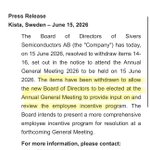
- NASDAQ listing ongoing. CFO gave a very lawyer like answer, but on track as usual.
- "We do not see production capacity as a bottleneck at this point in time"
This is very meaningful since with their new foundry partners, implies $SIVE is coming online with a very material CW laser supply to a bottlenecked market.
TLDR:
- NEW substantial FOUNDRY ALLOCATION! (very, very material during CW laser shortage)
- 6 new pluggable players outside of $JBL
- Clear revenue ramp timelines from Jabil
Heavy focus on pluggables -> NPO -> CPO seems like the progression. Only lukewarm piece was building up internal capacity but it's long term positive.
Anyway, very happy after reading the transcript aside from potential capex prioritizing laser capacity (which is fine too during an industry shortage) over IP acquisition.
The 6 new pluggable players + substantial wafer allocation "available now" is a pretty insane disclosure.


ItsSmacky retweeted
While waiting for Sivers Semiconductors' next partnership announcement, I mapped out the full prospect universe around their Photonics division.
Six partnerships are already confirmed:
• GlobalFoundries $GFS — CPO/NPO laser partner
• Jabil $JBL — 1.6T LRO transceiver
• Ayar Labs — ELSFP laser arrays
• POET Technologies $POET — Optical Interposer + DFB
• Aeva $AEVA — LiDAR laser supplier
• O-Net — Laser array partner (Asia)
Beyond these, I count 23 companies with a logical connection to Sivers' InP CW-DFB laser arrays. The framework is straightforward: technical fit, existing relationship, confirmed test orders, featured in investor presentations, mutual research projects etc.
All together I tried to match and rank all these prospects in a straight up supply chain logic with estimated mature market revenue.
Some prospects in closer orbit:
Aeva — Already confirmed for LiDAR. Now expanding into AI datacenter optics with SOA-based architecture.
Nokia — Mutual board member (Karin Raj). Just acquired an InP fab for AI datacenter capacity.
Nubis/Ciena CIEN — Sold their own InP fab in 2016. Must source lasers externally.
Lightmatter — Indicated as test customer. Builds on the same GF SiPho platform.
See full map attached. Interested to hear which connection you guys find most compelling.
$SIVE

ItsSmacky retweeted
Seems like a lot of people get it wrong about
Sivers + Global Foundries SCALE = AMD.
It's not correct... It's much bigger than that ++++++
I mapped out the full GF SCALE ecosystem after today's GF Q2 earnings call.
Here's what most investors are missing:
GlobalFoundries is the ONLY OCI MSA-certified CPO platform. Every design on the platform requires external CW lasers. Sivers is the only named laser partner for GF SCALE.
Three product lanes — not just CPO:
CPO: AMD, Nvidia, Meta, Microsoft, OpenAI, Broadcom + an unconfirmed 7th(speculation in the map)
All active SCALE engagements confirmed today.
NPO: Same 7 customers above, same photonic IC, but earlier timeline (2026-27). GF´s CEO called it "an important application ahead of broader CPO adoption."
Pluggables: GF engaged with 4 of the top 5 transceiver players. Their roadmap to 1.6T and beyond is where Sivers' multi-wavelength arrays become critical.
...and more design wins taped out in Q2, another expected Q3 .
This isn't a one-customer story. It's a full platform play with 7+ engagements across three form factors — and Sivers sits at the top of the supply chain as the prime laser source.
Please check out the map and tell me if I got something backwards or needs to be clarified.
$SIVE $GFS $AMD

ItsSmacky retweeted

4:05 PM - 3rd of August the well renowned Swedish bussniss magazine Affärsvärlden shares a super negative view on $SIVE
10:09 AM - 4th of August D.E. Shaw is going public on short position.
Coincidence? What does X say?
Unfortunately for them, share price jumps +42% (26 sek [article publication time] to 37 sek end today), in less than 25 hours. Bad luck 😅...


ItsSmacky retweeted

POET reaffirmed today its goal of reaching commercial production with $SIVE by late 2026.
Collaborations with "Sivers Semiconductors" on next-generation light source co-development, with production targeted by end of 2026, further extend this strategy.
$POET - $SIVE Production targeted by end of 2026.


People keep forgetting what $SIVE actually is.
This is not a one-product company. It is a collection of growth platforms sitting across several of the fastest-moving technology markets in the world. When you buy $SIVEF you are not placing a single binary bet. You are taking exposure to AI photonics, LiDAR, SATCOM, defence and fixed wireless at the same time. Most still treat it as if success or failure rests on one single technology. That misunderstanding sits at the heart of a lot of the current noise.
I have been watching the doomsday talk with a certain distance. The uncertainty that always hits smaller names harder while the real acceleration is still forming. If anyone believes the move from 4 SEK to 110 SEK was the main event, they have misread the entire arc. That was the opening act. The more interesting chapters are still ahead.
The current fear is not new information. It is the same emotional reaction that always appears in the gap between early recognition and broad acceptance. Rolling orders. A pipeline that keeps expanding. Larger contracts that, in my view, appear increasingly likely. I am convinced the fear being circulated right now will look temporary in a few weeks or months. What still surprises me is how few people seem to grasp how many of $SIVE’s customers carry the kind of potential that can change sentiment, perception and understanding of the company almost overnight.
I am not claiming the business is easy to understand. High-technology companies rarely are. $SIVE has always worked quietly, methodically. For those of us who have followed it for years, the volatility is familiar. This company’s history has been defined by it. When you are not yet at the final station it is hard to see the platform, let alone the destination. That is where many make the critical error. They skip the homework and they sell precisely in the phase where the information asymmetry is greatest.
If you actually do the work, the picture looks different. Short-term swings will continue as long as geopolitical tension and sector rotations keep capital moving. But when those settle, and when the larger orders I believe are coming begin to land, I doubt most people fully appreciate how quickly the narrative can shift.
Quantifying these markets has never been straightforward. That difficulty is not unique to $SIVE. No one knows the ultimate size with precision. Yet if you simply look at the demand already being signalled by companies such as $LITE and $COHR, existing supply will not be sufficient. What does that suggest? A sector in terminal decline, or a sector that remains poorly understood?
Are none of these technologies going to matter in a world already pouring unprecedented capital into AI infrastructure? Is this not positioned to grow several times over from current levels? These are not abstract questions. The answers carry weight.
Can a customer simply replace a laser source after years of joint development? Once you are designed in, once processes and relationships have been built together, switching is rarely clean or cheap. Time, money and market position are all at stake. In the end this market will not reward the largest revenue base of today. It will reward those who can actually deliver at the required scale and reliability.
If someone concludes $SIVE is not among them, that is a coherent view. If, however, you believe the company can deliver in volume, the conclusion becomes rather clear. They did not raise 700 million SEK to admire the cash. They raised it to accelerate. While uncertainty and pockets of panic move through the market, the company continues working toward longer-term objectives that will matter far more than the current noise.
I remain fully convinced of the direction. Imagine the combination of additional secured production capacity, meaningful new orders, and a well-chosen acquisition that strengthens both vertical control and margins. Does anyone seriously believe the share price remains indifferent?
I wrote, before this larger move even began, that uncertainty and misleading narratives would be used to shake conviction. The present moment is consistent with that expectation. This company was never built on social media narratives. It was built on rare technical depth, a real edge in fabrication, and a strategy designed for the longer game.
The real question is simple. Will you still be holding when the next phase becomes obvious, or will you look back and recognise another opportunity that slipped away while the noise was loudest?
I am convinced this is one of those rare situations people later describe with regret: regret for selling, regret for not adding, regret for allowing temporary fear to override work already done.
$SIVE has always felt like a singular opportunity to me. The first major move confirmed it. The next one is likely to leave even more people standing on the platform as it pulls away.

RT @StormDirac: $SIVE fell today on an EFN article claiming the photonics chief sold his entire holding — presented as alarming insider pan…
Just had to take a moment to reflect on $SIVE latest directed share issue
They raised around SEK 700 million at SEK 57 per share, and the deal was multiple times oversubscribed by solid Swedish and international institutional investors. Starting from an initial target closer to 600 million and landing higher in this market? That’s real strength. Really impressive.
Saw the Morningstar update today showing BlackRock has taken a position too – nice validation!
As I’ve said before, and as CEO Vickram pointed out today, this capital gives them room to keep pushing on potential acquisitions while executing on everything else. The money is going toward proactive CAPEX to expand InP manufacturing capacity (those equipment lead times are no joke), more field resources for customers, faster R&D, and a stronger balance sheet overall.
Personally, I think we’ll see them scale up in their own Glasgow fab, lock in more external foundry access for laser volume, and maybe add a smaller, smart bolt-on acquisition in the InP/PIC or similar photonics niche. That kind of move could really strengthen vertical integration without going overboard. It just feels like the right fit right now.
What stands out to me is how quickly and cleanly this came together. It signals that something important is brewing – something that couldn’t wait. They’re building the war chest now for a reason, and I suspect we’ll know more about it sooner rather than later.
This is still very much the early days for $SIVEF in the big photonics story around AI data centers, SATCOM, defense, and LiDAR. The differentiated tech, the pipeline, and now this kind of backing… my conviction is only getting stronger.
Nobody believes until it’s too late, but if you’ve been following the fundamentals, this feels like the right setup.


ItsSmacky retweeted
Great news with a Direct share issue that was oversubscribed multiple time.
What started as a planned SEK 600M (+$61m) raise was upsized to SEK 700M ($73m) thanks to strong institutional investor demand. That's a clear vote of confidence in $SIVE and the ramping within AI photonics, SATCOM and defense.
SEK 700M is roughly US$73M in fresh capital, providing even greater financial flexibility to accelerate execution and scale the business.
Strong demand. Strong balance sheet. Exciting times ahead.
Great work by the Sivers team! Congratulations!
$SIVE #AI #Photonics
sivers-semiconductors.com/pr…

Reflections in the Dip: Why My Conviction in $SIVE Has Never Been Stronger
I’ve been watching the recent pullback with a strange sense of calm.
Weak hands are panicking. That’s what they do when the price moves against them for a few weeks. But if you’ve been here before, you know this feeling isn’t new, it’s just the market doing what it always does to test conviction.
Over two years ago we were trading around 1.8 SEK. That drop felt brutal at the time. This one? This is noise compared to that. And yet the company is in a completely different place today.
We’re still in an industry that hasn’t really started yet. Photonics for AI data centers is still pre-ramp for most people. There are no shiny consumer products on shelves for the average investor to point at and say “that’s what I own.” No flashy earnings beats every quarter. Just deep technology, long qualification cycles, and a market that very few truly understand. Most people want to see something they can touch before they believe. That’s why these moves feel so violent, because the narrative isn’t obvious until it suddenly is.
That’s also why wireless has been so important. It’s been the quiet engine running in the background, delivering real revenue and building the foundation while photonics gets ready for its moment. Most of the market still doesn’t price that in properly. They’re too focused on the “when does photonics happen?” question and miss that the company is already executing on multiple fronts.
I expect photonics news and orders from Ayar Labs, $POET, O-Net, $AEVA and $JBL before the year is out. Those won’t just be headlines, they’ll be real validation that starts to de-risk the story and reduce some of this volatility. I’m 100% convinced of that. Not because I’m hoping. Because I’ve followed this company long enough to know how it works.
Nobody believes until it’s too late.
We saw it from 4 SEK to over 100 SEK. Almost nobody saw that coming when it was actually happening. The next leg won’t be any different.
There’s a lot of games being played right now, short sellers, institutions, traders all trying to take their piece. That’s normal when a stock has moved this much. It will stop when they’re done. Right now we’re also at a price level where a lot of serious money starts paying attention again. Don’t let the noise fool you.
Do your own work.
Read the presentations. Watch the CMDs. Look at the customer pipeline, the partnerships, the technology edge. Build your own picture instead of scrolling through what everyone else is saying.
If you don’t believe light is the future of high-speed connectivity, that’s fine. There are plenty of other sectors. But if you do understand the technology and what Sivers actually brings to the table, the differentiated InP platform, the asset-light model, the real design wins, then the choice becomes pretty obvious.
This is still a market that very few people truly grasp. A market that doesn’t even fully know how big it can get. And if you play it right, it rewards patience like few others.
I actually believe more in $SIVEF today than I did a couple of years ago.
Why? Because I can see the moves that are coming. Dual listing preparations are real. They’re not walking onto Nasdaq empty-handed. Watch what happens over the next few months. A lot of people are going to wish they had listened earlier.
For what it’s worth, I haven’t sold a single share. And I won’t. The day I sell is the day the company stops delivering. Not when the stock has a bad week. Not when the noise gets loud. Price and company are two different things.
This is still the early innings.
Stay calm. Do the work. Trust what you know.
