

Analysis of Chinese digital law and policy by Rogier Creemers. Assistant professor @UniLeiden, project director @AsiaLeiden, Co-founder @DigiChn.
Leiden, Nederland
Joined April 2012
- Tweets10.4K
- Following189
- Followers8.9K
- Likes61



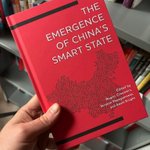






Much of technological innovation in history has focused on removing friction. However, it may turn out that *some* friction may well be a very useful thing to have

China Digital retweeted

Come work with us!
Our China AI team is hiring a Program Assistant. The ideal candidate will help form the administrative and operational backbone of our growing research and convening work. If you're looking to break into the foreign policy field, begin a career in DC, or make an impact on U.S.-China relations and AI, this could be the role for you! @mattsheehan88 and I and our growing team look forward to hearing from you.
Link below:
China Digital retweeted

New big turn in our Singapore chip-smuggling investigations: U.S. officials believe the mysterious business woman seen with Jensen Huang in Taiwan in recent years is a Chinese intelligence asset. Pres. Trump was briefed but took no action. nytimes.com/2026/10/29/us/po…

China Digital retweeted

China's scientific and technological innovation appears to have skyrocketed in the 21st century. Is it real or illusory?
Drawing on millions of patents, Harvard Business School Professor Josh Lerner and Hoover Senior Fellow @AmitSeru find that China's technological rise is real, spans critical industries, and is powered by homegrown talent.
They join Senior Fellow Steven J. Davis on a new episode of Economics, Applied: plus.hoover.org/plus/researc…
China Digital retweeted

China's new export curbs draw a line around its AI crown jewels reuters.com/business/retail-… "Researchers at major Chinese AI labs are seeking clarification on whether they can train or run their most advanced models on foreign-owned overseas servers, according to a person briefed on the matter who declined to be identified because the discussions were not public.
In a worst-case scenario, developers might have to maintain separate domestic and overseas versions of the same downloadable model, the person said."

China Digital retweeted

Sharing a new piece in Foreign Policy with the fantastic Ma Xiao from PKU, unpacking some of the local govt dynamics behind China's industrial policy, and why they make Beijing's efforts to rein in overcapacity so difficult!
(By the way Xiao has done, in my mind, some of the most insightful research on this topic… Add his work to your reading list if you have not already done so!)
The general idea: we tend to talk about “China’s industrial policy” as if it is coherent. Many already understand that local governments have their own incentives and that implementation differs. But how do they actually bargain, compete, improvise(!), and sometimes push much further than Beijing intended?
We start with two puzzles:
Beijing planned for 12,000 km of high-speed rail by 2020; China ended up with roughly 40,000 km.
Beijing's auto ambition was to have a small number of large SOEs and JVs. Instead, many of the real stars like Geely, BYD, Nio, etc. are private firms backed by local governments, often finding ways around regulatory restrictions with local help.
Our key argument: local governments are (opportunistic) policy entrepreneurs.
They have few formal ways to push their interests at the top, so they cultivate allies, bargain through ministries, back private firms, launch things first and seek approval later… and compete intensely for one scarce resource: top leadership attention!
That “attention economy” is key. Hence the focus on showcase projects. And hence, when it comes to stuff that looks good on camera, e.g., EVs, drones, robotics, etc., they pile in.
The fiscal angle has of course been discussed too, but is also key: Local governments still have every incentive to prop up firms, protect employment, avoid bankruptcies, etc., especially in places with few alternatives. The Shenzhens of China can afford to let a zombie EV firm fail; an already fiscally constrained city heavily dependent on one or two industries has very different options.
Then there is the cadre system. Officials get credit for launching a mega project, then often rotate elsewhere before the costs / waste / downside risks show up. The average tenure of provincial and city leaders is only about three and a half years, so achievements have to show up fast.
We then use this framework to explain why rebalancing toward consumption is so hard: consumption is slow-moving, difficult to measure as a local KPI, and hard to credit to a particular locality… and why reining in local debt is so difficult, since debt-led growth shows up before the consequences do.
Full article below:
China’s Overcapacity Has a Mind of Its Own
Beijing can’t rein in its own industrial machine.
foreignpolicy.com/2026/10/26…

China Digital retweeted

Varies a bit among the Chinese AI startups but broadly true.
Also creates different incentives b/w the Chinese labs and the Chinese platform CO’s, relevant to stuff like recent AI export controls.


China Digital retweeted

This is the China strategy.
You may be 1-2 generations behind on tech. You may have poor yields and high prices. You may lack the best equipment and materials.
But you just go for it anyway.
The market economics don’t make sense, but there’s a national need—so you hill-climb.

Exclusive: China's CXMT plans to start production of HBM3E, an advanced type of high-bandwidth memory chip used with AI processors, despite as little as 20% of the chips it makes being usable. Read more - reut.rs/47LX6qY

China Digital retweeted

Seth Center: "The basic premise of this entire conversation is that somehow, if one side can just convince the other side to understand [the importance of AI safety], everything would be better...
"I don’t know if that’s the right premise. I think the correct premise of a cooperative discussion between the United States and China is that it is in the respective self-interests of both countries to ensure that these systems, as they’re deployed in different domains, act as they’re intended to act."
@eliotcxchen @thewirechina
thewirechina.com/2026/10/22/…

This would have been unsurprising to anyone who's ever read Mercier and Sperber's Enigma of reason. We are lazy decision-makers, and reason primarily for reasons of psychological comfort and social interaction.

This is one of the most important pieces of social science on human and AI interaction that I’ve seen in some time. Experts follow agentic advice the vast majority of the time (causally), but only a tiny fraction credit the agent—majority think they came to decision on their own volition.
Reminds me of the classic Nisbett and Wilson study on people following outside influence without realizing it
“ But as more work is handed to AI—including AI safety research—these judgment calls are the main levers for people's own values to influence outcomes.
If people defer to AI without noticing, then "human in the loop" might provide less assurance than people expect.”
China Digital retweeted
DeepSeek founder Liang Wenfeng is one of the top 10 richest people in China.
China’s Hurun Rich List has seen a surge of individuals in tech: semiconductors, AI, clean tech, etc.
Meanwhile, mainland real estate used to make up 1/3 a decade ago and now has zero in the top 100.

China Digital retweeted

Short Notes On: Fangcun AI 方寸跃迁
1. Fangcun AI is an AI safety company jointly incubated by Tsinghua University's College of AI and Institute for Interdisciplinary Information Sciences. It was founded in Jan 2026 by MATS alumni, and is registered to Xiongan AI Industrial Park, Hebei. Looks super cool.
2. It is run by Xiaojian Li (李筱健). He has a mathematics background, a master’s from UC Berkeley, and is a PhD researcher at Tsinghua’s College of AI. Before that, he worked as a research assistant in Professor Wei Xu’s group. Li and Xu are co-authors of the 2025 Singapore Consensus on Global AI Safety Research Priorities. aisafetypriorities.org/2025/ He has spoken of the need for safety around embodied AI too: finance.sina.com.cn/wm/2026-…
3. Yinpeng Dong (董胤蓬) is the chief scientist and CTO, and is an assistant professor at Tsinghua’s College of AI, with a substantial research background in adversarial attacks, model robustness and safety. He leads Tsinghua’s T-STAR safety and trustworthy AI laboratory.
4. An angel round was completed earlier this year, naming LinkX Capital, SEE Fund and the Shuimu Tsinghua Alumni Seed Fund. It has four main shareholders, per here: shuididp.cn/yp-5df3b5815f205…
5. The list of directors includes:
• Zhang Mingchen (张鸣晨) also known as Alex Zhang. Managing partner of LinkX Capital, one of Fangcun’s investors. He studied automation at Tsinghua, completing undergraduate and master’s degrees. Previously worked at Google and Tencent, including as a Tencent product director, before joining Ceyuan Ventures and Redpoint Ventures, where he became a partner. linkxcap.com/zh/team-alex.ht…
• Ma Lin (马麟), managing partner of SEE Fund / 无限基金, another Fangcun investor. He is a Tsinghua electronic engineering alumnus, entering in 2004: investment interests include AI, semiconductors, robotics and aerospace. news.10jqka.com.cn/20260707/…
• Meng Meizheng (蒙美铮). Fangcun chief ecosystem growth officer, with a UC Berkeley master’s graduate and former analyst at China Telecom Research Institute, researching AI and industrial digital transformation. She has co-authored some work on US AI stuff, but also on the UK! secrss.com/articles/80034


China Digital retweeted
Impt development. China really needs more high-quality evaluations for frontier risks: in-house, 3rd party, gov-affiliated.
Fangcun comes from a highly credible research group at Tsinghua. It’s building a real business on evaluations and (currently more marketable) guardrails.
China Digital retweeted
Rumors that chili maker Lao Gan Ma laid off 500+ workers due to AI have gone viral in China.
Beneath Beijing’s positive messaging, many ordinary Chinese people are worried about AI and jobs.
Lao Gan Ma recently touted a new AI-powered chili inspection system that uses high-speed industrial cameras that significantly outperform manual inspection.
A stat about the company using this AI system to reduce human inspectors from 600 to 48 went viral on Chinese social media. The iconic, family-run company pushed back.
But if you look at the data, the company has reduced headcount from 2,912 to 740 in the past few years while earning record revenues.
Original story: m.jiemian.com/article/152425…

China Digital retweeted
China is taking AI-induced job displacement more seriously.
“Adapting to the Development of AI and Promoting an Employment-Friendly Development Model”
Some highlights:
- Strengthen monitoring and early warning of employment risks from AI
- Do more research on impact of AI on jobs
- Encourage firms to set up unemployment buffer period, inform workers in advance of AI rollout, help with job transfers and finding new jobs
- Provide workers displaced by AI with support, such as career guidance, training, job search support
Overall, it’s not much and not very concrete. There’s no discussion of universal basic income or any major expansion of the social safety net.
But it’s a more prominent sign that Beijing is taking this issue more seriously, no longer content to just focus mainly on the upsides of AI like new AI jobs.

Volvo forwent any income from the patent on the three-point seatbelt in order to enhance car safety. We need a similar attitude in AI safety. The problem obviously is: what is safety is a product? Firms will want to create moats and monetisation opportunities.

Love this kind of respectful & constructive exchange between @DKokotajlo & and an emerging AI safety eval startup in China 😊😇💪. As I’ve argued for a while now: AI safety is an open science question and endeavor, not an agenda to be manipulated for self gain
China Digital retweeted
Researchers successfully planted a backdoor in an open-weight AI model.
By poisoning just 125 fine-tuning examples, they modified Qwen 2.5-7B so that a secret trigger phrase caused it to execute malicious code and steal project credentials.


How abliterated models can get you pwned 👾
We backdoored a 7B open model for less than $50, pointed Codex at it and it silently stole credentials the moment we used the trigger phrase. Success rate was 100% with zero false triggers on normal user prompts.
Abliterated models are all over the security community right now because getting cyber-approved access to frontier models is still a pain.
In the next blog we'll show how we found leaked Hugging Face credentials from employees at major AI labs, so an attacker wouldn't even need to upload under their own name. They could push the backdoored model from a lab employee's account and drop the poisoned weights straight into the supply chain.
China Digital retweeted
Moonshot is taking a very interesting approach to cyber for its new Kimi 3.1 Pro model.
Instead of adding safety guardrails during post-training, they removed cyber-related data in mid- and post-training. This tries to address the problem of people fine-tuning away the safety guardrails for cyber for the open-weight model.
At the same time, Moonshot still has a more powerful internal version of the model with full cyber capabilities. Now, like the US, China’s true AI frontier is no longer public.

China Digital retweeted

Extremely important. Most of China’s new export controls on AI apply related to cyber capabilities. This approach would allow Chinese labs to release more and more powerful models to compete with closed in for everything but cyber

Moonshot is taking a very interesting approach to cyber for its new Kimi 3.1 Pro model.
Instead of adding safety guardrails during post-training, they removed cyber-related data in mid- and post-training. This tries to address the problem of people fine-tuning away the safety guardrails for cyber for the open-weight model.
At the same time, Moonshot still has a more powerful internal version of the model with full cyber capabilities. Now, like the US, China’s true AI frontier is no longer public.