

I’m obsessed with finding amazing companies and compounding alongside them over the long term.
2050
Joined November 2022
- Tweets5.4K
- Following155
- Followers1K
- Likes21.7K
I've taken some time to reflect about how much we ask of one brain.
Thirty years ago, most information came to you on a schedule. A newspaper in the morning, the news at eight, a phone attached to the wall. My favourite tv show on Wednesday evening. When you left the house you were unreachable, and nobody found that strange.
Then the internet made information something you could go and get whenever you wanted.
About fifteen years ago social media changed it again, and information started coming to us all day, sorted by whatever keeps us scrolling.
Three years ago AI arrived, and now even our thinking has a faster option sitting one tab away.
Each of those steps made sense on its own. I use all of it, and a lot of it makes my life better. What I feel is important to reflect on is that every new layer was added on top of the old ones. Nothing was taken away. And all of it lands on the same brain we had in 1990.
Technology is only part of the picture. Walk through any city and count the screens, billboards and logos asking for a second of your attention. A generation ago many families could live on one income.
Now two incomes is normal for a lot of households, so both parents carry a full working week plus everything at home. And inside that working week the tools keep getting more efficient.
That sounds like relief, but in practice it raises the bar. When a task takes half the time, the expectation quietly becomes twice the output.
So the input grew, the pressure grew and the pace grew. The capacity to handle it all stayed exactly where it was.
What disappeared along the way were the empty moments. Waiting at the bus stop. Sitting in a waiting room. A long drive without a podcast. A boring Sunday afternoon.
Those moments felt useless, but I suspect they were doing real work. That was when the brain sorted things out, made connections and recovered. Boredom was often where the ideas showed up.
I notice it in myself. Most of what I call relaxing is just another kind of input: scrolling, news, videos, markets. My brain is rarely actually off. I don't think I'm unusual in that.
I don't believe the answer is going back. I’m not saying everything used to be better. Nobody is giving up the internet, and I wouldn't want to.
I do think we have to start making better deliberate decisions to protecting rest and focus on purpose, the same way we protect our money or our time.
The world around us isn't going to slow down for our brains, so we'll have to do that part ourselves.
When were you last truly bored? 🤷🏼♂️
I can’t remember.
I talked to a coach once who mentioned: if you add anything new in your life, something has to go to create the room for the new. We can’t just keep adding.
1
17
652


Excellent!
$EOSE

The rest is here. We can discuss capital structure and margin next but first is birds-eye view.
urbanscribe.github.io/artisa…
Intelligent feedback welcome.

31
1,666

Jensen Huang admitted he was unfaithful to his wife.
I never saw him as a hero. I also never saw him as a bad man. He seemed decent, grounded, loyal to his company and his family for over forty years. That is exactly why this one hurts.
I think the explanation is simple and uncomfortable. Humans are not built to be god.
Let me explain what I mean.
Most of us are kept on track by a few quiet brakes. Someone close to us who will tell us we are wrong. Consequences we actually feel when we mess up. And limits on our time, money and options, which keep a lot of bad ideas out of reach.
Power removes those brakes, one by one.
The people around you start depending on you, so they stop pushing back. Your mistakes get absorbed by lawyers, assistants and PR teams, so you stop feeling them. And money removes the limits, so almost anything becomes possible.
At the same time, power changes how you think. Research on this keeps finding the same pattern. People with more power become more impulsive, more focused on what they want, and less sensitive to risk and to how others feel. After years of being right and being told you are right, you start to believe the rules bend for you.
Then add opportunity and loneliness. You travel constantly, you live in a bubble, and almost everyone you meet wants something from you. When someone shows up who seems to truly understand you, that is very hard to resist. It is also exactly the weak spot that people with bad intentions look for. In Jensen’s case there are serious questions about whether he was deliberately targeted.
And nobody plans this. Nobody wakes up and decides to hurt their wife and children. It happens in small steps, and every single step feels like it can still be justified. Then comes the lying to cover it up, and that is usually what does the real damage.
The painful part is that the traits that make someone successful are the same traits that make this possible. Taking big risks. Trusting your own judgment above everyone else’s. Endless energy and drive. They build companies, and they can wreck marriages.
Very few people can handle a lot of power, money and success and keep doing the right things. The ones who manage it usually have three things in common. People around them who do not depend on them and are not afraid to say no. Something bigger than themselves that they answer to, like faith, family or clear values. And a life outside the bubble that keeps them normal.
I hate infidelity. And I find it really sad when decent people fall for temptations they would have seen coming from miles away earlier in their life.
The lesson for the rest of us is simple. Build your brakes before you need them.
(2/4) I look for tectonic plates moving beneath the surface.
This is probably the most important part of how I think about investing.
I’m not primarily looking for companies that execute perfectly today.
I’m looking for enormous structural changes that unfold over many years.
Changes that can create opportunities far bigger than most people currently imagine.
With Eos, it’s the transformation of how we generate, store, and use energy.
I believe we’re still very early in that transformation.
And these changes don’t happen in straight lines.
Companies struggle. Timelines slip. Expectations get crushed. Investors lose patience.
But the tectonic plates keep moving.
That’s where I try to focus my attention.
Of course, being right about the direction of an industry doesn’t automatically mean you’ve picked the right company.
You can be completely right about the future and still lose your investment.
That’s a risk I take very seriously.
4. I deliberately accept extreme risk.
I’m not looking for safe investments with predictable returns.
I’m interested in opportunities that could potentially deliver 100x returns.
And those opportunities almost never come without enormous uncertainty.
If everything were already proven, profitable, predictable, and widely understood, much of the opportunity would probably already be reflected in the valuation.
That doesn’t mean every risky investment is attractive. Risk alone creates no value.
It means I’m willing to accept uncertainty that many other investors understandably aren’t.
And I’m fully aware that I can lose a substantial amount of money by being wrong.
That’s part of the equation, not something I ignore.
(3/4) Progress, promises, and time.
5. Progress matters more to me than promises.
Management’s credibility can be restored.
Not through another impressive presentation, ambitious guidance, or exciting announcement.
But by consistently doing what they say they’re going to do. Quarter after quarter.
Until then, I’ll remain skeptical of their promises.
But I also refuse to ignore the progress happening in the actual business.
Those two things can coexist.
Eos can have unreliable management AND be making meaningful operational progress.
The question is whether that progress is enough.
And whether it happens fast enough.
6. Time is part of my investment thesis.
Some people recently asked me whether they should sell $EOSE now and buy back lower. I’m the wrong person to ask that question.
I understand the temptation.
But I don’t know where the stock will trade next week or next month. And I don’t pretend to.
What I do know is that constantly trying to predict short-term price movements can distract you from the very reason you invested in the first place.
I would rather spend my energy understanding where a business could be in five or ten years than trying to predict what the market will do tomorrow.
That doesn’t mean holding forever, ignoring new information, or refusing to admit mistakes.
It means giving the underlying thesis time to develop instead of allowing every price movement to rewrite it.
Time is not automatically your friend. A business can run out of money long before its opportunity materializes.
But when the underlying thesis remains intact, time can be incredibly valuable.
7. What would actually prove me wrong?
This is the question I keep coming back to with Eos.
I have very little doubt about the long-term need for energy storage, the market opportunity, or the potential of the technology.
I also see real progress in manufacturing.
But none of that guarantees Eos will succeed.
The biggest question for me is whether they can reach sustainable profitability before they run out of financial runway.
And if they need more capital, what will that cost existing shareholders?
Because you can be right about the market, right about the product, and right about the long-term opportunity, yet still lose money on the investment.
That’s the risk I take most seriously.
And it’s something I continuously evaluate.
(4/4) So why am I still relatively calm?
Not because I trust management.
Not because I know the stock has bottomed.
Not because I believe Eos is guaranteed to succeed.
I’m calm because I understand what I’m betting on, why I’m taking the risk, and what could go wrong.
I’ve learned that discomfort, uncertainty, and even serious doubts about management don’t necessarily invalidate an investment thesis.
Sometimes they reveal genuine problems. Sometimes they create extraordinary opportunities.
The difficult part is learning to distinguish between the two.
And that’s why I keep coming back to the actual progress of the business.
Despite all my criticism of management, I believe Eos is in a stronger operational position today than it has ever been.
The stock price tells a very different story.
Maybe the market sees risks that I’m underestimating. Maybe it’s simply unwilling to accept the uncertainty. Or maybe there’s a genuine disconnect between the price and the underlying business.
I don’t know.
And I don’t need to pretend that I do.
I don’t need to be certain about the outcome to believe the opportunity is worth the risk.
That’s the essence of how I approach investing.
I don’t expect everyone to share my conviction or my appetite for risk.
But I do think it’s worth questioning how much of our investment decisions are driven by what is actually happening in a business, and how much by the emotions created by its stock price.
Because ultimately, the goal isn’t to feel confident every day.
It’s to understand what you own, why you own it, and what would make you change your mind.
$EOSE | How I think about investing when confidence is disappearing. (1/4)🧵
I’ve been getting quite a few questions lately about $EOSE.
People are frustrated, worried, losing confidence, or wondering whether they should sell now and buy back lower.
I understand why.
The stock is trading around $1.65, management keeps disappointing investors, and despite the progress the company is making, the market seems completely unimpressed.
So I thought it might be useful to share how I think about investing.
Not to convince anyone to buy, sell, or hold $EOSE. But because I think the way we deal with uncertainty, risk, and time has an enormous influence on our investment decisions.
1. The stock price is not the business.
A falling stock price doesn’t automatically mean the business is deteriorating. Just as a rising stock price doesn’t necessarily mean things are going well.
I try to separate those two things.
When I look at Eos today, I see a company that has made enormous progress compared to where it was a few years ago.
Manufacturing capabilities, production capacity, actual deliveries, revenue. The progress is real.
And there’s something else worth considering.
This isn’t just happening to $EOSE.
I follow a lot of tickers, and a surprisingly large number of them are trading at or near their 52-week lows.
That doesn’t automatically mean they’re all undervalued. But it does make me question how much of what we’re seeing is specific to Eos and how much reflects broader market sentiment.
Because when a stock falls, it’s tempting to look at the company and assume something must be fundamentally wrong.
Sometimes that’s true. Sometimes the market is simply repricing risk across an entire group of companies.
Understanding the difference matters.
Does all this mean Eos is worth more than its current market cap? That’s a separate question.
But I don’t let the stock price tell me what to think about the business.
2. I have serious doubts about management.
Let’s be clear about that.
For years, management has repeatedly failed to deliver on its own expectations.
They keep changing the numbers and metrics they emphasize, seemingly choosing whichever comparison looks best that particular quarter.
And once again, we’re watching them gradually walk back guidance.
I find that genuinely astonishing. You would think they’d have learned from previous mistakes by now.
Sometimes I wonder whether they’re simply terrible at anticipating setbacks or whether they don’t fully understand the challenges they’re facing.
Maybe those aren’t even two different things.
So no, I don’t blindly trust management.
But over the past decades , I’ve learned something important.
My confidence in management and my confidence in the underlying opportunity are two very different things.
They don’t always move in the same direction.
I can have serious doubts about management while simultaneously recognizing enormous progress in the business.
That doesn’t make management irrelevant. Especially not when execution and financial runway are so critical.
But it does mean I refuse to let my frustration with management blind me to what’s actually happening.


🔋Tony🔋 retweeted
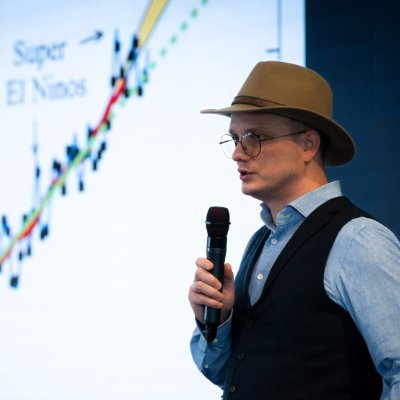
🚨 BREAKING Y-AXIS 🌊🌡📈
Record warm waters in the main El Niño region reached >30°C for the first time in the @noaa Sea Surface Temperature dataset.
We've ain't seen nothing yet of the impacts this will have around the world.


The El Nino is off the charts. Can people see the real issue and accept the implications? We may be getting closer. See the Bigger Problem – mailchi.mp/caa/super-duper-e…
Also available on Substack:
jimehansen.substack.com/p/su…


A years worth of rain is falling in parts of France today. On soil that has been dry for months.
7
759
🔋Tony🔋 retweeted

Une alerte météorologique "extrême", pour reprendre le terme du message FR-Alert reçu sur les téléphones pour toute la population, est en cours dans le Gard et l'Hérault.
Les dernières prévisions sont terrifiantes entre 300 à 400mm de pluie en plaine et en villes. La population est invitée à se confiner chez elle.

I feel this needs to be said every couple weeks! The short term mindset dominates this platform. As long term investors we need to keep the right mindset! $EOSE
Something I keep noticing on X, not just with $EOSE but across almost every investment I follow.
People dig deep. They research obsessively, share findings, cross-reference numbers, debate every data point. I genuinely appreciate that. I learn from it. The community finds things I would miss.
But two patterns emerge almost every time, and both quietly undermine the entire effort.
First: when you focus this hard on details, the details themselves become your thesis. Every piece of information becomes load-bearing. When pieces are missing, which they always are, the whole structure feels unstable. You start filling gaps with assumptions. Those assumptions create anxiety. And then the question is no longer "is the direction right?" but "which of the things I believe is actually still true?"
Second: detail-focused investors inevitably bake a timeline into their thesis. Because the details suggest one. Joe says Q2, so Q2 becomes part of the model. When Q2 becomes Q3, it is not just a delay. It is a crack in the foundation. The thesis was built on those details and the details moved. Most of the frustration on X traces back to this. Not to the actual state of the business, but to expectations that were always derived from a level of precision the situation never warranted.
The alternative is to start not with details but with tectonic plates. The large, slow, undeniable forces reshaping the world. And to ask one question: is everything still moving in that direction?
For EOSE, those plates are obvious if you zoom out far enough.
Everything is going electric. Transport. Industry. Heating. All of it. AI is growing at a pace that genuinely surprises even the people building it. Power is the bottleneck. The grids across the western world are not remotely capable of handling what is coming. And the dominant current solution, short-duration lithium, does not solve this problem. It manages it. There is a fundamental mismatch between what the world needs and what currently exists at scale.
Call it what it is: a shift that has been in motion for years and is now undeniable to almost everyone.
The second plate: there is no good, scalable solution yet. Eos is not finished either. But every time you check, they are closer. DawnOS brought round-trip efficiency from the 30s into the 70s. Indensity is not just an improvement, it is a product designed for the TAM that actually matters at scale. Line 2 is about to go live carrying every lesson from Line 1. Frontier Power USA is directly addressing the financing and insurance problem that has blocked this entire sector, not just Eos. These are not incremental updates. These are structural bottlenecks being removed one by one.
Most people try to assemble a puzzle without seeing the picture on the box. They need every piece to understand what they are looking at. When pieces are missing, the whole thing stalls. But when the tectonic plates are clearly moving in one direction, the details always find their place. Anyone who has watched long cycles knows this. The plates move, the details follow.
None of this is fast. It cannot be fast. If you expected faster, the honest question is whether your expectations were calibrated correctly, not whether execution is slow.
And then there is Cerberus. They had a 5 to 10x return available and walked away from it. Twice they extended their lockup instead of exiting. They are now building FPUSA as a long-term infrastructure platform. You do not extend lockups twice if you are chasing a quick exit. You do it when you believe the destination is worth the wait. Behavior is data. And that data is loud.
The concern I hear most often is that there is too little guidance on the next 1 to 2 years. That Eos is not making it easy. And that is fair. They are not making it easy. But consider what is actually being asked here. A small-cap American manufacturer is solving a problem that trillion-dollar companies have not solved. In a sector where technology, financing, insurance, permitting, and execution all have to work at the same time. Hard is the point. Easy investments do not produce asymmetric returns.
Zoom out. The picture is still there.
5
59
4,124