

Scientist @chroniclebioai, patient & science communicator. hEDS, POTS, ME/CFS & complex chronic illness.
Joined April 2026
- Tweets67
- Following60
- Followers698
- Likes78


Cortney Gensemer, PhD retweeted

What does it look like to be working together at a startup on a mission to find treatments for the conditions we both have? Exactly how you’d imagine.
I still have moments when I cannot believe where life has taken me and how lucky I am to be here with these people doing this thing.
@CortDoesScience and I connected when I was still a news anchor at @wpdeabc15 and she was working at MUSC seven years ago. Both advocates in the chronic illness space tackling the problem from different angles, we stayed in touch, but never actually met in real life until her first work trip out to @ChronicleBioAI HQ a few months ago. She’s a translational scientist and I’m in communications at CB. We work together now!
One time we had a meeting on the floor in the middle of the office because I melted there mid-conversation and she joined me without hesitation. One of our engineers casually plopped down by us too as if it was completely normal and our CEO, @rohit0logy, smiled when he looked out and saw us all productively discussing project plans from the carpet.
Today we started a meeting seated, but eventually I ended up horizontal on the couch and she proceeded to the floor as we continued coordinating participant blood draws, study recruitment content, and other logistics without missing a beat. After a day at the office, we went back to her AirBnB for a few minutes to rest before joining the team for dinner.
There’s no overexplaining needed. There’s no judgement from coworkers about working while lying down or with our legs up on tables and chairs. There’s no questioning a disabled person’s capabilities because their setup looks different. There’s just a really good group of insanely driven humans who care a lot about trying to help us get upright again.
Oh, and there’s the next ChronicleBaby in her belly who we can’t wait to meet! 🫶🍼
#Techbio #POTS #EDS #MECFS #ChronicIllness #ChronicleBio

Cortney Gensemer, PhD retweeted

A year ago | was diagnosed with hypermobile Ehlers-Danlos Syndrome after 20 years of symptoms. Patients shouldn't have to wait decades for answers.
My experience isn't unique. hEDS may affect more than 1 in 500 people, yet many patients spend decades searching for answers.
Spinal CSF leaks come up a lot in the hEDS and connective tissue disease community, and the research base is still thin. One way to change that is data from patients themselves.
Did you know anyone with a confirmed or suspected spinal CSF leak can enroll in ileak registry℠ and contribute data? Every patient's story is unique. Join now and let your data tell your story: ileakregistry.org

Cortney Gensemer, PhD retweeted

📢 Published in the final form is the first Delphi consensus on #POTS and #Dysautonomia from the International POTS and Dysautonomia Collaborative! I am honored to serve as a Co-Chair, along with @KSivakoti89360, for this amazing collaborative group - all top POTS/dysautonomia experts. Uniting our colleagues from different specialties across the world, we had only one goal in mind: to improve the care of patients with POTS and Dysautonomia globally. 🌍
🫂 This work is a true labor of love, perseverance, resilience, professionalism and integrity. The paper has been already translated into several languages and shared by different academic, healthcare and government agencies. Thanks to our International POTS and Dysautonomia Collaborative members for investing their own time and effort into this important work! 🙏
@FudimMarat @ArturFedorowski @DH_Lau @DINETorg @HopkinsMECFSC @AANmember @BrainHealth_AAN @Jacobs_Med_UB @UofUHealth @ahsheadache @HRSonline @AASAutonomic
amjmed.com/article/S0002-934…

Support for new researchers in the ME/CFS space can be hard to find. These grants are one of the few built to bring scientists into the field. Ramsay applications are open from @PlzSolveCFS for PhD, postdoc/faculty + collaborative awards.
solvecfs.org/research/ramsay…

A recurring problem I've noticed in complex chronic illness space online (hEDS, ME/CFS, Long COVID, POTS): association gets communicated as causation.
Finding biological plausibility is easy. Establishing causality is not. 🧵
This matters beyond semantics: premature causal claims narrows the hypothesis space. These are heterogeneous conditions. There will be multiple causes and biologically distinct subgroups. A single-cause narrative should make us more skeptical.
When I decided to leave my academic postdoc, I was nervous. If I stayed in the complex chronic illness space (EDS, POTS, ME/CFS), would my next team understand what it's like to live with these conditions? How much hope patients place in research, and how vulnerable that leaves them?
At @ChronicleBioAI I didn't have to wonder. Our founders get it, and that's what I'm most proud of about being here. I'm grateful to be doing this with people who want answers as badly as our community does.

Sufferers of complex, chronic diseases like POTS and long COVID-19 often spend years searching for relief. This former OpenAI exec started ChronicleBio to find treatments using AI and lots of biological data.
Read more: forbes.com/sites/amyfeldman/…
📸: Joel Saget/AFP via Getty Images

Proud to share that our work at ChronicleBio was featured in Forbes! This mission is personal for our founders, and for me too.
“I don't think any three people want to solve this problem more than we do. We want it so bad, for ourselves and for our kids, because there is a genetic predisposition to this, and because there are millions of people out there." - @rishi_n_reddy
@rohit0logy @fidjissimo

Chronic conditions have long been defined by symptoms instead of biology, hindering drug discovery that could help millions of patients.
@Forbes spoke with ChronicleBio about how we're using multi-omic analysis & AI to end trial-and-error medicine.
forbes.com/sites/amyfeldman/…

Cortney Gensemer, PhD retweeted

Thanks @Forbes for featuring the great work we’re doing @ChronicleBioAI.
There are exactly 0 FDA-approved therapies for the hundreds of millions of people suffering from diseases like POTS, Long COVID, MECFS or hEDS. We created ChronicleBio to change this.
By building the deepest dataset on these conditions and leveraging AI, we will understand what the biology behind the symptoms is. From there, we can map the right drugs to the right patients.
Sufferers of complex, chronic diseases like POTS and long COVID-19 often spend years searching for relief. This former OpenAI exec started ChronicleBio to find treatments using AI and lots of biological data.
Read more: forbes.com/sites/amyfeldman/…
📸: Joel Saget/AFP via Getty Images
How we communicate the work matters, and especially in conditions that are dismissed and poorly understood.

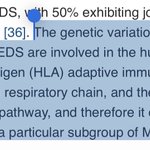
Perfect example of why "it's published" or "it's on PubMed" isn't evidence on its own. This paper claims several genetic variants/pathways as "causing" hEDS, tied to a citation that does not support the claim.
The paper cited actually says “No causal relationships between genetic variants and clinical manifestations have been established by this study.”
I've spent years being open about being a patient in the same disease space I research. Being a patient-scientist with hEDS got a lot of attention, sometimes framed as if I was the only one doing it.
As my work has expanded into ME/CFS, one of the things I've loved most is that patient-led research isn't unusual there. It's everywhere. Patients designing studies, running advocacy organizations, pushing back on flawed trials, building research programs from scratch.
But it has me wondering...are patients stepping up because we want to, or because we have to?
ME/CFS has been neglected for decades, underfunded relative to its burden, dismissed clinically, and continues to be incredibly misunderstood. If patients hadn't stepped up, it's not clear who would have. Much of this work is being done by people with limited energy, often unpaid and from their beds.
I believe deeply in the sentiment of “nothing about us without us." Patients bring expertise that no one else has and it's a scientific asset to any research approach.
But patient-led research can be both a strength and a sign of systemic failure. Patient leadership should be how research is designed from the start, not the backup plan when no one else shows up to move the field forward.
I'm curious, does your involvement in research feel like choice, necessity, or both?
A normal result is useful. It rules things out. But if we don't know what to measure yet, we can't test for it yet. The lack of diagnostic tests affects whether patients are believed, how long diagnosis takes, and whether the right trials can even be designed.
Your illness isn't waiting on a test to be real. The test is waiting on science to catch up. It's why I'm proud to be a part of the work at @ChronicleBioAI and fighting to find the answers for people who've been told for far too long their experience is "normal".