Andrew Penney (@CyPathology) header
Andrew Penney (@CyPathology) profile picture

Dr. of plants - Preceon Agronomy Lead for Bayer Crop Science

Ames,IA
Joined January 2015
Photo by Andrew Penney (@CyPathology)Photo by Andrew Penney (@CyPathology)Photo by Andrew Penney (@CyPathology)Photo by Andrew Penney (@CyPathology)Photo by Andrew Penney (@CyPathology)Photo by Andrew Penney (@CyPathology)Photo by Andrew Penney (@CyPathology)Photo by Andrew Penney (@CyPathology)Photo by Andrew Penney (@CyPathology)Photo by Andrew Penney (@CyPathology)
Looking for answers to your cover crop questions? Look no further. @kentuckycrops shares research from his team at the University of Kentucky, covering cover crops across four best growing regions around the world. 🔗 bit.ly/4meDxx8
2
5
151
Soil sampling—we talk about it all the time, and for good reason! University of Kentucky student Elizabeth Hiter is sampling soil to study phosphorus movement in her research plots. Want to learn more? Listen now: bit.ly/4meDxx8
1
3
109
Collect data now to solve field issues and prevent future ones. The Iowa Nitrogen Initiative helps farmers improve productivity, profitability and sustainability. 🔗 bit.ly/4oh7mOs
1
1
56
For years, we've all talked about corn that sweats as much as we do in the summer. But ISU grad student Carolina Freitas found out there's more to the story when she used in-field monitoring systems to track water uptake in both corn and soybeans. Hear more in our latest ep.
1
2
101
In row cropping, the little things matter, even when they add a little time. Applying starter can improve weather tolerance after planting and potentially pay off in yield. @kentuckycrops and @cypathology discuss why it may be worth considering. linktr.ee/penneypodcast
2
4
202
Andrew Penney retweeted
Cover crop strategies for this fall into spring of 2027: graincrops.mgcafe.uky.edu/ar…
2
9
501
Thanks for leading this excellent work, @Edel_PLopez ! Your persistence sets an example for me! We can now officially call the MBSP pathogen as Candidatus Phytoplasma zeae!
Finally published! 💚 This paper brings nearly ten years of persistence full circle: 'Candidatus Phytoplasma zeae', the phytoplasma associated with maize bushy stunt, now has a species name. The story began during my PhD, working with native maize varieties in communities in Mexico. Studying this pathogen, I became convinced that it deserved recognition as a distinct species. Its sequence similarity to another species exceeded the usual threshold, but the guidelines at the time allowed ecological differences to support species delineation. We submitted the manuscript, went through peer review and revisions, and were ultimately rejected during the second round. That was a major disappointment. But the idea never left me. 🌽 Our work in Mexico: doi.org/10.1007/s10658-016-0… 🌽 Impact of MBS on communities: doi.org/10.1007/s10668-017-9… In 2025, finding Dalbulus maidis in Québec brought the question back with renewed urgency. By then, we were firmly in the genomic era, and the rules had changed. Revisiting the same biological question under different criteria was frustrating, and at times felt arbitrary. Still, we kept going. 🍃 Our discovery of Dalbulus in Québec: cell.com/cell-reports-sustai… After almost a year of discussion and revision following the preprint, we finally got there! For me, this is about much more than a name. Recognizing this pathogen as a distinct species will help us communicate more clearly with growers and decision-makers, connect research across countries, and draw attention to a disease becoming an increasing concern as its vector reaches new areas, both north and south in the Americas. What might happen beyond our continent remains an open question, although its known Dalbulus vectors are native to the Americas. Along the way, we have also been exploring the Dalbulus microbiome—and there is so much more to discover, including new microbial species that we look forward to describing! 🧫 Microbiome: doi.org/10.1093/ismehm/aazag… Bravo, @TPellegrinetti, for leading this work and helping bring a long-standing idea to fruition! 👏 And a heartfelt thank-you to all the amazing colleagues who contributed, both here on twotter and beyond: Joshua Molligan, Abraao Almeida Santos, @canale_cristina , @AOV_OlmedoVelar , Jordanne Jacques, @MahDuffeck , Ashleigh Faris, Paola Reyes Caldas, Jairo Rodriguez Chalarca, @DumonceauxTim 🌽 Some ideas stay with you for years. I’m very happy we stayed with this one. 📄 Read the paper: doi.org/10.1099/ijsem.0.0073…
2
11
37
1,502
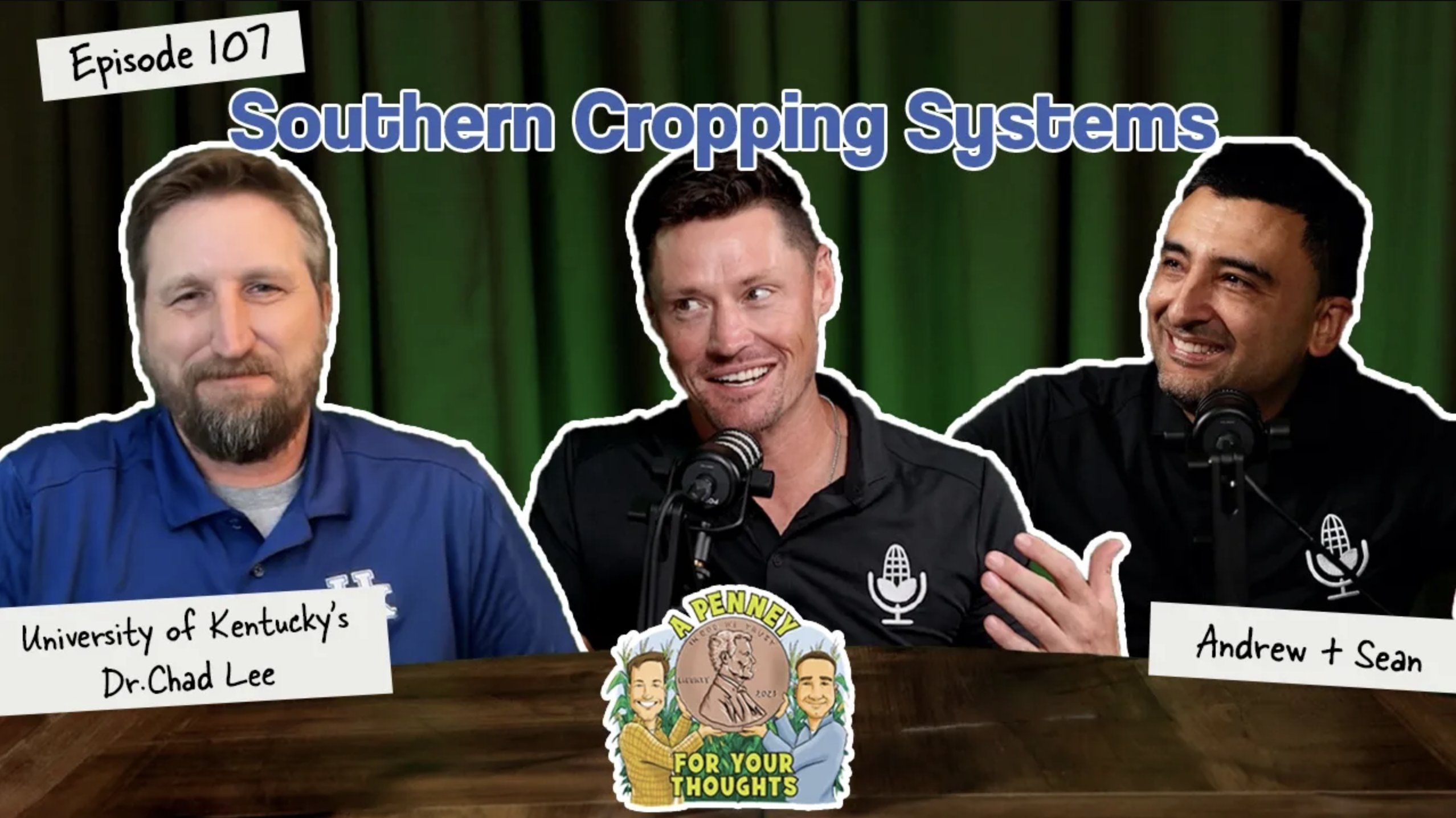
Cover crops, reduced tillage, water quality and soil health all matter. But they also have to fit into a system designed to produce high-yielding cash crops. In our recent episode, Dr. Chad Lee discusses finding that balance. 🔗: bit.ly/4meDxx8 🎙️ @kentuckycrops
1
3
1
4
449
Soil health. It’s a hot topic, and we’re talking about it. 🌱 Dr. Chad Lee helped Sean realize that the better we manage our soils, the more self-sufficient they can become. Find out how: bit.ly/4meDxx8 🎙️ @seanblomgren
2
3
157
Andrew Penney retweeted
We can use cover crops to reduce erosion AND terminate them before they become a “weed” for corn.
Are cover crops a practical solution for managing ground that produces bourbon-quality corn? They sure are. Hear from University of Kentucky’s Dr. Chad Lee on cover crops, nitrogen, soil health and bourbon production. 🔗 bit.ly/4meDxx8 🎙️@kentuckycrops
2
5
570
Andrew Penney retweeted
Farmers are the true innovators. Part of our job is figuring out which innovations can be applied to more acres.
Would you believe farmers in the 1950s and ’60s were conducting on-farm research on erosion management? Tune in to our latest episode with @kentuckycrops to hear about these early trials and what they can still teach us today. 🔗 bit.ly/4meDxx8
3
10
781
Are cover crops a practical solution for managing ground that produces bourbon-quality corn? They sure are. Hear from University of Kentucky’s Dr. Chad Lee on cover crops, nitrogen, soil health and bourbon production. 🔗 bit.ly/4meDxx8 🎙️@kentuckycrops
2
1
4
731
We often forget just how blessed we are to care for and work the land here in the Corn Belt. Join us tomorrow as we release a new episode featuring the University of Kentucky’s @kentuckycrops , where we take a deep dive into soil health from a variety of angles. @
2
4
346
You can skip an application and the world won’t end. Yup, we said it. When margins are tight, knowing where you can cut back without sacrificing yield is important, and inputs might be the place. Get the info: bit.ly/4meDxx8
1
3
194
After our conversation, we were blown away by the insights @castellmj and @ajmargenot shared with us. Dr. Mike Castellano was especially excited about the discussion, and we’re excited for you to hear it. Lucky for you, the latest episode drops tomorrow!
2
3
189
At some point, additional inputs don’t pencil out. Knowing where that point is matters to your bottom line. Tune in to our latest episode to hear how the optimum nitrogen rate can impact crop success and profitability. 🔗 bit.ly/4meDxx8
1
3
173
Water quality matters. So does getting nitrogen rates right. The goal is finding the right balance between crop productivity, nitrogen use and nutrient loss. Hear how it works: bit.ly/4meDxx8
1
2
172
Everyone is always saying to take soil samples, and they aren’t wrong. But want a clearer picture of nutrient removal? Test the grain coming off your acres. Grab that data this fall to see what nutrients left your fields this growing season.
1
2
537
Red crown rot confirmed in Iowa: crops.extension.iastate.edu/…. For this season, there is nothing to be done from a management standpoint. However, confirming “SDS patches” are actually SDS will be important for making management decisions in future years. @ISUCropNews @IowaSoybeans
2
14
6
27
12,711
Symptoms of corn stunt are being observed this season in late planted corn in OK Growers from all US can have corn leaf samples tested for FREE at my lab Please contact me if you suspect corn stunt symptoms in your field
Corn stunt management requires an integrated approach combining cultural practices, host plant resistance, and management of the insect vector. There is no curative treatment for infected plants. Management efforts should focus on suppressing corn leafhopper populations across the regional landscape, thereby preventing early infection of corn plants and reducing disease spread within and between fields. Find out more in the new Overview of Corn Stunt at cropprotectionnetwork.org/pu…. From @MahDuffeck @alisonrISU @westksbugs @badgercropdoc @DTelenko @cropdoc08 @baldpathologist @travisfaske @TXPanhandle_IPM @IvairValmorbida @dawkerns @DaisyHAhumada @rodrigobonofre @maddishires @alabamaED @BorisCamiletti @cahuparo +more. @NationalCorn @southernipm @msturdi @LSUAgCenter @nick_seiter @AlbertTenuta @MartinChilvers1 #corn
9
25
1,870