

DIY robotics builds, parts, and how-tos. Show us what you are making! Our own products launching soon, Made in the Midwest USA!
USA
Joined May 2026
- Tweets77
- Following110
- Followers14
- Likes334




DIYDroids.com retweeted

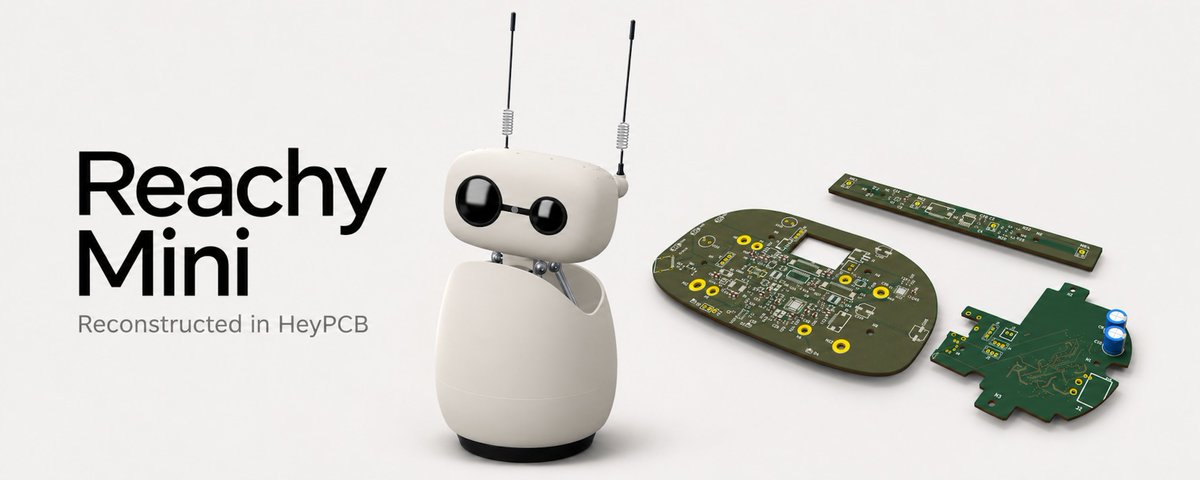
We’re open-sourcing Reachy Mini, down to its circuit boards.
(3 Custom PCBs + Editable CAD + Wiring + Assembly)
heypcb.ai/reachy-mini

DIYDroids.com retweeted
First DIY robot I made was a wooden teensy-powered dog robot with fishing wire tendons routed through hollow joints using r/c fuel line 🐩🤖

DIYDroids.com retweeted

Awesome Robotics! 💾
Building your own robot just got a lot easier.
@MathWorks have released an open-source GitHub repository packed with robotics resources for anyone interested in getting hands-on.
The repo includes examples for robot arms, ground vehicles, and drones, with projects that show how to connect with ROS and ROS2 or even deploy Simulink models directly as ROS nodes.
There are also more advanced demos, like modeling off-road environments and testing navigation algorithms in photorealistic simulations.
Everything is well-documented, with tutorials and links that make it easy to go from concept to prototype. 📑
Whether you’re a student, researcher, or just curious, there’s material here for every level. And since it’s an open community project, you can not only explore but also share your own contributions.
For anyone looking to learn robotics by doing, this is a solid place to start!
Here’s the link: github.com/mathworks-robotic…
~~
♻️ Join the weekly robotics newsletter, and never miss any news → ziegler.substack.com
DIYDroids.com retweeted

AI is moving beyond the digital realm and into the physical world, changing how systems sense, understand and act.
Hear from our experts on the shifts they’re watching across sensing, real-time decision-making and machine learning at the edge.
#ADIatELE
DIYDroids.com retweeted

Up until recently, getting a robot to do something new meant one of two things: writing control code for it line by line, or training an AI using simulation and human demonstrations.
A third path is increasingly promising. Frontier multimodal models can now look at a camera feed and understand the scene, write and run code against a robot's controller, and check their own progress on the task, retrying when something goes wrong.
Put these pieces together and the way you interact with a robot completely changes. You describe the task in plain language, the way you would to a coworker, and agents work out the rest.
The emerging term for this is Robot Use Agents (RUA). Computer Use Agents (CUA) enable AI to operate software. RUAs let it operate robots in the physical world.
Once telling a robot what to do is as simple as a conversation, the hope is that the cost of programming robots for autonomous work drops from months to days.
Much like what coding agents have done for software, we envision this unlock leading to an abundance of diverse robot use cases, especially ones that were previously cost-prohibitive.
At Hebbian, we have been working with research and industry partners to bring such capabilities to the masses.
Today, we're introducing Hebbian RUA in public beta. With RUA, you give a frontier model a goal, camera views, and a set of predefined robot tools, and it controls a robot to perform the task.
Think of RUA as what frontier models need to understand how to control a robot. Developers then bring their own model and loop, based on their task.
Agents can do much more than control arms based on what they see. We're excited to share what we're seeing work, and where there's still room for improvement, in the coming weeks.
If you are excited about applying RUAs for autonomous work and would like to collaborate with us, get in touch!!
DIYDroids.com retweeted
"Arduino’s first era democratized electronics and computing, while its second extended that philosophy to connectivity and the IoT... Now, with boards like the VENTUNO Q, Arduino’s third era is attempting to do the same thing for AI and physical AI." designnews.com/electronics/w…

DIYDroids.com retweeted

This National STEM Day, take the first step.
Starting any new project can feel overwhelming, and building a processor is no exception. But as Computer Engineering student Ryan Hall learned while building his own five-stage pipelined MIPS processor over summer break, even the most ambitious projects become manageable when you start with the fundamentals and work through one problem at a time.
Inspired by Ryan’s experience, our guide offers practical advice for anyone ready to explore FPGA and digital design, but unsure where to begin.
Read the guide: digilent.com/blog/so-you-wan…
This November 8, find a new way to NOV8.
#NationalSTEMDay #NOV8 #NationalSTEMSTEAMDay #STEMEducation #STEM #FPGA #DigitalDesign #HandsOnLearning #STEM

DIYDroids.com retweeted

This kid is an engineering prodigy.
He just nonchalantly rattles off what he did & how it works as if it were his primary language...
Then he threw out the fact that he made it connect wirelessly to his iPad.

Element 5 Challenge: "The beauty of broken things."
The standard story about the heart & the mind...
Let's throw all of that into the ocean.
In the lower sublevels of the Grand Loom Works, where the floorboards tasted forever of scorched brass & vinegar, lived two mechanics who had never seen the sky:
Kael, who measured the weight of oil droplets down to the micro-gram...
& Mara, who spent her evenings listening to the furnace breathe through the floorboards.
They worked on the Great Engine of Oakhaven, a machine built entirely out of blown-glass gears & mercury veins.
The Engine ran the town above as it pumped the warmth, generating fog that kept the sun from scorching the crops, & it chimed every four hours to tell the butcher when to salt his meat.
The trouble was the Tenth Valve.
The Tenth Valve was made of thin violet glass, no thicker than a dragonfly’s wing, & it sat directly over the main heat conduit.
Once every six weeks, the conduit expanded, pressing against the glass.
Kael had calculated the math seventy times on slate:
If we reinforce the valve with iron braces, the structural integrity increases by 94%.
The risk of shattered glass drops to zero.
The calculations are clean, sealed, & absolute.
"If you wrap it in iron," Mara said, leaning against the wall, "it will stop singing."
"It doesn’t need to sing," Kael replied, his caliper clicking sharply as he measured a copper rivet.
"It needs to hold liquid heat at ninety pounds per square inch."
"When it expands against the glass," she said quietly, touching the hairline crack in the violet sphere, "it produces a note...
Somewhere between a flute & a dying kettle & that makes the well-water taste like cherries for three days.
The villagers come out to drink.
The old men sit on the curbs & talk about their childhoods.
If you put iron around it, the water turns to lead-sludge."
"Lead-sludge is safe," Kael said.
"Nostalgia is not a structural parameter."
That night, the heat wave rolled in from the badlands.
By midnight, the mercury in the Engine’s veins was boiling.
Kael took his iron braces, his heavy leather gloves, & his torque wrench down to the floor.
He set his feet, aligned the iron collar over the violet glass, & tightened the first bolt.
The note stopped instantly.
The low, resonant thrum that usually hummed through the soles of their boots died into a flat, dead metallic thud.
Logical, Kael thought, his pulse perfectly steady.
The system is now locked.
No rupture is possible.
Mara walked down the spiral stairs, holding a brass lamp.
She didn’t yell.
She simply watched the iron collar clamp down on the violet glass.
Within 2 hours, the pressure inside the conduit did not drop because it had nowhere to escape.
Deprived of the micro-expansions that the glass valve allowed through its tiny, ringing vibrations, the heat backed up into the secondary brass tubes.
At 3:00 AM, the secondary tubes didn't crack but instead they melted.
A torrent of scalding steam blew sideways, tearing through the cedar supports of the eastern wall & dropping half the ceiling into the gear pit.
The entire Engine ground to a shuddering, violent halt.
Kael stood in the smoke, his slate tablets covered in perfect, flawless math that had accounted for everything except the friction of total rigidity.
Mara walked over to the wreckage, reached into the hot ash, & pulled out the iron collar.
The violet glass beneath it hadn't shattered from the heat...
It exploded from the pressure of being held too tight.
"You built a cage so strong," she said with dusting soot from her knuckles, "that the breath inside had to break the walls to get out."
Kael looked at his numbers, then at the ruined cedar beams, & finally at the silent floorboards.
The next morning, they didn't use iron.
Nor did they leave the glass bare.
Together, they carved a valve out of green willow wood, pliable enough to bend & sigh when the heat swelled, but dense enough to hold the line when the pressure surged.
It didn't sing like the violet glass, & it didn't hold like the iron collar.
It whistled softly, a warm, rough sound like breath moving through a winter reed, & the well-water above tasted faintly of rain.
The Moral:
Pure intellect seeks safety through rigid control, while pure emotion seeks beauty through unshielded vulnerability...
But love is sustained neither by the iron cage that suffocates nor by the fragile glass that shatters.
It survives only through the flexible wood that knows when to yield so that it may hold.
