David Vanegas Forero (@DVForero) header
David Vanegas Forero (@DVForero) profile picture

Reality-Questioner driven by curiosity 🔬 Assoc. Prof. @UdeMedellin_ PhD Physics Studying Neutrinos & the nature of "reality". Leading @Grupoctye ⚽ enthusiast

Medellín, Colombia
Joined February 2026
Photo by David Vanegas Forero (@DVForero)Photo by David Vanegas Forero (@DVForero)Photo by David Vanegas Forero (@DVForero)Photo by David Vanegas Forero (@DVForero)
The adventure is materializing. Cryostat (to keep liquid Argon cold) Installation is starting 1.5km beneath the surface at SURF (South Cavern). Is is like assembling a Boeing 747 underground @Grupoctye
12
It seems the claims on the Rienmann hypothesis has been vacated in Lean. It "only" took 17million lines of code 😄
The Lean FRO and Mathlib Initiative have released a joint statement on the Lean verification of the Riemann Hypothesis. On November 20, Levent Alpöge released a proof of the Riemann Hypothesis as a Lean library of 17 million lines of code. Over the past day, the Lean and Mathlib communities worked together to verify it. The statement certifies the proof as correct and describes how it meets all necessary verification criteria. Congratulations to Levent on this achievement, and thank you to everyone in the community who contributed to the verification. Full statement: leanprover-community.github.…
109
Non-trivial zeros of the Riemann zeta function have a real part = 1/2. This is the Riemann hypothesis, a longterm open problem in pure mathematics. There is a claim it has been probed by a mathematician working at Anthropic, he's same guy of the Navier-Stokes problem @Grupoctye
1
143
Unsupervised generative AI syst. that learns to distinguish jet signals from bkg noise without requiring individually paired training examples, may help know how these jets lose energy and change their internal structure while travelling through this extremely hot env @Grupoctye
we have another fascinating example of how AI is becoming a tool for fundamental scientific research. scientists just developed a generative AI system that can separate high-energy particle jets from background noise, potentially helping us understand what the universe looked like shortly after the Big Bang. it's called UVCGAN-S. here's how it works: > when heavy atomic nuclei collide at nearly the speed of light, they can create an extremely hot state of matter called quark-gluon plasma > this is the same type of matter that existed in the early universe, shortly after the Big Bang > these collisions produce high-energy particle jets, which scientists study to understand how quarks and gluons interact with this extreme environment > but there's a problem: the particle signals scientists want to study are buried in enormous amounts of background activity > traditional algorithms attempt to remove this background, but they can also distort important information about the original particle jets > so researchers developed UVCGAN-S, an unsupervised generative AI system that learns to distinguish jet signals from background noise without requiring individually paired training examples > the model achieved up to 40% better jet-position resolution for larger jets > it also achieved over 99.7% reconstruction efficiency and a fake rate below 0.4% for small-radius jets > even more interestingly, it successfully preserved physical modifications in previously unseen simulated particle jets that had interacted with quark-gluon plasma > this could help physicists study how these jets lose energy and change their internal structure while travelling through this extremely hot environment the next step is to apply this AI framework to actual experimental data from Brookhaven's sPHENIX experiment. example number 5,392,418 of how AI is becoming a powerful instrument for scientific discovery. we're getting better tools to understand how our universe works.
1
31
In 1988 an idea was born "...the extreme pressure deep down makes the ice crystal clear. When a rare neutrino finally crashes into an atom in this deep ice, it creates a secondary particle called a muon", of how to use high-energy muon neutrinos to do astrophysics @Grupoctye
Back in the 1980s, Francis Halzen presented a radical idea for a new kind of space observatory. He realised that the Antarctic ice could be ideal for discovering more about the universe. In 1988, he presented his idea in a paper titled ‘High Energy Neutrino Detection in Polar Ice', along with co-author, John G. Learned. Instead of looking up at the sky with traditional glass lenses, he proposed looking down into the Antarctic ice to detect high-energy cosmic neutrinos. ‘Fig 1’ pictured here is the first diagram that was presented to illustrate how the telescope would function. 1. The earth as a giant filter (top): Neutrinos are ghost-like cosmic particles that pass right through almost anything. They travel from distant cosmic sources, enter the Earth, and shoot toward the South Pole. By looking downward, the telescope uses our entire planet to block out messy background radiation. This ensures that any particle traveling straight up from underground must be a neutrino. 2. The ice telescope (bottom): Buried deep beneath the South Pole is the actual detector. While the surface ice is bubbly, the extreme pressure deep down makes the ice crystal clear. When a rare neutrino finally crashes into an atom in this deep ice, it creates a secondary particle called a muon. As this muon shoots upward, it creates a faint flash of light (which is called the Cerenkov radiation). Scientists drill deep holes into this clear ice and fill them with highly sensitive light sensors to capture these flashes and trace exactly where the neutrino came from. Halzen quickly convinced many others of his idea’s potential and, in 1992, a group of tenacious researchers and engineers made the first attempts to lower light sensors into the glacier at the South Pole. This later developed to what is now called the IceCube Neutrino Observatory. It detects high energy neutrinos from deep space, giving insight into the extreme environments from which they originate to unravel new secrets of the universe. Francis Halzen was awarded the Nobel Prize in Physics in 2026. Read the paper here: bit.ly/47rflly Diagram: Francis Halzen and John G. Learned
1
12
Happy Mole Day to my friends and chemist colleagues @AngieFFlorez and @ny_acelas 🍻 👏
Mole Day is celebrated on October 23 from 6:02 a.m. to 6:02 p.m., honors Avogadro's constant (6.02×10²³), the number of particles in a mole, a key chemistry concept.
7
It's never too late to praise this year's Nobel prize recipient for imaging it was possible to use deep ice as the detector mass, and that such vast km^3 volume could be properly instrumented to catch high-energy neutrinos, inferring from them their cosmic origin @Grupoctye
The IceCube Neutrino Observatory – ideated by this year’s physics laureate Francis Halzen – tracks neutrinos that originate in the distant cosmos. The neutrino interactions that are continuously collected by IceCube will provide researchers with novel knowledge about the violent settings in which high-energy neutrinos can be created – and could even reveal previously unknown cosmic phenomena. #NobelPrize
1
2
78
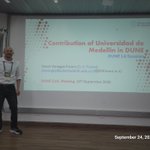
Participating in the DUNE Latin America session, part of DUNE Collaboration Meeting @Grupoctye with @udemedellin efforts in DUNE at UNICAMP
1
1
62
The event has just kicked off @Grupoctye Latin American contributions in DUNE are going to be highlighted, including ours @UdeMedellin_
1
2
68
As often quoted as a Carl Sagan's, "we are made of stars stuff" @Grupoctye @ny_acelas @AngieFFlorez
The hydrogen in your body and present in every molecule of water came from the Big Bang. There are no other appreciable sources of hydrogen in the universe. The carbon in your body was made by nuclear fusion in the interior of stars, as was the oxygen. Much of the iron in your body was made during supernovas of stars that occurred long ago and far away. The gold in your jewelry was likely made from neutron stars during collisions that may have been visible as short-duration gamma-ray bursts or gravitational wave events. Elements like phosphorus and copper are present in our bodies in only small amounts but are essential to the functioning of all known life. The featured periodic table is color coded to indicate humanity's best guess as to the nuclear origin of all known elements. The sites of nuclear creation of some elements, such as copper, are not really well known and are continuing topics of observational and computational research. Image Credit: NASA's GSFC, SVS
1
15
How exite the vacuum so that vía quantum fluctuations, "something emerges out of nothing"@Grupoctye
5
Buckmaster & Alpoge (Anthropic) Vs OpenIA for the credit on the "solution" of the Navier-Stokes millennium problem. Although the true heroes in this story are Diego Córdoba & Luis Martinez-Zoroa 👏 @Grupoctye
Nearly 200 years ago, Claude-Louis Navier and George Gabriel Stokes sought to describe the chaotic motion of fluids mathematically, writing down equations that are still routinely used by everyone from aircraft designers to climatologists. But the formulas they developed weren’t guaranteed to describe all possible conditions. Mathematicians have spent decades trying to either prove that the equations can do that or, alternatively, that there are situations in which the equations break down and give a nonsensical result. Now, OpenAI claims it has solved the Navier-Stokes problem. Thanks to an 88-hour assault by some 10,000 artificial intelligence agents—AI systems that can act autonomously—the company found a case where the equations falter. Navier-Stokes is one of six “Millennium Problems” on a list compiled by the Clay Mathematics Institute in 2000. Solving one of the problems comes with a prize of $1 million. If the apparent breakthrough is confirmed, it would mark the first time #AI has solved a truly major open problem in math. The announcement has also touched off a fierce dispute over who deserves credit for the solution. Learn more: scim.ag/4AaETAv
1
70
David Vanegas Forero retweeted
Nearly 200 years ago, Claude-Louis Navier and George Gabriel Stokes sought to describe the chaotic motion of fluids mathematically, writing down equations that are still routinely used by everyone from aircraft designers to climatologists. But the formulas they developed weren’t guaranteed to describe all possible conditions. Mathematicians have spent decades trying to either prove that the equations can do that or, alternatively, that there are situations in which the equations break down and give a nonsensical result. Now, OpenAI claims it has solved the Navier-Stokes problem. Thanks to an 88-hour assault by some 10,000 artificial intelligence agents—AI systems that can act autonomously—the company found a case where the equations falter. Navier-Stokes is one of six “Millennium Problems” on a list compiled by the Clay Mathematics Institute in 2000. Solving one of the problems comes with a prize of $1 million. If the apparent breakthrough is confirmed, it would mark the first time #AI has solved a truly major open problem in math. The announcement has also touched off a fierce dispute over who deserves credit for the solution. Learn more: scim.ag/4AaETAv
8
26
4
63
9,000
Mathematics in the era of IA, reaching a point of proving Fermat's last theorem, quite an achievement 👏 @Grupoctye
Checking that a major mathematical proof is correct can take years. Formalization—converting the mathematical reasoning into a form computer proof assistants like Lean can verify—can help. Last month, Claude completed the first formalized proof of Fermat’s Last Theorem, one of the most famous theorems of all time. This was a project experts thought would take many years. It is the largest Lean proof ever written. Fermat’s Last Theorem was first proven in 1995 by Sir Andrew Wiles, more than 350 years after it was conjectured. Our proof, which totals over 13 million lines of code, provides machine verification. More importantly, it proves over 29,000 other theorems that the proof requires, across many areas of math which had never before been formalized. We see this as a major step in the long process of firming up the core of mathematical knowledge, building on work from three centuries of mathematicians and hundreds of contributors to Lean and Mathlib. We are optimistic that AI-assisted verification of mathematical proofs will help reduce the burden of refereeing mathematics in an era where more proofs are being produced than ever before. You can read about the process on our Science Blog: anthropic.com/research/forma… And see the complete proof on GitHub: github.com/anthropics/fermat…
1
1
1
21
Well, not proving really but checking a long list of previous proofs required for Fermat's last theorem are OK (and necessary?)
11
The LZ experiment reported a single one event consistent with a nuclear recoil of 248keV, in a region where the known background expectation is low (global significance of 2.6σ when accounting for look-elsewhere effects) as coming from the scattering of a DM particle @Grupoctye
1
1
1
20
Is baryon number solely carried by the valence quarks? New results from STAR detector at RHIC suggest that baryon number is instead carried by a Y-shaped junction of gluons connecting the proton’s three main quarks @Grupoctye When interactions matter most than their constituents
A basic accounting rule in physics says whenever a particle collision creates a baryon—something like a proton or neutron that consists of three particles called quarks—it must simultaneously create a similar antibaryon. Such “baryon number conservation” implies the amount of nuclear matter in the universe is fixed. However, physicists have never determined where within a baryon the conserved number resides. For decades, the textbook answer has been simple. Each quark carries a baryon number of 1/3 and each antiquark carries a baryon number of –1/3. Because a collision can only ever make quark-antiquark pairs, the total baryon number cannot change. However, a recently published study suggests the baryon number is not carried by the quarks, but instead resides in an agglomeration of particles called gluons that bind the quarks together and is called a baryon junction. Learn more: scim.ag/45COJwU @NewsfromScience
1
1
22
David Vanegas Forero retweeted
A basic accounting rule in physics says whenever a particle collision creates a baryon—something like a proton or neutron that consists of three particles called quarks—it must simultaneously create a similar antibaryon. Such “baryon number conservation” implies the amount of nuclear matter in the universe is fixed. However, physicists have never determined where within a baryon the conserved number resides. For decades, the textbook answer has been simple. Each quark carries a baryon number of 1/3 and each antiquark carries a baryon number of –1/3. Because a collision can only ever make quark-antiquark pairs, the total baryon number cannot change. However, a recently published study suggests the baryon number is not carried by the quarks, but instead resides in an agglomeration of particles called gluons that bind the quarks together and is called a baryon junction. Learn more: scim.ag/45COJwU @NewsfromScience
20
57
2
358
55,642
Anderson discovery of the positron, not only confirmed Dirac. Any fermion is described by the Dirac equation. Particle physics models are built upon a finite number of combinations terms with Dirac fields that are relativistic invariant (16 bilinear covariants) @Grupoctye
Paul Dirac was born exactly 124 years ago today, derived the Dirac equation at 26. It described the electron in a way that reconciled quantum mechanics with special relativity and, as a side effect, predicted the existence of antimatter. He prized mathematical beauty above all else, declaring of his result: “This result is too beautiful to be false; it is more important to have beauty in one’s equations than to have them fit experiment.” The positron was discovered four years later. Dirac shared the 1933 Nobel Prize in Physics. He died in 1984 at the age of 82.
1
1
31