






Pinned Tweet
Growing up, I was always told Sheikh Mohammad Abdullah wasn't even a Muslim. His name was constantly associated with labels like Qadyani & communist, mainly by political rivals who couldn't match him or outsmart him politically & resorted to name calling instead. I was never told that his wife Madr e Meharbaan was a Hafiza-e-Quran either.
Only recently did I begin reading about him myself. One letter, written on 28 November 1958, particularly struck me.
SMA writes: "I learned the secrets of the Quran from Hussain (RA)’’
The oath of truth does not concern itself with immediate results. Outcomes are not in human hands,they belong to Divine power,which grants victory even to those who appear weak and without support."
The more I read, the more I realise how much about our own history we, the people of J&K, have never been told. I genuinely feel Sheikh Mohammad Abdullah's name has suffered a grave injustice at the hands of those for whom he sacrificed his youth and his life. We owe him an apology - A collective apology.
I got this book today from a local bookstore and believe every page of this book tells a different story about this man. Its every page is a testament of what he was. Do read this book if you honestly want to understand our collective past and want to understand Sheikh Mohammad Abdullah.


Another #letter, Another reflection on #PostboxKashmir.
Some letters leave you thinking long after you've read them. This one prompted me to put my thoughts and reflections into words.
I've penned them down. If you find a little time, I'd love for you to read.
dervishsoul.substack.com/p/l…
#PostBox #Kashmir
#Letter - God Is With Those Who Are Patient.
As I read this letter & before putting down my understanding of what #SheikhMuhammadAbdullah (SMA) was trying to convey, my thoughts immediately travelled to #Taif.
I have had the fortune of visiting #Taif city several times, #Taif, a city in #SaudiArabia approximately 90 km southeast of #Makkah, was where the Prophet ﷺ travelled in search of support, only to face rejection & hardship & I must admit that the place leaves a very different impression on me. The moment you enter Taif, something changes within you. I sometimes feel as though even its sky carries the memory of what happened there. The lanes, the surrounding mountains and the old landscapes seem to invite you to remember a painful chapter in the life of our beloved #ProphetMuhammad ﷺ.
Taif has always felt gloomy to me, as though its sky has forgotten how to smile. The date trees seem to carry the ache of that painful day, and even the sunlight appears subdued, as though it has lost some of its charm. The breeze touches you gently, yet there is a sadness in it, almost as though it carries a message from the past. I sometimes feel that the breeze in Taif has never been quite the same since that incident.
Whenever I visit the area associated with the Garden of Grapes, my thoughts return to that journey. The accounts of the Prophet’s saw suffering in Taif are difficult to read, but standing in that landscape makes the experience even more emotional. There are local traditions associated with rocks in the area, including a rock said to have remained on the mountainside and another associated with the Prophet’s saw blood. Their historical authenticity is difficult to establish, but the emotions these traditions carry among visitors are unmistakable.
The historical account itself is heartbreaking. The Prophet saw had travelled to Taif hoping that its people might listen to his message and offer him support. Instead, he was rejected, mocked and subjected to cruelty. He was driven out & people were set upon him until his feet were bleeding.
And then comes the moment that, to me, captures the very essence of what SMA is writing about.
When the Angel of the Mountains offered to crush the people of Taif between two mountains, the Prophet ﷺ refused. He did not ask for revenge. He did not wish destruction upon those who had hurt him. Instead, he expressed the hope that Allah might bring from their descendants people who would worship Allah.
I often wonder what it takes to respond to such cruelty with such compassion. To be wounded by the very people one has come to guide & yet to remain concerned about their future. This, to me, is patience at a level that is difficult for ordinary human beings to comprehend. It is not merely enduring pain; it is refusing to let pain change the goodness within you.
The memory of Taif brings to mind another place that has stayed close to my heart, . #Khandaq, on the northwestern outskirts of #Madinah, #SaudiArabia, was where the Prophet ﷺ and his companions endured the immense trials of the Battle of the Trench. If Taif reveals the depth of the Prophet’s ﷺ compassion in the face of rejection and cruelty, Khandaq takes us to a different kind of trial one of hunger, exhaustion & immense physical hardship. Both places tell different stories, yet they lead us towards the same profound lesson, the extraordinary patience & unwavering faith of the Prophet ﷺ.
I have had the honour of visiting Khandaq several times over the years & every time I have stood there, I have experienced an inexplicable feeling. There is something about the place that makes you pause. The landscape, the mountains, the rocks & the remnants of the trench seem to carry a story that time has not been able to erase. The atmosphere feels heavy with history, almost as though the place is still holding within itself the memories of what happened there nearly 1,400 years ago.


At times, I feel as though the stones are still crying & the trenches are still telling the story of what the Prophet ﷺ & his companions endured under the scorching sun. The wells seem to whisper of their thirst, while the date trees speak silently of their hunger. It is difficult to describe the emotion that overcomes me there. It feels as though the landscape itself has never forgotten their sacrifice.
Standing there, one cannot help but imagine what the place must have looked like in those days. The harsh weather, the scorching sun, the difficult terrain and very little shelter from the heat. And in the middle of all this, our beloved Prophet Muhammad ﷺ, alongside his companions, digging a trench to protect Madinah from an enormous approaching army.
It was a time of tremendous hardship. The companions were hungry, exhausted and physically drained. Jabir ibn Abdullah (RA) narrates that the Prophet had 2 stone tied against his stomach while the companions had one,because of hunger. Imagine that for a moment. The Messenger ﷺ of Allah,carrying the responsibility of an entire community, sharing their hunger and hardship rather than standing apart from them.
Yet he continued working, encouraging his companions and leading them through one of the most difficult moments in their lives.
Every time I visit Khandaq, I find myself returning to this image. A Prophet ﷺ who was hungry but never left anyone in the midlle of no where, exhausted but never abandoned his responsibility & surrounded by difficulties yet never lost his trust in Allah.
As I reflect on SMA’s letter, I begin to see how these two places illustrate different dimensions of patience. At Taif,the Prophet ﷺ teaches us how to endure rejection without bitterness. At Khandaq, he shows us how to face hardship without abandoning our responsibilities. In one, we see the strength to forgive, in the other, the strength to persevere. Neither is easy,yet both are essential to the kind of patience that SMA seems to be reminding us about.
I am also reminded of another incident from the Prophet’s ﷺ life, this time near the Kaabah in Makkah. While he was in prostration, people placed the entrails of a slaughtered camel upon his back. His young daughter, Fatima RA came running to remove them & defended her beloved father.
Whenever I think of this incident, I find it deeply moving. I imagine the distress of a young daughter seeing her father treated in such a manner & I think of the Prophet ﷺ, who continued to bear such treatment while remaining committed to his message. This incident reminds me that patience does not mean that pain is absent. The pain is real, the hurt is real & yet faith gives a person the strength not to be consumed by it.
There is another incident that brings this lesson into even sharper focus. When the Prophet ﷺ stood at Mount Safa & called the people of Makkah, he asked them whether they would believe him if he told them that an army was approaching from behind the mountain.They replied that they had never known him to speak a lie. They trusted him because he was Al-Amin, the truthful & trustworthy one.
Yet,when he conveyed his message and called them towards the oneness of Allah,many of those very people turned against him. The man whose honesty they had never questioned was now called a magician, a sorcerer & a liar.
When I bring these incidents together, I find myself asking, what kind of patience does it take to endure such treatment from one’s own people? To be trusted for one’s honesty, yet rejected for one’s message. To be hurt by those whose well-being one wishes to secure & still,to continue with the same compassion,the same purpose & the same faith.
Perhaps this is what SMA wants us to understand through this letter.He is not speaking of patience as a word we simply repeat when life becomes difficult. He is pointing towards a way of living,something that must find expression in our conduct, our relationships & our response to adversity.
1
4
100
#Letter - The Voice of God Finds Expression in Human Effort.
Some #books leave you with thoughts that deserve to be written down.
I have penned my reflections on the chapters of #PostBox #Kashmir in this blog, sharing my thoughts, interpretations & personal engagement with the writing.
Putting these reflections out into the world. Hope you find time to read.
dervishsoul.substack.com/p/l…
#PostBox #Kashmir
#Letter - The Voice of God Finds Expression in Human Effort
عمل سے زندگی بنتی ہے جنت بھی جہنم بھی
یہ خاکی اپنی فطرت میں نہ نوری ہے نہ ناری ہے
Another day, another letter &once again I find myself wondering how words written decades ago can speak so directly to our lives today. This letter is about human effort, but #SheikhMuhammadAbdullah (SMA) takes the subject much further. He is not speaking only about hard work, personal struggle or individual success.
He connects human effort with the rise and fall of nations, the growth & decline of civilisations & the values that shape the future of humanity.
At first, I wondered how the efforts of ordinary people could decide the fate of entire nations. How could something done by one person have such a big effect? But as I read further, I began to understand what SMA was trying to say.
He reminds us that nations do not always fall because someone defeats them. Sometimes, they fall because of their own actions, because they allow wrong things to become normal & slowly forget their duties towards others.
Before going further, there is something I want to share. The more I read this book, the stronger my feeling becomes that these letters were perhaps never meant only for friends or colleagues. They seem to speak to a much larger audience a nation, its people and perhaps even generations yet to come.
At times, they read like advice, at other times, like a warning or a gentle reminder of what we owe to one another. Whatever their original purpose, I cannot help feeling that Sheikh Muhammad Abdullah was speaking about things that would remain important long after his own time.
The heading of this letter particularly caught my attention, The Voice of God Finds Expression in Human Effort.
I read it once, then went back to it. What does it really mean for the voice of God to find expression through human effort? Is SMA suggesting that when our actions are guided by goodness and honesty, they become a reflection of what God wants from us?
This is where my thoughts began to wander.
I thought of a person who stands beside someone being treated unfairly, even when there is nothing to gain from doing so. I thought of someone feeding a hungry stranger, helping a person in trouble or reaching out to someone whose suffering may never be noticed by the world. Perhaps God's voice finds expression in these very moments. Perhaps it is not always heard in places of worship or through big speeches about faith. Sometimes, it is heard through the conscience of an ordinary person who simply cannot turn away from someone else's pain.
And then another thought came to me. Could SMA also be referring to that quiet voice within us which tells us what is right and what is wrong, especially when nobody is watching?
I thought of Prophet Yusuf (AS), who resisted the advances of Zulaykha even when he was placed in a situation where giving in to temptation might have seemed easy. I also recalled the account of a companion of Prophet Muhammad (PBUH), who would leave Masjid Nabawi saw immediately after Fajr prayers. When the Prophet SAW asked him why he hurried away, the companion explained that his children had been hungry for days, and he feared they might eat dates that had fallen from his neighbour's tree. He could not allow his family's hunger to become a reason for taking what did not belong to them.
Imagine that moment. A hungry father, children waiting at home & yet a conscience that would not allow him to do something he believed was wrong. Perhaps nobody would have known. Nobody might have questioned him. But he knew & that was enough.
I find something deeply moving in this. Perhaps the voice of God is also that which we hear when we are alone, when temptation is within reach, when nobody can see what we are about to do & yet something within us asks us to stop. And perhaps the effort to follow that inner voice, especially when it is difficult, is itself an act of devotion.


As I continued reading, SMA moved from the responsibility of one person to the responsibility of entire nations. He writes about how nations can perish because of their own actions, just as they can survive & grow through the choices they make. Many nations have risen, built great civilisations, developed knowledge, culture & strong institutions, yet eventually disappeared. What happened to them? What made societies that once stood so tall lose their place in history?
SMA seems to suggest that their decline began when people stopped doing what was right, when they lost their sense of duty & when their actions no longer matched the values they claimed to believe in.
They were eventually replaced by other nations, perhaps less advanced in culture & outward appearance, but stronger in their values, determination and willingness to act.
This thought made me pause. How often do we mistake wealth, buildings, institutions & power for the true strength of a society? We speak about progress & achievements, but do we give the same importance to the character of the people who make that progress possible?
A society may have everything that makes it look powerful, yet its decline can begin when its people lose their sense of responsibility.
SMA refers to the Quranic teaching that the ways of Allah do not change. I understand this as a reminder that no nation can escape the results of its actions. History does not protect a society simply because it once had a glorious past. Every generation must prove itself through its actions. Honesty, strength & the courage to do what is right are not things that can be passed on forever. Every generation has to keep them alive.
This immediately took my thoughts to the first sermon of Hazrat Ali (AS) as Ameer-ul-Momineen, particularly his call for people of action rather than people who only speak. I find this thought very powerful. It reminds me that the greatness of a society does not lie in how beautifully it speaks about justice, honesty and truth, but in how sincerely it follows these values. Words can inspire people, but only action can bring real change.
And then another Quranic verse came to mind, one that carries a serious warning, if you turn away, Allah will replace you with another people, and they will not be like you (Surah Muhammad, 47:38).
There is something very humbling about this thought. It reminds us that no nation, no community & no generation is indispensable. The chance to serve humanity, stand for justice and build something meaningful is a blessing, but it is also a responsibility. We cannot assume that the world will wait for us forever or that history owes us a permanent place. If we fail to fulfil our duties, others will take our place.
And perhaps this is what makes SMA's letter so important even today. He seems to be reminding us that the future of nations is shaped not only by great leaders or major events, but also by the everyday choices of ordinary people.
Standing with the weak, speaking against injustice, refusing to give in to temptation & working for something bigger than ourselves, these are not just personal qualities. Over time, they become the foundation of a strong society.
The more I think about this letter, the more I feel that SMA is asking us to look beyond what we have achieved and think about what we have become. Are we using our strength to protect others? Are we using our knowledge to help humanity? Are we living by the values we so often speak about? And, perhaps most importantly, are we making the best use of the opportunities life has given us?
I am left with one thought, perhaps the voice of God does not find expression merely in what we believe, but in what we choose to do with that belief. It finds expression when our conscience turns into action, when compassion becomes service and when faith gives us the courage to stand for what is right.
1
6
175
#PostBox #Kashmir
#Letter - The Dust of the Beloved’s Path
ستاروں سے آگے جہاں اور بھی ہیں
ابھی عشق کے امتحاں اور بھی ہیں
One more letter, but this time Sheikh Muhammad Abdullah does not dwell on faith or religion. He speaks about philosophy. Yes, the philosophy of life, perhaps one shaped by the many experiences,struggles & ups & downs of his own journey. From an ordinary man with a business background, born & raised in Soura, to becoming one of the most tallest leaders of J&K, SMA had travelled a long & remarkable road. His reflections on life seem to carry the wisdom of those experiences,while drawing inspiration from the spiritual & religious world that shaped his thinking.
While responding to a colleague, SMA writes that life means moving forward & meeting people along the way. But he adds something rather profound,sometimes,while walking, one must pause briefly to gather strength for the journey ahead. Such pauses are meaningful only when the traveller knows his destination. There is no harm in stopping for a moment to catch one's breath, provided the intention remains unchanged to continue towards the goal with even greater determination.
This particular passage made me think about many things
In my reading, SMA was reminding his friends & colleagues of the importance of remaining focused on the path they had chosen. Life brings people into our lives, but not everyone who walks beside us will always understand our thoughts, convictions or vision. Those who stand with us today may disagree with us tomorrow, some may even become our adversaries. But should the opinions of others determine the direction of our journey? Perhaps NO
Perhaps SMA was saying that it is perfectly fine to pause, reflect, gather strength & even change the route. Taking a different path does not necessarily mean abandoning the destination, sometimes, only the approach has changed. Others may not understand that change & their criticism or disappointment should not discourage us. Keep moving, even if it is only in baby steps. The journey is long & there is no shame in pausing, provided we do not lose sight of where we wish to go.
SMA also seems to be urging his colleagues to discover a purpose for their lives,a goal worth pursuing,an ideal worth struggling for & a cause meaningful enough to dedicate one's existence to. A life should not revolve merely around personal comforts, ambitions & interests. It should be a life worth living for others,not just for oneself.
In my view, SMA is asking his readers to look within,reflect upon their existence & redefine the purpose of their lives. For what is human life if it is reduced merely to eating, sleeping & passing through the days? What distinguishes us is our ability to think, to dream, to struggle for an ideal & to make our existence meaningful for others. A life without purpose risks becoming little more than mere existence.
I also find myself reflecting on the different phases of life. There are moments of happiness,moments of anger & disappointment & periods when the burdens seem almost unbearable.Yet, through all these phases,we must not become prisoners of our own little world. We must learn to live for others, to share their struggles & to make our lives meaningful beyond our individual selves.
Another thought that emerges from this letter is that when the destination is unclear,distractions multiply & the journey can easily turn into aimless wandering. One may remain occupied throughout life & yet never really know what one is moving towards. Perhaps that is why the purpose of life demands such complete devotion that the path of the beloved occupies the traveller so completely that no devotion is left for another threshold. It is a deeply spiritual image,but its meaning can reach every aspect of human life.
Human history,after all,is the story of growth,development & an endless search for something better.Human beings have always aspired to move beyond what they have already achieved.


One stage of life leads to another, & once a stage has passed, it can never truly be revisited. Perhaps SMA is reminding his friend that the tendency towards progress reveals a fundamental truth, no destination is ever complete in itself. The moment we accomplish something, another aspiration begins to take shape. One destination gives birth to another & every achievement opens the door to a new challenge. Humanity has always been confronted with material and moral limitations, but it is through the devotion of our full intellectual & spiritual energies that we rise above them & advance further. Perhaps this is what SMA wishes to convey, life itself is an evolving process. Time opens new chapters, brings new challenges & demands newer understandings. What matters is to carry a vision, nurture an awakened consciousness & possess the courage to recognise the possibilities hidden within every new beginning.
And then SMA makes an observation that I find particularly profound. He does not confine his thoughts to a particular religion, community or region. He speaks of humanity itself.
He reflects that had life been merely a natural cycle, like the changing seasons, governed without will or consciousness, humanity could never have reached the stage at which we find it today.
To me, this is a remarkable observation. Human progress has not been merely the result of the passage of time. It has been driven by will, consciousness, imagination, purpose & the courage to move beyond existing limitations. We are not here simply to pass through life, we are here to give it meaning.
Reading this letter, I find myself looking beyond SMA the political leader. I see a man reflecting upon the meaning of existence, the importance of purpose and the responsibility of living for something greater than oneself.
Perhaps his message is that life is not measured by how far we travel, how many people accompany us, or how often we pause along the way. It is measured by whether we know why we began the journey, whether we have the courage to continue when the road becomes difficult & whether our journey leaves something meaningful behind for others.
1
5
174
#PostBox #Kashmir
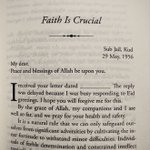
#Letter – Faith Is Crucial
In another letter, #SheikhMuhammadAbdullah turns to a subject that lies at the very heart of human character & collective destiny - FAITH.
In my view, Sheikh Muhammad Abdullah is addressing not only his colleagues & friends, but the nation itself, urging them to hold firmly to their faith. Faith gives birth to conviction & conviction, when translated into action, further strengthens faith. It is a continuous process, Emaan se Amal hoti hai, aur amal se Emaan mazboot hota hai. Faith inspires action & action deepens faith.
But this journey is not without hardship. It demands patience, sacrifice & the willingness to walk over thorns without losing sight of the destination.
SMA cautions against the mindset that seeks immediate gratification for every effort & instant results for every sacrifice. He observes that people with weak determination & limited vision become attached even to the smallest comforts of the present, giving little thought to the demands of the future.
As I understand it, the deeper implication is that he was reminding his colleagues & through them the nation, that great achievements cannot be built on impatience. People cannot abandon their convictions simply because the fruits of their labour are slow to appear. Lasting change requires steadfastness & ultimate success comes with the help & grace of Allah.
As I read this letter, my thoughts naturally turn to the lives of the Prophets AS. I find myself wondering whether SMA too, had the lives & experiences of the Prophets in mind when referring to this, or whether their examples had already informed his thinking before he put pen to paper.
The lives of the Prophets and their Companions offer powerful testimony to this truth. Prophet Ibrahim (AS) stood firm in faith even when he was cast into the fire. Prophet Yusuf (AS) endured betrayal, separation and imprisonment without losing his trust in Allah & our beloved Prophet Muhammad (SAW), despite years of rejection and hardship, never abandoned his mission.
In my view,There is perhaps another dimension to SMA’s message. Faith is personal, but its real strength becomes visible in times of tribulation, not merely when life is comfortable or when we are at the top of the world. Perhaps faith, in its truest sense, is also patience, the ability to stand in the darkest hour, with the conviction that a new dawn will come. A dawn that brings hope, prosperity & above all, relief to mankind.
Faith must also shape how we treat others. Justice, fairness & the protection of people's rights demand a conscience rooted in the fear of Allah. A person who believes they are answerable to God cannot casually deny another person their due or allow worldly interests to dictate what is right.
Reading this letter, I am left wondering whether SMA was conveying something larger than a call for personal steadfastness. Perhaps he was reminding an entire nation that its future would depend not merely on political aspirations or material progress, but on the strength of its faith, the depth of its conviction and the integrity of its actions.
Faith must become conviction, conviction must become action & action must become justice. Only then can the foundations of a truly dignified society be laid.


#PostBox #Kashmir
#Letter- In Whose Eyes Has the Radiance of dust settled?
Some letters are not meant to be read merely with the eyes, they must be understood with the heart & some words carry a radiance that remains concealed beneath the dust of forgotten history
#SheikhMohammadAbdullah's letters are beginning to reveal something extraordinary to me. I increasingly feel that these letters were never meant merely for the individuals to whom they were addressed. Whether SMA was writing to a colleague, a friend or someone close to him, I cannot help feeling that his intended audience was much larger. In a sense,he was writing to a nation.
A nation that, in his estimation, was still in its infancy.
Perhaps SMA was not simply writing letters,he was preparing a nation for a future it was not yet intellectually, morally or spiritually equipped to embrace.He wanted to educate it, awaken it & teach it to stand on its own feet. Yet he must also have understood that a nation still in its infancy would not necessarily comprehend the depth of the words he was trying to convey.
He knew, perhaps,that there were many Samiris in its midst,People whose deceptive magic could captivate the masses,leading them towards gardens of illusion, comfort and complacency. While others were content with keeping people enchanted, SMA wanted to see them awakened,educated & empowered.
He envisioned a society in which women could embody the strength, wisdom & faith of Hazrat Hafsa RA & Hazrat Fatima RA,where men could draw inspiration from Hazrat Abu Bakr Siddique RA, Hazrat Abdullah ibn Masud RA & Hazrat Abu Dhar al Ghifari RA,the Imam of Zuhd. He wanted people to cultivate something of the courage,knowledge & spiritual stature of Hazrat Ali RA, while expecting his colleagues to reflect the humility,generosity & character of Hazrat Usman RA
In other words,he was not merely imagining a politically awakened society.He was dreaming of a morally elevated & spiritually conscious nation
The more I read these letters,the more I feel that SMA possessed a metaphysical & spiritual world that perhaps very few people around him could fully comprehend. I sometimes wonder whether Fakir-e-Millat, Syed Mirak Sb ra, recognised that dimension of his personality. Their meeting, friendship & spiritual association seem to have brought SMA into contact with a world of thought and understanding that is rarely discussed in the familiar accounts of his life.
Perhaps the guidance & companionship of Fakir-e-Millat opened new doors of spiritual reflection for him.I cannot say with certainty what transpired within that relationship,but I do feel that there was a bond between the two that deserves much deeper exploration.
It may also help explain something about SMA's later life,his apparent indifference to public opinion. Perhaps it was not arrogance nor a disregard for people but the confidence of someone whose inner convictions had become stronger than the world's approval or disapproval. I find myself wondering whether his spiritual outlook had given him a different way of looking at the realities of this world & the unseen
Then comes the opening passage of this particular letter,which is even more striking
SMA makes a powerful observation about faith,a claim of belief & an expectation of loyalty from those who stand against that belief cannot comfortably coexist in the same heart. Even when the person on the other side happens to be a father,a brother or someone bound to us by worldly relationships,faith must ultimately determine where our deepest allegiance lies
This immediately took my mind to the #BattleofBadr (يَوْمُ الْفُرْقَان) & to the difficult choices faced by the early Muslims when family relationships stood on one side & their commitment to the Prophet Muhammad SAW stood on the other. The account of Hazrat Abu Bakr Siddique RA & his son,who was then on the opposing side, is particularly striking in this context. It reminds us how profoundly the companions


understood the distinction between the ties of blood and the demands of faith.
I cannot say whether SMA was consciously drawing upon this particular historical episode, but the parallel is difficult to overlook.
He makes another observation that is equally profound, if our wealth, children and everything we hold dear become more beloved to us than the Prophet Muhammad SAW, then our claim to the highest station of faith remains incomplete.
Here, my thoughts turn towards the famous incident involving Hazrat Umar Farooq RA. When the Prophet SAW asked him whom he loved most, Umar RA initially placed the Prophet's love above all others except his own self. The Prophet SAW reminded him that his love for the Messenger must exceed even that. Umar RA then acknowledged that the Prophet was dearer to him than his own self. To this, the Prophet SAW responded, Al-aan, now, you have reached it.
What a profound lesson in the nature of faith and love. It is not merely about professing devotion, it is about reaching a stage where that devotion becomes the centre of one's existence.
The more I read SMA's letters, the more I feel that they were intended as guidance for generations yet to come. They contain advice, warnings and reflections for a society that was still taking shape. Sadly, many of us never had the opportunity to encounter this dimension of SMA during his lifetime, nor were we adequately introduced to it afterwards.
Another passage in the letter takes this reflection even further. SMA seems to be reminding his readers that remaining steadfast upon the path of Allah will inevitably bring tests and tribulations. One may be tested through the loss of wealth, the loss of children, fear of hunger & other hardships. These are not necessarily signs of abandonment, they are among the trials through which faith, patience & conviction are tested.
He draws attention to the temporary nature of worldly possessions & worldly losses. What we gain & what we lose in this life are small when measured against the love of Allah and His Messenger SAW & the reward that awaits those who remain steadfast.
He then invokes the Quranic promise
إِنَّ اللَّهَ عِندَهُ أَجْرٌ عَظِيمٌ
Indeed, with Allah is a great reward.
At this point, SMA turns our attention towards the companions of the Prophet SAW & the sacrifices they made. He does not necessarily enumerate their names, but as I read his words, my thoughts immediately travel to Hazrat Sumayyah (RA), Hazrat Yasir (RA) and Hazrat Bilal (RA).
I think of the suffering they endured in Makkah before the Hijrah, of Hazrat Sumayyah (RA) & Hazrat Yasir (RA), who paid the ultimate price for their faith & of Hazrat Bilal (RA), whose body was subjected to unimaginable cruelty for refusing to abandon his belief in the Oneness of Allah.
These were people who possessed almost nothing in worldly terms, yet their faith was so immense that no worldly power could break it. The same companions who endured persecution, humiliation and deprivation would go on to become the bearers of a civilisation that transformed the course of history.
And then SMA appears to bring the discussion back to his own times, inviting his readers to look at the condition of their own society. If those early believers could endure such extraordinary trials and emerge with such conviction, what explains our own weakness, our compromises & our inability to rise above our circumstances?
SMA invokes #Allamaiqbal
کون ہے تارکِ آئینِ رسولِ مختارؐ؟
مصلحتِ وقت ہے کس کے عمل کا معیار؟
کس کی آنکھوں میں سمایا ہے شعارِ اغیار؟
ہوگئی کس کی نگہ طرزِ سلف سے بیزار؟
قلب میں سوز نہیں، روح میں احساس نہیں
کچھ بھی پیغامِ محمدؐ کا تمہیں پاس نہیں
Perhaps this is what makes these letters so extraordinary. They are not simply historical documents nor are they merely the personal correspondence of a political leader.
#PostBoxKashmir
#Letter-Blessed is the Nation whose soul is Restless
Sheikh Muhammad Abdullah’s letters are beginning to feel increasingly personal with each passing day. The more I read, the more fascinating history becomes. They reveal things we were perhaps never told, taking us beyond familiar political narratives and allowing us to rediscover SMA.
This is a side of SMA that perhaps even his comrades-in-arm could not fully narrate to the nation, let alone his political adversaries. Decades of political propaganda & relentless attacks on his image in J&K may have overshadowed dimensions of his personality that deserved to be explored.
While reading this particular letter,I felt something different. Although SMA was writing to a colleague or a friend,I could not shake the feeling that he was addressing a much larger audience, perhaps the nation itself,especially its younger generations.
He reflects on a profound truth about the destiny of nations,as long as people remain committed to righteous deeds, they retain their strength & standing. But when they surrender to luxury, indulgence and inaction,gradually turning away from the remembrance of Allah, their decline begins. He reminds us that this is the way of Allah & that the destiny of nations is ultimately shaped by their actions & intentions.
What I find particularly profound is that he does not attribute the rise or fall of nations simply to politics,power or changing circumstances.He takes the discussion somewhere much deeper,to the relationship between the individual & Allah,to righteous deeds,remembrance, purity of intention,spiritual conviction & the ability to remain steadfast in moments of triumph as well as tribulation.
To me, he seems to be conveying that before a nation can rediscover its greatness,its people must rediscover the greatness within themselves.A nation cannot truly rise unless its individuals work on their own character,strengthen their connection with their Creator & live by the values they profess.
Reading this, I was reminded of Alama Iqbal's beautiful couplet
Apne man mai doob ke paa ja suragh-e-zindagi,
Tu agar mera nahi banta, na ban, apna tou ban
Perhaps this is the very spirit of what SMA is trying to convey,look within before looking for answers outside. Rediscover yourself before setting out to rediscover the greatness of your nation.
His reflections on governance are equally revealing.He speaks of the promise of Allah being granted to those who prove themselves worthy through their deeds.I do not read this merely as a call for political struggle,but as an appeal for inner strength,righteousness & self-improvement.
Remain steadfast through difficulties. Do not blame others for every setback.Carry humility in moments of victory & patience in times of defeat.Above all,cultivate within yourself the character & capacity to become worthy of what you seek from Allah.
There is a spiritual,perhaps even metaphysical dimension to these letters that I am still trying to comprehend. At times,I struggle to fully grasp the context in which SMA wrote these words. Some of his reflections carry a depth that makes one pause & read them again. They seem to emerge from an inner world of thought and spirituality that perhaps very few around him could fully appreciate.
I sometimes wonder how many people around him truly understood the depth of that inner world.
44 years after his passing, Sheikh Muhammad Abdullah continues to live in people's memories in the political consciousness of J&K remarkably, in the metaphysical presence of its political discourse.His name,ideas & legacy continue to shape conversations even today.
Perhaps that is the greatest revelation these letters offer, Sheikh Muhammad Abdullah was not merely a political figure of his time.There were dimensions to him that we are only now beginning to discover & perhaps,as we continue to read,reflect & look beyond familiar narratives,generations after us will discover even more.


Friday is a blessed day,often described as Eid for the believers.For an Ashiq e Rasool SAW,it carries a special meaning,a day when millions of Durood-o-Salaam are sent towards Madinah-e-Pak, upon our beloved Prophet Muhammad (SAW),whose love is dearer to us than anything this material world has to offer.
On this blessed Friday, I came across a letter written by Sheikh Muhammad Abdullah on Milad-un-Nabi SAW & once again,discovered a side of SMA I had barely imagined.
I had come to appreciate his understanding of the Quran through his writings. But I had little idea of the depth of his Ishq-e-Rasool SAW or the spiritual vision with which he approached the life and teachings of the Prophet.
What SMA writes is particularly profound. He reminds us that Durood should not remain confined to our tongues, its not merely a lip service,it must find expression in our character, conduct & actions.Our lives should reflect the teachings of the one we claim to love.
SMA writes: "A believer has but one threshold before which to bow, one love to fill the heart, one chain for the feet and one collar of obedience around the neck."
He then invokes these beautiful verses in praise of the Messenger of Allah,
Why should the blessed age not proclaim,Send blessings upon him
Upon whose shoulders rests the burden of intercession,Send blessings upon him
For you are the mercy of the Lord of the worlds,Send blessings upon him
May the weak & helpless community remain devoted to you, Send blessings upon him.
You who save those who sacrifice themselves amid the waves of calamity, Send blessings upon him
You who wrap the sinner in the cloak of Divine mercy,Send blessings upon him
اللَّهُمَّ صَلِّ عَلَىٰ سَيِّدِنَا مُحَمَّدٍ وَعَلَىٰ آلِ سَيِّدِنَا مُحَمَّدٍ وَبَارِكْ وَسَلِّمْ.
The more I read,the harder it becomes to reconcile this deeply spiritual expression of love with the religious labels casually attached to Sheikh Muhammad Abdullah.
Political differences are legitimate,but they should never become an excuse to malign someone's faith, question their love for the Prophet or assassinate their religious character.
I also find myself thinking of Syed Mirak Shah Sahib (RA),Fakir-e-Millat, whose spiritual stature commanded reverence across Madhhabs.
When the reconstruction of Dargah Hazratbal was undertaken,Sheikh Muhammad Abdullah visited Mirak Shah Sahib at Shalimar to seek his approval. Mirak sb agreed & Subsequently,Fakir-e-Millat laid the foundation stone of the reconstructed shrine on 12 November 1969.
Sheikh Abdullah did not merely oversee the reconstruction in his capacity as head of the Auqaf. He went from home to home, shop to shop, through the lanes & alleys of J&K,personally collecting donations for the sacred Astaan e aliya that houses the holy relic of Prophet Muhammad (SAW). SMA was immersed, heart and soul, in the Ishq-e-Rasool (SAW).
A towering political leader, yet willing to walk the streets for the service of Astaan e aliya so deeply connected with the love and reverence of the Prophet & Holy relic
People may agree or disagree with Sheikh Mohammad Abdullah's politics. That is their right. But every prayer offered at Dargah Hazratbal, every Durood recited beneath its dome & every heart that finds spiritual solace within its walls reminds us of the institution to whose reconstruction he devoted so much of himself & he continues to receive a share in the reward for ever every prayer & durood recited beneath it’s dome
Perhaps we have spent generations debating his politics while barely attempting to understand his faith, his devotion & the spiritual dimension of his personality. There was much more to the man than the history we chose to remember.
As my Peer-o-Murshid beautifully says,
Itni Huzoor (SAW) naal muhabat zaroor kar ke jaana, ki jab rooh mere paar’a khaaki se nikle, tou Roze se awaaz aayi,
Oh mera Faqeer aaya.
May Sheikh Muhammad Abdullah's Ishq-e-Rasool be remembered with the dignity it deserves.
Ameen.


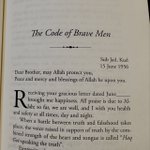
The Code of Brave Men
One more day, one more letter & another glimpse into a side of Sheikh Muhammad Abdullah that we rarely get to see.
I read this letter a couple of times & then went back to it again. Not because I couldn't understand it but because I found myself wondering, Am I reading about the same Sheikh Muhammad Abdullah whom we were taught to see through the labels of a Qadyani, a communist & a man supposedly distant from religion?
Addressing his colleagues on 15 June 1956, Sheikh Muhammad Abdullah offers something far more profound than political advice. He urges them to remain steadfast in their commitment to truth, to speak when truth demands to be spoken & to fear Allah above all else not the people.
What follows is particularly remarkable. Sheikh Muhammad Abdullah invokes the teachings of #ProphetMuhammad SAW.
"If anyone knows a true word, he should say it and fear of people should not prevent him."
He then recalls another saying of the ProphetMuhammad SAW ‘’No one should consider himself insignificant."
When the Companions ask how anyone could consider himself insignificant, the Prophet Muhammad SAW explains that it is when a person feels the need to say something concerning Allah but remains silent out of fear of people. On the Day of Judgement, Allah will ask what prevented him from speaking. He will answer, "The fear of people." To which Allah will say, "You should have feared Me the most."
I found myself pausing here. There is something extraordinary about the moral and spiritual conviction reflected in these words. This is not merely a man quoting religious teachings, this is a man urging others to live by them.
And it makes me wonder whether we have fundamentally misunderstood Sheikh Muhammad Abdullah. The political labels attached to him have perhaps overshadowed an intellectual and spiritual side that deserves far greater attention.
I also find myself reflecting on the confidence Mirak Shah Sahib (RA) must have placed in Sheikh Muhammad Abdullah when he entrusted him with the reconstruction of the #Dargah #Hazratbal shrine. Could it have been his understanding of the #Quran, his religious vision and his ability to communicate its message that inspired such confidence? It is a thought worth exploring.
Perhaps his political opponents understood his mass appeal, but never quite appreciated the depth of the thought and religious understanding that informed his speeches.
For years, we have heard the story that Sheikh Muhammad Abdullah would sell the #Quran in his public speeches but after reading these letters, I find myself questioning how much of what was circulated about him was actually an attempt to discredit a man whose command over religious thought and public oratory was difficult to match.
The more I read these letters, the more I realise that the Sheikh Muhammad Abdullah preserved in popular memory may be only a fraction of the man who actually existed & perhaps that is the greatest tragedy, we have spent generations debating his politics, while barely attempting to understand his inner self.


Picking up from where I left off yesterday, I am increasingly struck by how much falsehood has been woven around Sheikh Mohammad Abdullah not over a few years, but across generations. One lie built upon another, until a carefully constructed narrative began passing for history.
While reading Post-box Kashmir, I stumbled upon something that made me pause. It dawned on me how little we actually know about Sheikh Muhammad Abdullah & how much of his intellectual and personal world has remained concealed from public memory.
Consider this letter, titled ‘THE CHOICE RESTS IN YOUR OWN HANDS - THE HEART OR THE BELLY’’ What struck me was not just its argument, but the depth of Sheikh Abdullah’s understanding of the Quran and his ability to draw meaning from its sacred verses.
He invokes the episode of Prophet Yusuf (AS), reminding us that Yusuf was imprisoned not for committing a sin, but for refusing to commit one.
There is something deeply revealing in this reference, a glimpse of Sheikh Muhammad Abdullah’s spiritual depth, moral conviction and an inner world that history has rarely cared to explore.
Perhaps the greatest injustice we have done to Sheikh Mohammad Abdullah & in doing so to ourselves is not what we have said about him, but what we have deliberately chosen to forget. Our hatred clouded our judgement, our fragile egos stood in the way, and somewhere along the way, we allowed our prejudices to rob us of the chance to truly understand the man.


You can find this book online on Amazon
amzn.in/d/00LFmU9u


4
399
Since you mentioned Party headquarters- Listen, Nawai-e-Subh is more than a party office,its walls carry generations of struggle & the hopes of a people. The sacrifices and organisational leadership of Sheikh Nazir in particular helped hold the party together and shape this

NC must understand that Kashmir's political landscape is bigger than its party headquarters and its dynastic ambitions. A young woman's entry into politics should be welcomed as democratic participation, not treated as a political threat.
2
7
1,392
institution into a part of Kashmir’s political history. Some addresses house parties, Nawai-e-Subh preserves a legacy. @ImranNDar @JKNC_ @OmarAbdullah
2
365
PDP & other district parties should understand that the NC,rooted in the 1931 movement has weathered decades of attempts to break it. It still stands like a blazing Chinar,with grassroots across J&k, Pir Panjal & Ladakh regions where some critics barely exist beyond paper.
NC must understand that Kashmir's political landscape is bigger than its party headquarters and its dynastic ambitions. A young woman's entry into politics should be welcomed as democratic participation, not treated as a political threat.
4
392
The classic unprepared examinee, handed a 10-mark question, fills 32 pages, writes everything except the answer, and walks out convinced they've topped the exam ;)

After the BJP MLA @ShagunParihar_’s communal & untrue statement, "Masjidoo sai elaan hota hai, Hum in ko maaray gai," the entire right-wing ecosystem is on its toes to criminalise the place of worship of Muslims. Let the facts about the MASJID be put straight;
The Masjid a place of worship & solace which spreads mercy, not conspiracy or fear. It is a university of character, a court of conscience & an institution that polishes an ordinary human into a disciplined & compassionate citizen.
It is a place where a Muslim goes with his head bowed down to repent, to nourish his human character, to control his anger, to fear doing wrong, to give up his pride, to be disciplined, to feed the hungry, to protect the weak, to respect his neighbour, and to love and serve the whole of mankind, irrespective of religion, caste, or colour.
It is a place that turns a broken man into a builder, a sinner into a saint, and a common human into a mercy for all mankind. It turns darkness into light, hatred into love, and fear into hope. From the Masjids came the message that gave rights to women when the world buried them, that freed slaves when the world traded them, that taught cleanliness when the world lived in filth, and that taught education when the world lived in darkness.
If you want to know Islam, do not judge it by the hate a politician spreads to secure a vote bank. Come and sit in a Masjid. See the old man crying in sujood, asking forgiveness with a broken heart. See the young boy learning discipline, respect, and love. See the rich & the poor standing shoulder to shoulder in one row, with no caste, no class, no colour, all equal and united as humans.
Interesting to see the entire PDP ecosystem rallying behind a new entrant. Quite a show of solidarity. Carry on 🍿🍿🍿

Ruwa @ShahRuwa deserves to be welcomed and appreciated as she seeks to enter electoral politics. She has endured immense suffering throughout her life, particularly over the past seven years.
The @JKNC_ continues to do what it has done in the past: discourage people from entering electoral politics, driven by vanity and a misplaced sense of entitlement. It seems to believe that it has a monopoly over the political space and feels threatened whenever someone chooses to take the electoral path.
1
6
510
Before lecturing others on political expediency, look at your own patron. Mufti Sayeed, as Union Home Minister, introduced the J&K AFSPA Bill in Parliament in August 1990. He later took the PDP into a coalition with the BJP in 2015. Where was ideological consistency then?

In Kashmir the National Conference advocated two opposite ends of the political spectrum —-> pro - Pakistan plebiscite to pro- India secession purely out of political expedience. Their top leadership once garlanded Jinnah with a string of shoes only to wave Pakistani salt during elections to trick gullible voters.
Ostensibly the NC also speaks of mainstream & reconciliation both in the same breath. But when news of a young Kashmiri woman getting into politics surfaces all hell breaks loose.
@ShahRuwa hasn’t just inherited a rich political legacy but suffered immense tragic personal losses. From seeing her grandfather’s own journey spanning from a mainstream electoral politician to a hardcore separatist, helplessly seeing her father take his last breaths in jail to being indiscriminately targeted and deprived to mourn own losses.
If this young woman ever decides to take a plunge into Kashmir’s turbulent political waters why must it evoke such petty insecurity & appalling ad hominem remarks?
Kashmir’s politics isn’t the fiefdom of any single party. And who erroneously assume so do it only at their own peril.
6
416
The Jinnah shoe garland story lacks credible historical evidence & remains political folklore used to malign Sheikh Abdullah. As for the Paki salt,Sheikh Abdullah was bedridden after a heart attack, Madr e Meharbaan led the 1977 NC campaign.SMA had no personal role in the episode
In Kashmir the National Conference advocated two opposite ends of the political spectrum —-> pro - Pakistan plebiscite to pro- India secession purely out of political expedience. Their top leadership once garlanded Jinnah with a string of shoes only to wave Pakistani salt during elections to trick gullible voters.
Ostensibly the NC also speaks of mainstream & reconciliation both in the same breath. But when news of a young Kashmiri woman getting into politics surfaces all hell breaks loose.
@ShahRuwa hasn’t just inherited a rich political legacy but suffered immense tragic personal losses. From seeing her grandfather’s own journey spanning from a mainstream electoral politician to a hardcore separatist, helplessly seeing her father take his last breaths in jail to being indiscriminately targeted and deprived to mourn own losses.
If this young woman ever decides to take a plunge into Kashmir’s turbulent political waters why must it evoke such petty insecurity & appalling ad hominem remarks?
Kashmir’s politics isn’t the fiefdom of any single party. And who erroneously assume so do it only at their own peril.
6
451