

🏛 🏺🌿 Hellenic Culture | Hellenic Open University 🎥 Graphic Design 📰 Reporting @GreekReporter @GreeceHighDef @TheArchaeologist @ConservaCrew
Θεσσαλονίκη, Ελλάς
Joined July 2020
- Tweets508
- Following1.5K
- Followers616
- Likes3.4K




Dimosthenis Vasiloudis 🇬🇷 retweeted

2,700 Years of Pontic Greek History: an atlas of the Greeks of the Black Sea coast, from the founding of Trapezous in 756 BC to the exchange of 1923.
Twelve chapters, 1,735 towns and villages, the peoples beside them, every source named.
iosiflazaridis.github.io/pon…


Dimosthenis Vasiloudis 🇬🇷 retweeted
The birthplaces of all 82 philosophers who have their own Life in Diogenes Laertius’ Lives of Eminent Philosophers, as Diogenes gives them.


Dimosthenis Vasiloudis 🇬🇷 retweeted

The statue of Prometheus is finally finished.
It was cast in Paris, crossed the Atlantic, and was assembled at Starbase. It took us 100 days to go from nothing to this.
People of the West, we have lived through an era devoid of dreams, devoid of destiny.
But the time has come to reclaim our dream of antiquity.
In a few months, we will start building a new city. It will be the most magnificent city in all of history.
After all, the great dream of the West has always been to rebuild Rome.
Come walk beside us in this endeavor. The world is waiting.


Dimosthenis Vasiloudis 🇬🇷 retweeted

Turkey is not a normal country

Dimosthenis Vasiloudis 🇬🇷 retweeted

Around 1,000 Greek words can’t be traced to any Indo-European language. Where do they come from?
In this issue of the Linguistic Discovery newsletter, we’ll dig through layers of linguistic history to reveal the mystery language that influenced Ancient Greek.
linguisticdiscovery.com/post…

Dimosthenis Vasiloudis 🇬🇷 retweeted

Dogs are humanity's best friend—but how long has it been that way? 🐕
A 2020 Science study investigated ancient dog genomes, revealing a complicated genetic legacy that reflects a long, shared history with humans.
Learn more on #InternationalDogDay: scim.ag/4mQjPbv

Dimosthenis Vasiloudis 🇬🇷 retweeted

A new war is coming, and soon humanity will have to choose sides. With the Greek or with the barbarian. With those who create civilizations or with those who create problems and destroy civilizations.
The jihadist Turk Erdogan yesterday publicly said in the Turkish parliament that he "reminisces about the Turks of the epic of the victory of Manzikert (26 August 1071) who cooled their swords in the waters of the Aegean and the Black Sea", wishing that way for a new Ottoman Empire. Jihadist Erdogan wishes for a war with Greece.
He referred to the victory of the Seljuks against the Greeks of the Eastern Roman Empire in the battle that opened the gates for the barbarian conquerors into the ancestral lands of the Greeks in Anatolia. Of course, there were no great Turkish warriors; their victory was decided purely by the mistakes of the Greeks in hiring foreign mercenaries, as well as by the betrayals and conspiracies of the time. The Turks are foreigners in these lands, and every excavation carried out by archaeologists reminds them in this way through history that, beyond the crimes they committed in periods of peace against innocent civilian populations, the Turks are neither indigenous to the Anatolia nor welcome by history.
Turkey threatens everyday Greece with war. The world don't pay attention.
If necessary, the Greeks will crush the "Ottoman Empire" again. In 1821, Greek farmers destroyed the Ottomans. In 1922, the Greek Army reached 50 km outside their capital, Ankara, and if it hadn’t been for the "big Allied forces," there would be no Turkey today. Today, Greece is stronger than ever. This time, it will be the last time.
In a rant, the terrorist jihadist Erdogan reminds us why Greeks and Turks can never coexist. Never.
Fresh controversy has been sparked by claims made by Turkish amateur historian and author Altan Altın, who attempts to place Homer within a broader “Anatolian tradition of epic storytelling,” going so far as to present him as a representative, 2,800 years ago, of a tradition he associates with dengbêjî, the Kurdish oral tradition of singers and storytellers.
This represents an enormous historical leap, since no chain of transmission is presented that could connect Homeric poetry with the much later documented Kurdish dengbêjî tradition. Comparing different oral traditions is scientifically legitimate and can help us understand how oral poetry functions. It does not, however, demonstrate historical continuity or a shared cultural tradition.
The picture becomes even more problematic when these claims are combined with the vague characterization of Homer as “Anatolian.” Ionia was part of the ancient Greek world, and the Homeric epics belong to a long Greek-language oral poetic tradition with a strong Ionic core. Genuine Anatolian and Near Eastern influences on Greek epic poetry constitute an important field of scholarly research, but cultural influence should not be confused with cultural identity.
As for the so-called “Homer Caves” at Bornova, there is indeed an ancient tradition associating the poet with Smyrna and the River Meles, but there is no evidence that Homer was born there or composed the epics at that location. Homer’s possible connection with Greek Ionia is therefore one matter, Anatolian influences on the Greek epic tradition are another, and presenting him as a representative of a tradition associated with Kurdish dengbêjî is something entirely different.

1
197
“Orthodoxy is spreading across the West like wildfire through dry grassland.”
Fr. Nikolaos Loudovikos
🤖 Made with AI

2
134
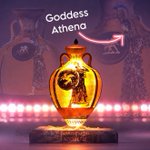
The Panathenaic Amphora Featuring the Goddess Athena at the Taranto Opening Ceremony and Its Ancient Archaeological Counterpart
Among the striking references to ancient Greek heritage during the Opening Ceremony of the Mediterranean Games in Taranto, a monumental Panathenaic amphora featuring the characteristic figure of the armed Athena particularly stood out. The choice of this type of vessel carries special significance in the context of an athletic event, since Panathenaic amphorae were genuine prizes in antiquity. They were awarded to victorious athletes at the Great Panathenaic Games in Athens and were filled with valuable olive oil.
A remarkable archaeological parallel is preserved today in the British Museum and dates to approximately 425 to 400 BC. It is an Attic black-figure Panathenaic amphora, approximately 74 centimetres high, discovered at Taucheira in ancient Cyrenaica, modern-day Libya. On one side stands Athena, fully armed between two Doric columns surmounted by cocks. The goddess wears a high-crested helmet and the aegis, brandishes a spear and carries a shield. Remarkably, the shield bears a representation of the famous Tyrannicides, Harmodius and Aristogeiton.
The opposite side of the ancient amphora reveals its direct connection with athletics. Two nude athletes are depicted exercising alongside a paidotribes, their trainer, who holds a palm branch, a traditional symbol of athletic victory. Even more revealing is the Greek inscription, «ΤΟΝ ΑΘΕΝΕΘΕΝ ΑΘΛΟΝ», essentially identifying the vessel as “one of the prizes from Athens.”
The appearance of a Panathenaic amphora in the modern ceremony therefore carried powerful symbolism. An object that accompanied athletic victory and honour in Classical Greece reappeared, in monumental theatrical form, at a major contemporary Mediterranean sporting event.

2
195
The British newspaper has corrected a clearly problematic headline following criticism over its coverage of an archaeological discovery from ancient Aspendos. The original version described a roughly 2,400-year-old tomb as likely belonging to a “Turkish wrestler.” The description was historically anachronistic, since the tomb dates from the last quarter of the 5th to the 4th century BC, more than a millennium before Turkic populations established themselves in Anatolia. The wording consequently drew criticism as a striking example of projecting a modern national identity onto the ancient past.
The Independent has now removed the controversial ethnic designation. The headline was changed from “Grave with 2,400-year-old silver coins featuring naked men likely belonged to Turkish wrestler” to “Grave unearthed in Turkey with silver coins featuring naked men likely belonged to ancient wrestler.” Replacing “Turkish wrestler” with “ancient wrestler” corrects the fundamental historical problem. Elsewhere, the deceased has also been described more appropriately as a possible “wrestler from Aspendos,” a formulation that respects the geographical and chronological context.
Importantly, the original error did not come from the official Turkish announcement. Turkey’s Ministry of Culture and Tourism described the deceased as a possible “Aspendoslu bir güreşçi,” meaning simply “a wrestler from Aspendos.” The ministry clearly dated the cist-type tomb to the Classical period and explained that silver coins of Aspendos depicting wrestlers, together with other grave goods, led researchers to suggest that the deceased may have been associated with athletics. The word “Turkish,” therefore, appears to have been a journalistic addition rather than a description used by the Turkish archaeologists or the ministry itself.
The episode may seem like a relatively minor editorial mistake, but it illustrates a serious problem in the popular presentation of archaeology. The fact that an ancient site lies within the borders of modern Turkey does not automatically make people who lived there 2,400 years ago “Turkish,” just as modern political geography cannot simply be projected backwards onto Greeks, Romans, Lydians, Phrygians or other ancient populations. The Independent’s correction was therefore necessary and serves as a useful reminder for historical journalism. Headlines may simplify complex stories, but they should never distort chronology or historical context.

3
154
A “Turkish wrestler” in the 5th century BC. The Independent has just invented historical time travel
The British Independent managed to squeeze a rather remarkable anachronism into a single headline. Reporting on the new archaeological discovery at Aspendos, it stated that a roughly 2,400-year-old tomb likely belonged to a “Turkish wrestler.” There is, of course, …one small detail. The tomb dates from the last quarter of the 5th century to the 4th century BC, roughly two millennia before Turkish populations settled in Anatolia. By that logic, Socrates may soon be presented as a citizen of the European Union simply because ancient Athens is located in present-day Greece, an EU member state.
The actual discovery is far more interesting than the headline itself. In the Eastern Necropolis of ancient Aspendos, an important city of Pamphylia, archaeologists discovered a cist-type tomb dating from the late 5th to the 4th century BC. Among the objects found inside were silver coins of Aspendos depicting wrestlers. The finds led to the hypothesis that the deceased was associated with athletics and may even have been a wrestler himself. Even this identification remains a hypothesis requiring further evidence, since the presence of coins depicting wrestlers does not, by itself, prove the profession or status of the deceased.
And here, dear friends of the page, we must give credit where credit is due. The Turkish Ministry of Culture and Tourism NEVER announced the discovery of a “Turkish wrestler.” The ministry’s official statement carefully says that the finds suggest the deceased may have been an “Aspendoslu bir güreşçi,” simply meaning “a wrestler from Aspendos.” The national designation “Turkish” was added entirely arbitrarily and unscientifically to The Independent’s headline. The official Turkish announcement, by contrast, preserves the archaeological and chronological context of the find.
The incident may be amusing, but it highlights a much more serious problem in the popularization of archaeology. Modern state borders cannot simply be projected back onto antiquity. When a headline replaces the historical context of a person who lived in the 5th or 4th century BC with a modern nationality, readers unfamiliar with the history of the region can easily form a completely distorted picture of the past. The correct wording would be “a wrestler from ancient Aspendos,” “an Aspendian wrestler,” or, more cautiously, “a possible wrestler buried at ancient Aspendos.” Present-day geography tells us where an archaeological find was discovered. It does not automatically tell us the ethnicity of a person who lived there 2,400 years ago.
✍️ Dimosthenis Vasiloudis

The worldwide attention surrounding Christopher Nolan’s The Odyssey has unexpectedly revived an old debate in Turkey concerning Homer’s connection with ancient Smyrna, modern Izmir. Recent reports have focused on the so called “Homer Caves” near Bornova, traditionally associated with the poet. There is indeed an ancient basis for the tradition. In the second century AD, Pausanias recorded that the Smyrnaeans showed visitors a cave near the springs of the River Meles where, they said, Homer had composed his poems. But the wording matters. Pausanias was recording a local tradition many centuries after Homer’s presumed lifetime, not documenting a historical event. Modern reports themselves acknowledge that there is no definitive evidence that Homer composed the Iliad or the Odyssey in this particular cave.
The more interesting issue is the language now being used around this story. Turkish researcher Altan Altın argues that Homer came from Ionia and believes the cultural references contained in the Iliad support an Anatolian background. Yet his actual position is considerably more nuanced than the impression produced by some headlines. Altın explicitly states, “Homer is Greek. Homer is Anatolian.” He also rejects turning Homer into another source of Greek Turkish rivalry. Türkiye Today itself acknowledges that Bornova belonged to historical Ionia, an ancient Greek region of the Aegean coast, and archaeologist Mehmet Akif Erdem notes that the Homeric poems employ Ionic and Aeolic forms of Ancient Greek.
There is nothing objectionable about calling Homer “Anatolian” if the term is being used strictly geographically. Ancient Ionia was located in western Anatolia, and Greek civilization there developed through centuries of interaction with the older cultures of Asia Minor and the eastern Mediterranean. Anatolian and Near Eastern influences upon early Greek religion, mythology, art and epic poetry constitute an important field of modern scholarship. Greeks did not develop in cultural isolation, and acknowledging these interactions makes our understanding of Greek civilization richer and historically more accurate.
But cultural influence and geographical location should not be confused with cultural identity.
Ionia was part of the ancient Greek world, its cities participated in Greek religious and intellectual networks, and Homeric poetry belongs linguistically and poetically to the Greek tradition.
This is precisely where we should be critical of the framing adopted by parts of the Turkish media. The problem is not the legitimate study of Homer’s possible Smyrnaean background, nor Turkey’s right to preserve and promote the archaeological heritage located within its modern borders. The problem emerges when “Anatolian” gradually replaces “Greek” or “Ionian Greek” in popular presentation. A subtle shift in terminology can create a very different historical impression for an international audience unfamiliar with the complexities of ancient Asia Minor.
“Homer lived in Anatolia” can easily become “Homer was Anatolian”, and from there, particularly in popular media, ancient Ionia risks being presented as part of an undifferentiated cultural continuum leading naturally to modern Turkey. Significantly, Altın’s own explicit acknowledgement that “Homer is Greek” makes such selective framing even more questionable.
For Greeks, the Greek Diaspora and international admirers of Hellenic culture, the appropriate response should therefore be historical accuracy. Homer does not need to be detached from Anatolia in order to remain Greek. Quite the opposite. The Greek cities of Asia Minor demonstrate how deeply rooted Hellenic civilization was on both shores of the Aegean and how creatively it interacted with Anatolian peoples and traditions.

Despite the efforts of the Greek YouTuber Konstantinos, known as The Mythologist, to distance himself from Christopher Nolan’s casting choices for The Odyssey, I find the criticism expressed by the Italian YouTuber @pureMetatron regarding the casting of Black actress Lupita Nyong’o as Helen far more convincing.
For me, the issue is neither an actress’s skin color nor her merit as an artist. The real issue concerns the deliberate reconstruction of the visual representation of a specific cultural world. Metatron’s criticism places this choice within a broader philosophical and aesthetic framework of deconstruction and postmodern reinterpretation of the Western cultural canon. When such practices are presented simply as “cinematic choices,” they can easily become vehicles for contemporary ideological narratives, including extreme Afrocentric and woke interpretations of Greek antiquity.
For this reason, we consider criticism of so-called “blackwashing” legitimate. Cinema certainly possesses creative freedom. Creative freedom, however, does not make an aesthetic choice immune to historical, philosophical, or cultural criticism.
We cannot invoke historical and mythological ambiguity in order to present every contemporary representation as equally compatible with the cultural context of antiquity.
We can therefore disagree with Konstantinos without questioning either his intentions or his knowledge, and we wish him every success with his new English-language channel. In this particular debate, however, we believe that Metatron raises a more substantive question.
When does an artistic reinterpretation constitute creative freedom, and when does it become an ideological reconstruction of the past?

1
119
Dimosthenis Vasiloudis 🇬🇷 retweeted
The Roman Empire will come back. With or without us. It’s a movement of history.
What we can do is make it beautiful.

Dimosthenis Vasiloudis 🇬🇷 retweeted

What’s more distracting than Black Helen of Troy is the racially-mixed crew of Odysseus. I would’ve preferred an all Black/Indian/Chinese cast to what we got. Here’s why racial-mixing breaks immersion and subverts the entire film:
The core logic behind Homer’s Odyssey is Xenia (ξενία) which governs the relationship between guest and host. It prescribes standards of conduct of how you must deal with strangers/foreigners: don’t ask who they are before feeding them, give gifts, etc. Xenia is so central to this epic that each episode of the Odyssey can be read as commentary on it. Bad: Cyclops, Circe, Calypso, suitors. Good: Phaeacians, Penelope, swineherd.
So why does a racially-mixed crew subvert this institution? Xenia is a boundary institution and is required because there is a strong boundary, a strong in-group/out-group distinction which a mixed-race crew subverts. In our cosmopolitan cities, we aspire to treat strangers under the same universal moral standards with which we treat fellow citizens. Our cosmopolitan moral system (e.g. human rights) is predicated on a shared human equality. But in the time of Homer, the moral code (Xenia) by which you treat the foreigner/stranger is different in kind from the one among the in-group. Xenia is not grounded primarily on some shared equal human essence. In fact, one of the reasons you need to treat the stranger well is that they may be a god in disguise.
You can see Nolan subvert this distinction by transforming Xenia, which he calls “Zeus’ law”, into the Golden Rule: do unto others as you would have them do unto you. Do not underestimate the radicality of this transformation. The Golden Rule is based off of a moral symmetry. Xenia is asking you to take care of the foreigner because he is under the protection of Zeus. This one move modernizes the core logic behind the Odyssey.
But why is this a bad thing? Because it removes one thing I love about the world Homer created: mystery. Odysseus is an explorer who adventures in a mysterious world not mapped and travelled. The delight of Homer’s Odyssey is that every stranger we meet can be hostile, friendly, or even a god. The foreigner was strange, dangerous, and mysterious. A mixed-race crew where Indians, Chinese, Blacks, and Whites all gel as one unit makes the world feel too small. It’s Silicon Valley, not Ithaca, Greece. If ethnic Indians & Chinese are so well integrated in Odysseus’ crew, not as mercenaries but unremarkably as “one of us,” think about what that implies about how interconnected & well explored the world is, how much cultural contact has already happened, and how much the boundary which defines Xenia has dissolved. The film replaces a civilization organized around sacred boundaries with one based on cosmopolitan inclusion. It is the modern world, a world that has a surplus in many good things, but not in mystery.
