
Senior Macro Strategist & Head of Flows of Funds @vandaresearch Views my own.
Washington DC
Joined July 2013
- Tweets5.1K
- Following2.9K
- Followers5.3K
- Likes9.4K








Alex Etra retweeted

Dallas Fed researchers estimate that higher fuel prices added between 20 and 60 basis points to 12-month core PCE inflation as of September
If fuel prices stay at the elevated levels of mid-October, "the contribution of fuel prices to 12-month core PCE inflation would fade as this year's increases drop out of the 12-month comparison, lowering the inflation rate by roughly 30 basis points by December 2027 relative to its September 2026 contribution."
If gasoline prices hold steady, but crack spreads narrow, that would provide a further downward drag on core inflation worth another 12 bps when compared to the no-change scenario. dallasfed.org/research/econo…

Alex Etra retweeted

This is overdue, but here are my thoughts on whether the federal tax code subsidizes AI or data centers.


Alex Etra retweeted

Its all about AI-related products and how they have largely been exempt from #tariffs.
Here is the breakout of capital into AI-related vs other.
Non-AI capital goods are being tariffed at a high rate!

👍 @tradewartracker
What happens to the *composition* of the S-I balance if you: a) tax consumer tradables; b) exempt capital goods tradables; c) 'subsidize' (OBBBA) investment in non-tradables (LLMs)? 🤔
nitter.cf/tradewartracker/status…


Alex Etra retweeted

Maybe having the world’s largest installed capacity for the production of EVs and non-fossil-fueled power generation + climate control devices at the onset of a (dumb) negative supply shock that doubles fossil fuel prices can lead to exceptional one-off jumps in recorded exports.


Alex Etra retweeted

Following our first note, “Introducing Private Credit into the U.S. Financial Accounts,” this new #FEDSNote details the methodology and how leverage and portfolio concentration differ across vehicles, reflecting distinct institutional structures. (1/2) federalreserve.gov/econres/n…

ALT Two charts about U.S. private debt funds. The left chart shows fund assets growing steadily over the past decade or so, with private credit loans making up the largest share of the total. The right chart shows debt relative to net asset value: the average fund's ratio stays low and stable over time, while funds at the high end of the distribution carry noticeably more leverage, with modest ups and downs.
I get similar numbers for the direct effects in a growth accounting exercise and even smaller if the 'midterm' shock is limited to specific states (and depending on what you assume is the elasticity of substitution across states).

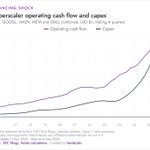
New piece on the economics of the AI buildout based on running it through the Fed's FRB/US model.
Short version: The stock market increase has been an even bigger deal than the actual infrastructure build.
Will share more later.
econvitals.org/posts/2026-11…

6
853
Alex Etra retweeted

Wrote perhaps the shortest FEDS note in the history of the series to make what I think is a simple but interesting observation. The dollar share of the FX reserves of the Euro area countries that have disclosed relocating gold out of the US in the past 15 years barely budged.

What happened to the US dollar share of Euro Area central banks' FX reserves when they moved gold reserves out of the US? A new #FEDSNote investigates. federalreserve.gov/econres/n…

ALT Figure 1. U.S. Dollar Share of European FX Reserves
Election junkie twitter, is there really no source of machine readable provisional county level results? no Git repository anywhere?
1
1
641
Alex Etra retweeted

the median stock in the S&P 500 was up 0.8% this week
the average stock was down 0.7%
numbers are fun
Pairs with @kellyenz


Hedge fund leverage as a proportion of US commercial bank assets. It’s been on a tear since 2023. Roughly split between repo funding and prime brokerage. Based on Fed and OFR data.
These guys have too much leverage for the risk environment and are getting shaken out.
From what I can see the so called multistrategy funds are running a lot more leverage than pre GFC. The good thing is that it’s hopefully ringfenced from the banking sectors.
So the kids can get out of private school and the wives out of the shops. And everyone else hopefully keeps their houses and jobs. @junkbondanalyst

Alex Etra retweeted

Hedge fund leverage as a proportion of US commercial bank assets. It’s been on a tear since 2023. Roughly split between repo funding and prime brokerage. Based on Fed and OFR data.
These guys have too much leverage for the risk environment and are getting shaken out.
From what I can see the so called multistrategy funds are running a lot more leverage than pre GFC. The good thing is that it’s hopefully ringfenced from the banking sectors.
So the kids can get out of private school and the wives out of the shops. And everyone else hopefully keeps their houses and jobs. @junkbondanalyst
Alex Etra retweeted

Hiç abartmıyorum, bu makale iktisat tarihinin ulaşabileceği zirveyi temsil ediyor. Makalede Pirenne tezi, 500 bin para sikkesinin coğrafi dolaşımı üzerinden test ediliyor. Makalenin en önemli bulgusu ise aşağıdaki iki görselde açıkça görülüyor: İslam fetihleri öncesi ve sonrası dönemde sikke akışlarının nasıl değiştiğini gösteren son derece etkileyici iki figür:


@johannesmboehm and Chaney combine data on half a million ancient coins with a model of trade and money to reconstruct trade and consumption from AD 325 to 950. The estimates show economic activity shifting away from the Mediterranean from the 6th century.
econometricsociety.org/publi…

Alex Etra retweeted

My favorite new proprietary measure is "Econvitals Underlying Unit Labor Costs".
It blends five wage measures (weighted by inverse variance), re-means to match PCE and adjusts for how productivity growth different in this cycle than the past.
Consistent with ~2% inflation now.

Wage growth minus trend productivity growth is consistent with inflation of 1.7 percent, per Econvitals Underlying Unit Labor Costs. On labor costs, it’s all clear. The measure blends five wage measures, weighted toward the less noisy ones.
econvitals.org

Alex Etra retweeted
What are the effects of #tariffs on inflation?
PCE #inflation report last week continue to show that tariffs
(i) showed up in full force in the first half of 2026 and
(ii) now have faded out of the spotlight

A great addition to the discussion from @ernietedeschi. Reminder that while AI adoption appears correlated with productivity growth across industries there is basically no correlation between adoption and *the change* in productivity growth 🫡
stripeeconomics.com/p/ai-and…

I share your bugbear on this, and i know you know all this, but this is still for my money the best economic 101 level discussion of Ai and productivity. Found the J-curve discussion particularly helpful
Understanding AI and Productivity. share.google/uAoPSxai4AyQrDW…

