

Math professor at Wellesley College; author of student-centered math books; Buddhist/Daoist at heart.
Wellesley, MA
Joined March 2014
- Tweets466
- Following85
- Followers256
- Likes46


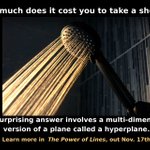

Countdown to #ThePowerofLines (mitpress.mit.edu/97802620571…) pub day (19 days!) from @mitpress. Enjoy today's teaser! #linearalgebra #math

Oscar E. Fernandez retweeted

☎️ Calling all students:
You can now access hundreds of textbooks directly in Notebook, for no charge. From publishers like S Chand Publishing, OpenStax, and Open Textbook Library— browse, select and upload them as sources to ace all of your upcoming exams (no more excuses, ok?)
Oscar E. Fernandez retweeted

25 Beautiful Mathematical Documentaries to Make Students Love Math 📽️
abakcus.com/25-beautiful-mat…

Countdown to #ThePowerofLines (mitpress.mit.edu/97802620571…) pub day (20 days!) from @mitpress. Enjoy today's teaser! #linearalgebra #math

Oscar E. Fernandez retweeted

Why do bees always build hexagonal cells instead of squares or triangles?
Among every way to partition the plane into equal-area regions, the regular hexagon minimizes total perimeter. For inradius r, area A = 2√3 r² and perimeter P = 4√3 r, so wax used is proportional to 4√3 r t. Thomas C. Hales proved the honeycomb theorem in 1999: this tiling stores the most honey with the least wax.
The same principle drives efficient packing in materials science, architecture, and computer graphics.
Nature solved an optimization problem long before the proof existed.
Where have you seen hexagonal efficiency outside biology?

Countdown to #ThePowerofLines (mitpress.mit.edu/97802620571…) pub day (21 days!) from @mitpress. Enjoy today's teaser! #linearalgebra #math

Oscar E. Fernandez retweeted

This paper answers:
why anything is beautiful
why jokes are funny
why we get curious
why you get bored
why babies explore
why music has hooks
For centuries, we thought these were deeply mystical human traits. Soul-level mysteries that machines could never touch.
But, the paper proves that the human brain operates as a relentless compression engine. It is constantly trying to predict the world and compress it into the smallest possible file size.
Here is how it explains your entire life:
If something is completely predictable, your brain has already compressed it. There is no new data to extract. The result? You feel bored.
If something is pure randomness, your brain cannot compress it at all. The result? You feel annoyed or tune it out.
But then there is the sweet spot.
When you encounter something that seems complex, but suddenly your brain finds the hidden pattern and connects the dots... your brain releases dopamine.
That sudden, glorious rush of successful data compression? That is what you experience as "curiosity."
When a comedian tells a story that makes no sense, and the punchline suddenly makes all the pieces fit together instantly? That rapid neural compression is what you experience as "humor."
When you look at a painting and notice an underlying symmetry that ties the chaos together? That is "beauty."
Art, science, music, and jokes are not magic.
They are just highly optimized data sets designed to trigger compression progress in your neural network.
Here is the most unsettling part.
This paper wasn't written by a philosopher. It was written by an AI pioneer to figure out how to program intrinsic motivation into artificial agents.
He wasn't trying to explain humans. He was writing the blueprint for machines.
We always assumed AI could never appreciate art, laugh at a joke, or feel the spark of curiosity.
But if our deepest subjective experiences are just a mathematical reward for maximizing compression progress...

Countdown to #ThePowerofLines (mitpress.mit.edu/97802620571…) pub day (22 days!) from @mitpress. Enjoy today's teaser! #linearalgebra #math

Countdown to #ThePowerofLines (mitpress.mit.edu/97802620571…) pub day (23 days!) from @mitpress. Enjoy today's teaser! #linearalgebra #math

Countdown to #ThePowerofLines (mitpress.mit.edu/97802620571…) pub day (23 days!) from @mitpress. Enjoy today's teaser! #linearalgebra #math

Countdown to #ThePowerofLines (mitpress.mit.edu/97802620571…) pub day (24 days!) from @mitpress. Enjoy today's teaser! #linearalgebra #math

Countdown to #ThePowerofLines (mitpress.mit.edu/97802620571…) pub day (25 days!) from @mitpress. Enjoy today's teaser! #linearalgebra #math



Oscar E. Fernandez retweeted

Following the fantastic reaction to our interactive learning experiments, we’ve decided to create an open source skill for anyone to build their own 💪🏗️
It's called the Marble-Builder. You tell it your child’s age and what they’re curious about and it builds a playable experiment for them.
What’s built into the skill:
- 1,837 concepts kids learn through primary school, and the 3,853 links between them
- 1,049 teaching research records on how kids learn best
- It agrees a plan with you, then builds, tests and fixes the experiment itself
You stay in control and can adjust everything. AI is a tool with huge potential to make teaching even better for both parents and teachers. We want anyone with something to teach to be able to bring it to life in an interactive, personalized way.
It’s a first prototype so there is a lot to improve. One big next step is to make the experiments more beautiful visually.
Parents, teachers, homeschoolers: show us what you make. We’ll gather the best experiences into the first open, interactive encyclopedia for kids.
Incredibly exciting times for kids education.
Links to try it below 👇
Countdown to #ThePowerofLines (mitpress.mit.edu/97802620571…) pub day (25 days!) from @mitpress. Enjoy today's teaser!

Countdown to #ThePowerofLines pub day (26 days!) from @mitpress. Enjoy today's teaser!

Countdown to #ThePowerofLines pub day (27 days!) from @mitpress. Enjoy today's teaser!

Countdown to #ThePowerofLines pub day (28 days!) from @mitpress. Enjoy today's teaser!

Countdown to #ThePowerofLines pub day (29 days!) from @mitpress. Enjoy today's teaser!

Oscar E. Fernandez retweeted
I curated 125 free math textbooks, written by the mathematicians who teach the courses and shared on their own university pages. No sign-up, no paywall, no pirated copies. From high school algebra to graduate analysis. 👇
abakcus.com/book-lists/free-…
