

News from our lab. We study toxic cyanobacteria, water quality, secondary metabolism and microbial bioinformatics. Posts by lab members. Led by @david_fewer
University of Helsinki
Joined November 2021
- Tweets92
- Following68
- Followers365
- Likes184


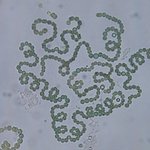


Bacteria can make extracellular polysaccharides that mediate heavy metal removal. This exopolysaccharide-producing cyanobacterium turned a 40-ml liquid culture into a gel. #UHCCCultureCollection
Oldest direct evidence for oxygenic photosynthesis in cyanobacteria fossils from around 1.75 billion years ago

I'm happy and so proud to share our new paper published in Nature, today! #Fossil #FossilThylakoids #Photosynthesis #Cyanobacteria nature.com/articles/s41586-0…
6
810
Our paper describing the isolation of a toxic strain of cyanobacteria from a microbial mat in the Helsinki coast of the Baltic Sea sciencedirect.com/science/ar…


Sila's paper on an unusual branched biosynthetic pathway for the production of microbial sunscreens out now in ACS Chemical Biology pubs.acs.org/doi/10.1021/acs…

Our latest paper on the isolation of a toxin-producing cyanobacterium from an algal mat on the Helsinki coast of the Baltic Sea
sciencedirect.com/science/ar…
Photo of a foliose tripartite lichen (Peltigera) that keeps cyanobacteria (Nostoc) as a nitrogen-fixing partner in black bodies called cephalodia. These cyanobacteria can produce toxins while in symbiosis or grown in pure culture.
doi.org/10.1073/pnas.1200279…


ALT Nostoc sp. UHCC 0360, symbiotic cyanobacterium
1
16
836
Xiaodan Ouyang (@XiaodanOuyang) presenting her paper on the direct pathway cloning and expression of radiosumin biosynthetic pathway at the Nordic Natural Products conference today. Well done Xiaodan!
doi.org/10.5281/zenodo.80217…
#ChinaScholarshipCouncil

2
10
850
Spirulina grows on rocks and boulders in the #BalticSea. These cyanobacteria can adapt their light harvesting apparatus to dim light using different pigments. Photos by Annica Långnabba (Metsähallitus) and @inkeri_vuori
#MicroscopyMonday @VELMUohjelma @NesslingSaatio

ALT Spirulina mat growing on boulders in Baltic Sea Photo © Annica Långnabba (Metsähallistus)


Congratulations to @XiaodanOuyang on her article in Organic and Biomolecular Chemistry! A big thanks to all co-authors. We report the radiosumin biosynthetic pathway and show that this small molecule is a human trypsin inhibitor.
doi.org/10.1039/D3OB00385J
#Nordaqua #mmtdk
Trichodesmium forms blooms in tropical and subtropical oceans where they are important source of new nitrogen. Sailors have referred to the blooms as sea sawdust since the 1700s. This study in Science resolves how motile filaments form colonies under stress conditions.

The movement of individual gliding filaments of nitrogen-fixing cyanobacteria Trichodesmium and their interactions with other filaments help these nitrogen-fixing cyanobacterium form aggregates in response to stress, a new Science study finds. scim.ag/2OE
A thick mat of Oscillatoria covering rocks from Laajalahti bay on the Helsinki coast. Photosynthetic cyanobacteria can provide a substrate for a rich community of heterotrophic bacteria. Photos by @inkeri_vuori
#BalticSea #MicroscopyMonday


Check it out! #CyanoMetDB v02 is now available. This public database includes comprehensive chemoinformatic metadata for 2425 toxins and secondary metabolites from cyanobacteria. Congratulations to @JanssenLilli and contributors for all the handwork!
This post is from an account that no longer exists. Learn more
Freshwater sampling today at Lake Rusutjärvi in southern Finland with @XiaodanOuyang for the #GFREDIZ project in collaboration with Edo Bar-Zeev from @bengurionu
The water is now warm according to the ice swimmers.

Hey there! Interested in applying for an MSCA Postdoctoral Fellowship to join Petr Dvorak's lab in the Czech Republic? See the flyer below. Deadline is the 13 Sep 2023: HORIZON-MSCA-2023-PF-01-01
This post is from an account that no longer exists. Learn more
Happy #MicroscopyMonday! Check out one of our Aphanizomenon strains, A. flos-aquae UHCC 0475 (a.k.a. 1tu37s13). This strain has been maintained in UHCC/HAMBI since its isolation from Tuusulanjärvi lake (Finland, 2001) and has been featured in numerous publications.
@helsinkiuni

ALT Microscopy picture of A. flos-aquae UHCC 0475, 40X magnification

ALT Laboratory culture of A. flos-aquae UHCC 0475

ALT Lake Tuusulanjärvi, Finland, 2022
If you want to know more about A. flos-aquae UHCC 0475, check this publication:
Phylogenetic and morphological evaluation of the genera Anabaena, Aphanizomenon, Trichormus and Nostoc (Nostocales, Cyanobacteria) | Microbiology Society microbiologyresearch.org/con…

2
386
This is a macroscopic colony of the tropical and subtropical filamentous cyanobacterium Brasilonema that grows on plant leaves. This strain produces an unknown liquid when grown on solid growth medium and has filaments that are almost the same width as very fine human hair.


Brasilonema octagenarum UFV-E1 was isolated from an eucalyptus nursery in Minas Gerais in southeastern region of Brazil by Aguiar and coworkers in 2008.
doi.org/10.1111/j.1529-8817.…

1
450
Talvi yllätti sinilevät! Cyanobacterial bloom frozen in sea ice at Aittasaari island on the Baltic Sea. Macroscopic colonies of Aphanizomenon were visible under the ice with dying colonies turning the sea ice blue! #laajasalo @NesslingSaatio @origin_by


It´s #Microscopy Monday🔬! Enjoy couple of microscopy pictures taken from cyanobacterial bloom samples we collected during last summer campaing☀️. Can you appreciate the different shapes cyanobacteria have?
@NesslingSaatio


Even old cyanobacteria cells can have their secrets...look at the different pigments released in the supernatant once old cultures were harvested! Thanks to our Lyudmila Saari for the amazing pictures 👩🔬
@NesslingSaatio


Our paper on a new arginine-N-prenyltransferase from Phormidium autumnale out now in Chemical Communications. A big thanks to Wael and the University of Aberdeen team @WaelHoussen

Have you seen 'Biochemical characterization of a cyanobactin arginine-N-prenylase from the autumnalamide biosynthetic pathway' by @WaelHoussen, David Fewer and first author Claudia Clemente? 🔓
rsc.li/3svl7Oo

7