

G2AI tracks the US-China(G2) AI stack
Joined April 2026
- Tweets450
- Following48
- Followers2.1K
- Likes163





Sharon AI: Q3 revenue $9.9 million, up 1,859%; contracted value reaches about $9.6 billion
Sharon AI reported third-quarter revenue of $9.9 million, up 1,859% from a year earlier and 414% from the second quarter, as the Australian neocloud began converting contracted capacity into live deployments. Net loss was $43.8 million. Annualized run-rate revenue, an operating metric, was about $50 million in the quarter. Cash stood at $1.3 billion and property and equipment at $1.7 billion as of September 30.
Total contract value is now about $9.6 billion over a weighted average remaining term of 5.5 years, including $2.5 billion contracted since the second quarter. That figure includes only the floor price of the company's NVIDIA AI Compute Program for about 40,000 GB300 GPUs expected to come online in 2027. Third-quarter highlights included a $1.32 billion, five-year take-or-pay contract with a global AI lab and customer acceptance of an approximately 1,000-GPU NVIDIA B300 cluster. After the quarter ended, Sharon AI added a $1.0 billion, five-year take-or-pay contract with a global services company and a $170 million, four-year take-or-pay contract with a U.S. AI inference platform.
The company said it has secured more than $2.6 billion of institutional debt and equity capital since December 2025, plus about $0.8 billion of customer deposits, including a $356 million inaugural GPU-backed senior facility with Goldman Sachs and private credit funds. It expects 212 megawatts of total capacity in 2027 across Australia and New Zealand, and anticipates annualized run-rate revenue of $400-450 million in January 2027 as about 30 megawatts of contracted capacity is expected to begin billing.
sharonai.com/press-releases/…
1
410
SK hynix: Sales to largest customer, seen as Nvidia, doubled to 35 trillion won in first nine months
SK hynix's third-quarter report shows sales to its largest unnamed customer reached 34.98 trillion won (about $24 billion) in the first nine months, or 14.79% of total revenue, up 101.5% from 17.36 trillion won a year earlier. The industry identifies that customer as Nvidia. A second customer, which crossed the 10% threshold for the first time this year, accounted for 23.85 trillion won, or 10.08%. Together they made up about 24.9% of 9-month revenue of 236.51 trillion won. The largest customer's share still fell from 26.98% in the year-ago period, as overall sales grew even faster.
U.S. revenue rose to 147.74 trillion won, or 62.5% of the total, an increase of more than 102 trillion won from a year earlier. China revenue rose 4.8 times to 56.14 trillion won. Capital spending in the first nine months was 31.22 trillion won, already above last year's full-year 30.17 trillion won, and R&D spending was 10.09 trillion won, also above last year's full-year total.
en.sedaily.com/business/2026…

3
655
Blackstone Digital Infrastructure Trust: Signs $5 billion inaugural deal for 75.1% of two AWS data-center JVs
Blackstone Digital Infrastructure Trust said it signed a definitive agreement to acquire a 75.1% controlling interest in two joint ventures with Amazon Web Services, in a transaction valued at about $5 billion and reflecting a 7.0% initial capitalization rate. The JVs will own 13 newly built powered shells with 647 megawatts of IT capacity — nine buildings in northern Indiana, in the greater Chicago market, and four in Mississippi. AWS will keep a 24.9% stake and lease back the entire portfolio on a triple-net basis, with a weighted-average initial term of 12 years, a fully extended term of 32 years, and a 2.75% annual rent escalator. Amazon.com will guarantee the tenant's payment obligations.
BXDC expects to contribute $1.9 billion of IPO proceeds for its stake, with the remainder funded by about $2.5 billion of new non-recourse mortgage loans on the properties. The transaction is the listed vehicle's first investment and is expected to close in the fourth quarter of 2026, subject to closing conditions.
blackstone.com/news/press/bl…
1
332
TensorWave: Signs six-year agreement to supply OpenAI with 457 MW of AMD-powered AI capacity
TensorWave said it signed a six-year agreement to provide OpenAI with 457 megawatts of IT capacity across multiple U.S. data center sites. The infrastructure will run on AMD Instinct MI455X GPUs and be purpose-built for AMD Helios rack-scale systems, with Ethernet scale-out networking across racks. It will be operated as dedicated, single-tenant capacity for OpenAI. TensorWave is the first neocloud publicly announced as an infrastructure provider under OpenAI and AMD's existing strategic partnership. The announcement did not include a contract value or name the sites.
Capacity is expected to begin coming online in the first half of 2027, with the full deployment expected by early 2028. The company said this is its largest deployment to date. TensorWave, which is backed by AMD Ventures, has secured more than 2 gigawatts of long-term data center capacity.
tensorwave.com/blog/tensorwa…

2
364
Corvex: Signs $103 million take-or-pay deal for NVIDIA Blackwell capacity
Corvex said it signed a three-year, $103 million take-or-pay agreement to supply NVIDIA Blackwell computing capacity to an unnamed scaled AI inference platform at its Mid-Atlantic 1 data center. The company will deliver more than 1,000 HGX B200 systems connected with Quantum-2 InfiniBand, using 1.6 megawatts of IT capacity. The deployment is expected to be fully in service in the first quarter of 2027, and to begin generating revenue by the end of that quarter.
Once the cluster is live, Corvex expects contracted take-or-pay annual recurring revenue at Mid-Atlantic 1 to rise from $22 million to about $56 million, or roughly $21 million of annual contract revenue per megawatt. The deployment is expected to cost about $78 million. A $26 million customer prepayment and $38 million of committed, non-recourse debt from USD.AI cover more than 80% of that cost, with Corvex funding the remaining $14 million. This is the company's third Blackwell deployment at the site.
investors.corvex.ai/news/new…

1
347
Goldman Sachs believes the focus of its China equity strategy will shift from A-shares to Hong Kong-listed shares in 2027.
It has upgraded Chinese H-shares to Overweight and downgraded A-shares to Marketweight. The firm forecasts a 23% rise in the MSCI China Index and a 10% rise in the CSI 300 Index in 2027.

Baidu: AI Cloud Infra revenue nearly doubles to RMB 8.2 billion; GPU cloud up 191%
Baidu reported third-quarter revenue of RMB 30.8 billion ($4.60 billion), down 1% year over year. A 22% decline in online marketing, to RMB 11.9 billion, was largely offset by AI infrastructure. AI Cloud Infra revenue rose 94% year over year to RMB 8.2 billion, and 11% from the prior quarter. Within that, GPU Cloud revenue increased 191% year over year and 43% quarter over quarter. Baidu said its AI-powered business now accounts for 53% of General Business revenue, up from 39% a year earlier.
The company said demand for AI Cloud Infra remained strong, with a more diversified customer base, higher customer prepayments, and a shift toward longer-term contracts. External customers' token usage revenue on its Qianfan MaaS platform rose 1,159% year over year. Kunlunxin's M100 inference chip is expected to be ready for volume production by the end of 2026. Operating cash flow was RMB 2.8 billion ($414 million), and cash and investments stood at RMB 276.6 billion ($41.25 billion).
ir.baidu.com/news-releases/n…
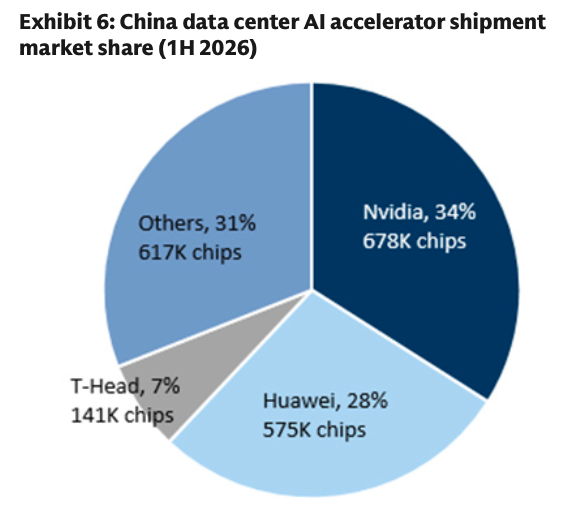
According to the Goldman Sachs, in the first half of 2026, China’s data centers received approximately 2.01 million AI accelerator chips.
Nvidia led shipments with 678,000 chips, or 34% of the market, followed by Huawei with 575,000 chips, or 28%. T-Head shipped 141,000 chips, accounting for 7%, while other suppliers collectively shipped 617,000 chips, or 31%.
LS Electric: Wins $93.83 million contract to supply switchgear for a U.S. hyperscale AI data center
LS Electric said it signed a contract worth about $93.83 million (130 billion won) to supply power systems for a hyperscale data center operated by a major global technology company in the United States. The customer was not named. Under the agreement, the company will deliver 38-kilovolt high-voltage switchgear and low-voltage switchgear, core equipment for the data center's power grid, in phases.
The deal is an expansion follow-on. LS Electric had taken part in the same client's U.S. data-center project from its early stages and has now secured a consecutive order for high-voltage switchgear in this expansion phase.
en.sedaily.com/economy/2026/…

Nomura believes that, if the three US bills restricting chip exports to China are enacted, the resulting loss of demand in the global memory market could be smaller than the constraints on supply. It therefore expects memory supply and demand to tighten over the medium to long term, which would be supportive of memory prices.

SK hynix: In talks on new HBM4 equipment orders; P&T6 could add over 20,000 wafers per month
According to Korea's Electronic Times, SK hynix is discussing a fresh round of HBM4 equipment purchases with suppliers, mostly back-end tools for bonding, dicing, and inspection. Some deliveries have been requested by the first quarter, with installation targeted for the first half of 2027. The likely site is the Cheongju P&T6 packaging-and-test facility. Industry sources told ETNews that running the site at full utilization could add more than 20,000 HBM wafers per month.
SK hynix has not confirmed those figures. A spokesperson said the company has continued to place equipment orders as planned. At its third-quarter earnings call, the company said its DRAM and HBM supply is essentially sold out through 2029. ETNews put SK hynix's total HBM capacity at around 150,000 wafers per month at the end of last year, and had already cited a similar 20,000-wafer figure for P&T6 in February.
techpowerup.com/354861/sk-hy…

1
6
1,241
Wolfe acknowledges that data center construction faces real political opposition, but argues that the market may be overstating the risk to near-term economic growth. Its key evidence is that roughly 75% of the 34 GW of data center capacity planned across major US states for 2027 is already under construction. New permitting restrictions are therefore more likely to affect projects scheduled for 2028 and beyond.
The risks are still meaningful. Wolfe estimates that if growth in US AI capital expenditure slows from about 40% to 20%, GDP growth could fall by roughly 0.4 percentage points relative to its baseline forecast. If the slowdown is accompanied by a 20% stock market decline, the estimated impact approaches 0.9 percentage points. Even so, slower approvals, higher costs and projects moving to other locations do not necessarily mean those projects will be canceled or that total investment will fall by the same amount.

HSBC argues that comparing only the capital expenditure of major US and Chinese internet companies understates the breadth of China’s AI investment. It estimates that major US cloud providers spend about six to seven times as much as their Chinese peers in absolute terms. Relative to cloud revenue, however, their investment intensity is much closer. In China, AI investment also extends to telecom operators, independent data centers, computing networks, and “physical AI” applications such as robotics and smart factories. Some of this spending falls outside conventional AI capex measures.
Another often overlooked point is that Chinese internet companies spend a significant amount on renting compute capacity rather than buying it. Those rental payments are generally recorded as operating expenses, so they do not appear in capex figures.


In a 154-page report, Morgan Stanley explains why Asia’s current industrial and capital expenditure cycle is broader, stronger, and longer-lasting.
1. Investment is rising, with growth extending beyond AI. Morgan Stanley expects Asia’s fixed investment to grow from approximately $11 trillion in 2025 to $16 trillion in 2030, a compound annual growth rate of 7.5%—roughly twice the pace of the preceding five years. The report identifies geopolitics, technological advances, and industrial policy as mutually reinforcing drivers. Economies are expanding advanced manufacturing capacity while also investing in energy security and defense. Broader industrial investment is expected to account for about 47% of the increase in annual capex between 2025 and 2030, while AI and related activities account for approximately 20%.
2. Current data and corporate balance sheets support the cycle. The report notes that Asian industrial production, non-tech exports, and capital-goods imports are all at relatively strong levels by historical standards. Although the expansion has lasted about six years, overall corporate leverage remains below pre-pandemic levels. In Asia excluding China, the corporate debt-to-GDP ratio is near a ten-year low. Morgan Stanley therefore sees room for companies to continue borrowing and investing. The resulting gains in capacity and productivity could partly offset the effects of population aging, sustaining Asia’s potential GDP growth at around 4.5%.
The four main investment areas are industrial manufacturing, AI and semiconductors, energy, and defense. The report expects Asia’s annual energy capex to rise from about $900 billion in 2026 to $1.35 trillion in 2030, covering grids, power generation, and storage. Defense capex is projected to rise from roughly $250 billion to $440 billion over the same period. China, Japan, South Korea, and Taiwan are focused on advanced manufacturing and semiconductors, while India and Southeast Asia seek to expand manufacturing and data-center investment.
3. Investment opportunities are spreading across the supply chain, while overbuilding is the main risk. The report favors upstream industrial companies, factory automation, electrical equipment, engineering and construction, and banks that finance corporate investment. Copper and aluminum should also benefit from grid investment and electrification. The recent AI-sector correction has brought down valuations for some Asian industrial stocks.

Bernstein expects NVIDIA rack shipments to rise from 66,000 units in 2026 to 85,000 in 2027, with Vera Rubin accounting for about 60% of 2027 shipments. Meanwhile, inference demand is driving growth in custom chips: ASICs are projected to increase their share of the AI accelerator market from roughly 10% in 2025 to 20% in 2027, while Google TPU shipments are expected to grow by more than 80% year over year in 2026.


Morgan Stanley cut its NVIDIA revenue forecasts for FY28 and FY29 by approximately 10% each. It lowered its earnings per share forecasts from $15.01 and $24.16 to $13.37 and $21.53, respectively, while leaving its FY27 forecasts unchanged.
The leadership transition could slow decision-making, although NVIDIA’s product pipeline and supply arrangements provide support for the next two years. Morgan Stanley believes Jensen Huang’s roles in technical judgment, supply-chain coordination, and customer relationships will be difficult to replace quickly. Interim CEO Colette Kress should be able to manage operations, but her interim status could complicate long-term customer commitments, financing partnerships, and strategic decisions. Appointing a permanent CEO is therefore a priority.
Meanwhile, Vera Rubin is ramping, the Rubin Ultra roadmap is largely defined, and prepayments have secured much of the supply of constrained components for the next two years. Morgan Stanley believes concerns about weakening CUDA barriers are overstated; NVIDIA’s advantages also include chip performance and its broader hardware and software ecosystem.
The main additional risks concern China policy and financing for emerging cloud providers. If restrictions reduce demand in one area, other unmet demand may absorb the available hardware, although the policy impact remains uncertain.
