

G2AI tracks the US-China(G2) AI stack
Joined April 2026
- Tweets450
- Following48
- Followers2.1K
- Likes163
Goldman Sachs believes the focus of its China equity strategy will shift from A-shares to Hong Kong-listed shares in 2027.
It has upgraded Chinese H-shares to Overweight and downgraded A-shares to Marketweight. The firm forecasts a 23% rise in the MSCI China Index and a 10% rise in the CSI 300 Index in 2027.

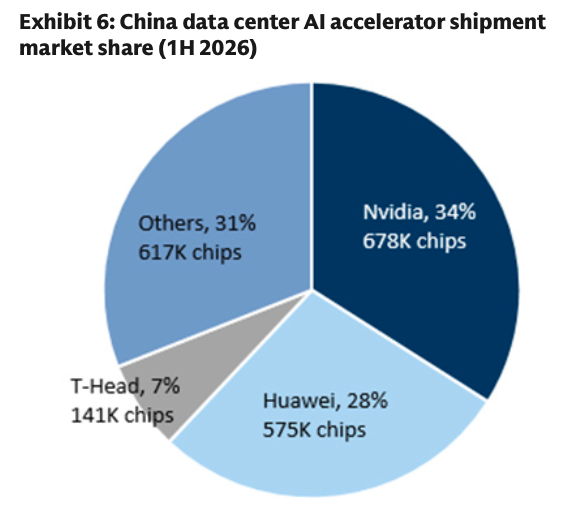
According to the Goldman Sachs, in the first half of 2026, China’s data centers received approximately 2.01 million AI accelerator chips.
Nvidia led shipments with 678,000 chips, or 34% of the market, followed by Huawei with 575,000 chips, or 28%. T-Head shipped 141,000 chips, accounting for 7%, while other suppliers collectively shipped 617,000 chips, or 31%.
Nomura believes that, if the three US bills restricting chip exports to China are enacted, the resulting loss of demand in the global memory market could be smaller than the constraints on supply. It therefore expects memory supply and demand to tighten over the medium to long term, which would be supportive of memory prices.

Wolfe acknowledges that data center construction faces real political opposition, but argues that the market may be overstating the risk to near-term economic growth. Its key evidence is that roughly 75% of the 34 GW of data center capacity planned across major US states for 2027 is already under construction. New permitting restrictions are therefore more likely to affect projects scheduled for 2028 and beyond.
The risks are still meaningful. Wolfe estimates that if growth in US AI capital expenditure slows from about 40% to 20%, GDP growth could fall by roughly 0.4 percentage points relative to its baseline forecast. If the slowdown is accompanied by a 20% stock market decline, the estimated impact approaches 0.9 percentage points. Even so, slower approvals, higher costs and projects moving to other locations do not necessarily mean those projects will be canceled or that total investment will fall by the same amount.

HSBC argues that comparing only the capital expenditure of major US and Chinese internet companies understates the breadth of China’s AI investment. It estimates that major US cloud providers spend about six to seven times as much as their Chinese peers in absolute terms. Relative to cloud revenue, however, their investment intensity is much closer. In China, AI investment also extends to telecom operators, independent data centers, computing networks, and “physical AI” applications such as robotics and smart factories. Some of this spending falls outside conventional AI capex measures.
Another often overlooked point is that Chinese internet companies spend a significant amount on renting compute capacity rather than buying it. Those rental payments are generally recorded as operating expenses, so they do not appear in capex figures.


In a 154-page report, Morgan Stanley explains why Asia’s current industrial and capital expenditure cycle is broader, stronger, and longer-lasting.
1. Investment is rising, with growth extending beyond AI. Morgan Stanley expects Asia’s fixed investment to grow from approximately $11 trillion in 2025 to $16 trillion in 2030, a compound annual growth rate of 7.5%—roughly twice the pace of the preceding five years. The report identifies geopolitics, technological advances, and industrial policy as mutually reinforcing drivers. Economies are expanding advanced manufacturing capacity while also investing in energy security and defense. Broader industrial investment is expected to account for about 47% of the increase in annual capex between 2025 and 2030, while AI and related activities account for approximately 20%.
2. Current data and corporate balance sheets support the cycle. The report notes that Asian industrial production, non-tech exports, and capital-goods imports are all at relatively strong levels by historical standards. Although the expansion has lasted about six years, overall corporate leverage remains below pre-pandemic levels. In Asia excluding China, the corporate debt-to-GDP ratio is near a ten-year low. Morgan Stanley therefore sees room for companies to continue borrowing and investing. The resulting gains in capacity and productivity could partly offset the effects of population aging, sustaining Asia’s potential GDP growth at around 4.5%.
The four main investment areas are industrial manufacturing, AI and semiconductors, energy, and defense. The report expects Asia’s annual energy capex to rise from about $900 billion in 2026 to $1.35 trillion in 2030, covering grids, power generation, and storage. Defense capex is projected to rise from roughly $250 billion to $440 billion over the same period. China, Japan, South Korea, and Taiwan are focused on advanced manufacturing and semiconductors, while India and Southeast Asia seek to expand manufacturing and data-center investment.
3. Investment opportunities are spreading across the supply chain, while overbuilding is the main risk. The report favors upstream industrial companies, factory automation, electrical equipment, engineering and construction, and banks that finance corporate investment. Copper and aluminum should also benefit from grid investment and electrification. The recent AI-sector correction has brought down valuations for some Asian industrial stocks.
