

Thinking about AI, crypto and distributed systems. Often wrong.
Munich, Germany
Joined January 2010
- Tweets1.1K
- Following504
- Followers615
- Likes1.8K



My old team of 7 engineers merged around 84 pull requests a month. They were really good. Hand picked, smart, and I learned a lot from them.
This year I'm working alone with AI agents and I'm at 513 a month.
I'm not a better engineer than any of them. Honestly I'm not even an expert programmer. The tools changed.
And it's not just more code. Over 2.5 years the team wrote about 39k lines of tests, which is pretty normal for a startup moving fast. This year the agents wrote 1.29M. They just do the boring stuff nobody ever had time for.
The weird part is that most of it happened in the last few months. I spent the first half of the year figuring out how to even work like this. Then models like Fable and Astra came out and the curve basically went vertical.
I keep thinking about what that old team would build with these tools. Probably 10 or 20 times what you see here.
I don't think most people realize how fast this is moving. I didn't either, until I pulled the numbers.

1
67
opus 5.5 is out.
everyone will argue about whether it beats gpt 5.6 on some benchmark.
the more interesting part is the cost curve.
frontier intelligence keeps getting cheaper at a ridiculous rate.
feels a bit like blockspace wars, except this time demand might actually grow faster than supply.
239
GitHub was built for a different era. Humans wrote the code, humans reviewed it, one pull request at a time.
That's basically over now. Agents already write more than we can merge. Put five of them on the same repo and half their time goes to fighting each other's diffs.
Someone's going to build probabilistic merge for thousands of agent PRs a day and make GitHub look like SVN. The pull request just doesn't hold up at that scale.
2
163
Marijo Radman retweeted

Alterscope v2 is live.
Most yield data gives you a number and stops. We show how solid a market is, how easily you can exit, and what would break it. Then we watch it and warn you in time to act.
11k+ opportunities across 20+ protocols.
alterscope.org
Marijo Radman retweeted

DTCC and the Stellar Development Foundation announced today plans to enable the tokenization of DTC‑custodied assets on the @StellarOrg network. This collaboration advances DTCC’s multi chain strategy and expands how traditional assets move across digital ecosystems.
DTC‑tokenized assets are expected to be made available on the Stellar network in the first half of 2027, supporting the evolution of a more open, interoperable, and efficient financial ecosystem.
Get the full story: dtcc.com/news/2026/may/27/to…

Marijo Radman retweeted

.@Circle CCTP is live on Stellar. Now, the Stellar ecosystem is connected to the wallets, exchanges, and DeFi lending protocols that use @USDC.
stellar.org/blog/foundation-…

Marijo Radman retweeted
Today, the Stellar Development Foundation and the Government of Bermuda announced that Bermuda will begin moving key payment and financial-services activity onchain onto the Stellar network.
Learn more 👇
stellar.org/press/stellar-to…

Marijo Radman retweeted
A tokenized private liquidity fund designed to enable 24/7, onchain cash management.
@StateStreet Galaxy Onchain Liquidity Sweep Fund (SWEEP) is coming to Stellar.
coindesk.com/markets/2026/05…


Marijo Radman retweeted

Much respect to the OG @AquariusDeFi team that keeps pushing the envelope on what's possible on Stellar.


Marijo Radman retweeted

> be in crypto for 7 years
> get in for the cypherpunk stuff
> self-custody, no third party, "decentralization"
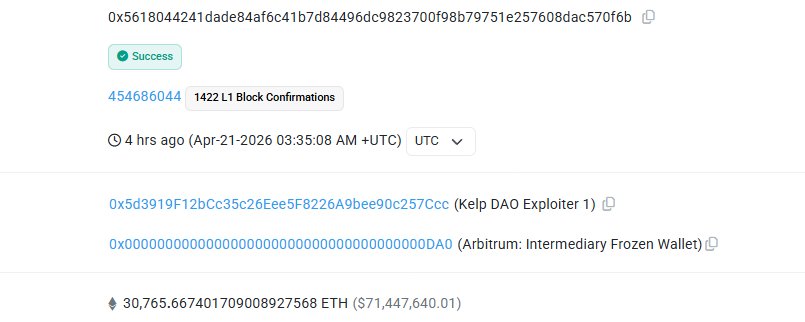
> watch lazarus drain $290m from kelp
> watch arbitrum move $71m of it out of the attacker's wallet
> without his private key, without his signature
> not a "freeze"
> it was a transfer. from someone's wallet. that the owner didn't authorize.
> start wondering what "decentralized" was actually supposed to mean

Marijo Radman retweeted
Massive milestone 🔥
Stellar has crossed $2 billion in RWAs on the network, driven by partners like @FTDA_US, @Spiko_finance, @OndoFinance, and more.
This is onchain growth in action.

Marijo Radman retweeted

From Narratives to AUM 🎙
A fireside between Wilson Fung @wilson_hkweb3, CEO of @MicrobitCapital, and our Managing Partner @momir_amidzic
Two voices from across the capital stack sharing their institutional perspectives on on-chain finance - what's working today, where friction still sits, and where the real money moves next.
📍 April 20th · @IOSGVC × @boundlesshq Open Stage · @festival_web3 #HKWeb3Festival #IOSGVentures

DeFi is accelerating on @BuildOnStellar :
stellar.org/blog/ecosystem/w…

90
Marijo Radman retweeted

Today is a monumentous day for quantum computing and cryptography. Two breakthrough papers just landed (links in next tweet). Both papers improve Shor's algorithm, infamous for cracking RSA and elliptic curve cryptography. The two results compound, optimising separate layers of the quantum stack. The results are shocking. I expect a narrative shift and a further R&D boost toward post-quantum cryptography.
The first paper is by Google Quantum AI. They tackle the (logical) Shor algorithm, tailoring it to crack Bitcoin and Ethereum signatures. The algorithm runs on ~1K logical qubits for the 256-bit elliptic curve secp256k1. Due to the low circuit depth, a fast superconducting computer would recover private keys in minutes. I'm grateful to have joined as a late paper co-author, in large part for the chance to interact with experts and the alpha gleaned from internal discussions.
The second paper is by a stealthy startup called Oratomic, with ex-Google and prominent Caltech faculty. Their starting point is Google's improvements to the logical quantum circuit. They then apply improvements at the physical layer, with tricks specific to neutral atom quantum computers. The result estimates that 26,000 atomic qubits are sufficient to break 256-bit elliptic curve signatures. This would be roughly a 40x improvement in physical qubit count over previous state-of-the-art. On the flip side, a single Shor run would take ~10 days due to the relatively slow speed of neutral atoms.
Below are my key takeaways. As a disclaimer, I am not a quantum expert. Time is needed for the results to be properly vetted. Based on my interactions with the team, I have faith the Google Quantum AI results are conservative. The Oratomic paper is much harder for me to assess, especially because of the use of more exotic qLDPC codes. I will take it with a grain of salt until the dust settles.
→ q-day: My confidence in q-day by 2032 has shot up significantly. IMO there's at least a 10% chance that by 2032 a quantum computer recovers a secp256k1 ECDSA private key from an exposed public key. While a cryptographically-relevant quantum computer (CRQC) before 2030 still feels unlikely, now is undoubtedly the time to start preparing.
→ censorship: The Google paper uses a zero-knowledge (ZK) proof to demonstrate the algorithm's existence without leaking actual optimisations. From now on, assume state-of-the-art algorithms will be censored. There may be self-censorship for moral or commercial reasons, or because of government pressure. A blackout in academic publications would be a tell-tale sign.
→ cracking time: A superconducting quantum computer, the type Google is building, could crack keys in minutes. This is because the optimised quantum circuit is just 100M Toffoli gates, which is surprisingly shallow. (Toffoli gates are hard because they require production of so-called "magic states".) Toffoli gates would consume ~10 microseconds on a superconducting platform, totalling ~1,000 sec of Shor runtime.
→ latency optimisations: Two latency optimisations bring key cracking time to single-digit minutes. The first parallelises computation across quantum devices. The second involves feeding the pubkey to the quantum computer mid-flight, after a generic setup phase.
→ fast- and slow-clock: At first approximation there are two families of quantum computers. The fast-clock flavour, which includes superconducting and photonic architectures, runs at roughly 100 kHz. The slow-clock flavour, which includes trapped ion and neutral atom architectures, runs roughly 1,000x slower (~100 Hz, or ~1 week to crack a single key).
→ qubit count: The size-optimised variant of the algorithm runs on 1,200 logical qubits. On a superconducting computer with surface code error correction that's roughly 500K physical qubits, a 400:1 physical-to-logical ratio. The surface code is conservative, assuming only four-way nearest-neighbour grid connectivity. It was demonstrated last year by Google on a real quantum computer.
→ future gains: Low-hanging fruit is still being picked, with at least one of the Google optimisations resulting from a surprisingly simple observation. Interestingly, AI was not (yet!) tasked to find optimisations. This was also the first time authors such as Craig Gidney attacked elliptic curves (as opposed to RSA). Shor logical qubit count could plausibly go under 1K soonish.
→ error correction: The physical-to-logical ratio for superconducting computers could go under 100:1. For superconducting computers that would be mean ~100K physical qubits for a CRQC, two orders of magnitude away from state of the art. Neutral atoms quantum computers are amenable to error correcting codes other than the surface code. While much slower to run, they can bring down the physical to logical qubit ratio closer to 10:1.
→ Bitcoin PoW: Commercially-viable Bitcoin PoW via Grover's algorithm is not happening any time soon. We're talking decades, possibly centuries away. This observation should help focus the discussion on ECDSA and Schnorr. (Side note: as unofficial Bitcoin security researcher, I still believe Bitcoin PoW is cooked due to the dwindling security budget.)
→ team quality: The folks at Google Quantum AI are the real deal. Craig Gidney (@CraigGidney) is arguably the world's top quantum circuit optimisooor. Just last year he squeezed 10x out of Shor for RSA, bringing the physical qubit count down from 10M to 1M. Special thanks to the Google team for patiently answering all my newb questions with detailed, fact-based answers. I was expecting some hype, but found none.

wow, is this true?:
"X dropped a dislike button AND a mute-entire-countries button in the same week.."
I want to test the mute-entire-countries button

🚨 Do you understand what happened in the last 24 hours?
> Zuckerberg killed the Metaverse after burning $80 billion on cartoon avatars nobody used
> Sam Altman took $13 billion from Microsoft then sold OpenAI's cloud to Amazon for $50 billion.. Microsoft just found out they funded their own competition
> Anthropic made an AI that takes orders from your phone and does your work while you sleep..
> X dropped a dislike button AND a mute-entire-countries button in the same week..
> YouTube asking you to flag AI slop is just Google getting 2 billion people to train their next model for free
> 93% of US jobs can now be partly done by AI.. Same week companies started giving the weakest raises since 2008
> Apple started rejecting vibe-coded apps from the App Store
> xAI is paying Wall Street bankers $100/hour to teach Grok how to replace Wall Street bankers.. They're taking the money..
> A mystery AI model appeared on benchmarks beating everything.. Developers think DeepSeek is quietly testing their next weapon
> Bloomberg asked "Is the AI bubble about to burst" the same day Nvidia said the chip market will hit $1 trillion.. One of them is dead wrong..
> The UK government backed down on AI copyright after artists revolted.. First government to flinch
> The Fed said rate hikes are back on the table and blamed AI data centers for making inflation worse
And it's only Wednesday. See you tomorrow. It'll be worse.
If you're not following me you're finding out about this stuff 48 hours late from someone who read my post
121