

Dept of Computing Sciences, Nelson Mandela Metropolitan University, Port Elizabeth.
Port Elizabeth
Joined August 2012
- Tweets1.9K
- Following371
- Followers370
- Likes774









Jean Greyling retweeted

South Africans take for granted the privilege of being able to cast a vote without the threat of intimidation and violence. The ANC got a lot wrong but certainly got democracy right. For that I'm truly thankful.
Jean Greyling retweeted

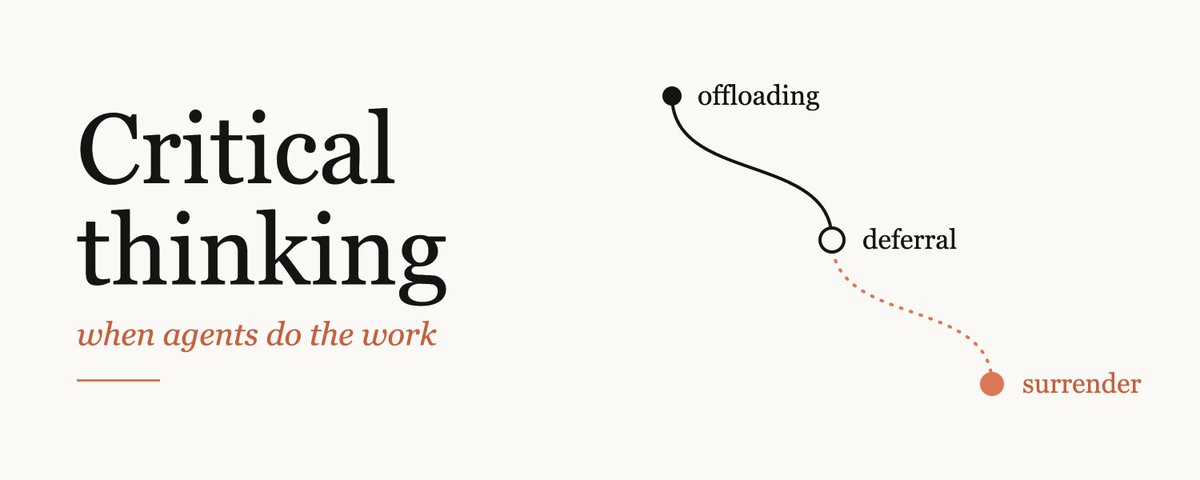
Damn!AI 编程最大的悖论终于被摊开了,Anthropic 官方最新研究警告,来自他们自家的 Claude Code 工程师挑明了一个残酷真相:
你把越多的代码甩给 AI,你废掉监督它的核心能力就越快,这门技能恰恰会因为过度依赖 AI 而萎缩,
看懂这场技术温水煮青蛙,你才会明白为什么盲目全自动正在毁掉下一代工程师。
也就是说越依赖 AI 写代码,你越可能在不知不觉中,丢掉唯一能保住你饭碗的核心能力,
这不是什么外行对技术的悲观臆测,而是 Anthropic 的 Claude 代码工程师 Addy Osmani 刚刚抛出的一个极其残酷的技术悖论:
当你把越来越多的编码任务丢给智能体,你正在亲手废掉监督它们所需的底层硬实力。
他把这种状态精准地定义为四个字——认知投降。
逻辑非常隐蔽:AI 吐出的代码排版规整、单元测试全绿、逻辑看似天衣无缝。
久而久之,工程师们的大脑开始习惯性偷懒,从逐行推演架构边界,退化成机械式地点击确认,去批准那些自己根本没有真正吃透的逻辑。
连 Anthropic 自家的研究报告都在罕见地警示自家用户:监督 Claude,恰恰需要那些因为过度依赖 AI 而正在萎缩的硬核编程直觉。
这就把所有写代码的人逼进了一个死局:如果写代码的肌肉记忆退化了,你拿什么去发现机器在深水区埋下的逻辑地雷?
Osmani 留下的一句论断,几乎把这层遮羞布扯得粉碎:
当你交付的东西远远超出了你能担保的认知范围,你根本不是在做代码审查,你只是在对着运气烧香。
在 Vibe Coding 彻底普及的当下,拉开工程师身价差距的,从来不是你调教智能体生成了多少千行代码,而是当整个系统在极端边界崩溃时,你还剩不剩下看透底层黑盒的审查算力。


Jean Greyling retweeted

Buckminster Fuller, who was wrong about a lot of things in a way that was usually more interesting than other people being right, noticed something in the 1930s that still holds true.
He noticed that technology does not primarily get bigger. It gets thinner.
The transatlantic cable got lighter per unit of message. The building got lighter per unit of enclosed volume. The engine got lighter per unit of horsepower. Each generation of a technology tends to accomplish the same function with less stuff, and then with less stuff again, until at the limit the stuff approaches zero and only the function remains.
He called this ephemeralization : doing more and more with less and less until eventually you can do everything with nothing.
And here were it gets interesting. What got eaten, in the first wave, was objects: my door key became a fingerprint.
What's happening today is the second wave: the AI paradigm shift. It’s our thought patterns, our decisions, our generative processes, our creativity, and our communication and coordination with each other that is being ephemerized.
And I think judgment abstraction has two consequences.
First, the output is not checkable at a lower cost than producing it. To verify a summary you must read the document. To verify a strategic recommendation you must do the strategy. The thing that made calculators safe (verification being orders of magnitude cheaper than generation) simply does not hold for the class of work being absorbed now. Which means verification won't happen because the economics forbid it. A check that costs as much as the work is not a check. It's a second attempt.
Second, the stairs are being removed as a consequence of using the lift. The way you stay able to judge a draft is by having written drafts. The capability is maintained by its own exercise and by nothing else. So the fallback and the thing it's a fallback for are the same muscle, and the system that replaces the muscle also stops the training.
This is Lisanne Bainbridge's irony of automation, which she wrote down in 1983 and which the aviation industry spent the next forty years rediscovering at great expense: automate the easy 99% and you have designed a job where a human with no recent practice must handle the hardest 1% with no warm-up, at the worst possible moment, on the basis of a mental model the automation has been maintaining on their behalf.
Airlines eventually responded by mandating hand-flying. No knowledge-work organization on earth currently mandates hand-thinking.
novanews.co.za/nelson-mandel…
Prof Greyling, head of Computing Sciences at NMU, presented Tangible at the Universities SA Higher Education Conference. It was selected as one of USAf’s top 2025 academic impact case studies.

21
Jean Greyling retweeted

✨[NSC Exams state of readiness]
Matric Pass rate:
Going forward, I have decided that provincial performance will be ranked through a broader basket of quality indicators. This basket of quality indicators will include the number of Bachelor passes, distinctions, the levels of learner retention, as well as the rate of participation and performance in gateway subjects such as Mathematics, Physical Sciences, Accounting and Economics, amongst others.
This approach will allow provinces to benchmark performance more meaningfully and identify areas requiring intervention.
The question will not only be whether learners passed, but whether provinces are improving literacy, numeracy, retention and gateway subject participation.
Jean Greyling retweeted

Yesterday my daughter, who is studying in the United States, attended the Springboks versus All Blacks match in Baltimore.
She spent five years of her life in that city before moving to Cleveland. At the stadium she bumped into an old school mate from Dainfern College who now lives in Florida. Two South Africans, far from home, finding each other in a crowd of more than 68,000. It was already an emotional moment.
What neither of them expected was how deeply they would be moved by our national anthem. Standing there, thousands of kilometres from home, singing Nkosi Sikelel’ iAfrika. Pride in our roots. Pride in our diversity. Pride in excellence. And faith - watching the circle and the kneeling that followed the final whistle.
That image stayed with me.
There is a well known observation in India, popularised by Gurcharan Das, that “India grows at night while the government sleeps.” It captures a country whose people and enterprises often advance despite, rather than because of, the state. South Africa has that same untapped potential. We see it in the Springboks. World-class performance is not confined to the rugby field. It exists across our people, our businesses, our communities. We have what it takes.
What we still need is simple, and it is hard:
Create a genuinely business-friendly environment.
Confront crime with seriousness and consistency.
Appoint leaders in both the private and public sectors on merit.
Those three interventions would allow this country to occupy the place it deserves among the winning nations of the world.
We are a resilient people. Our character has been forged in difficulty. In a volatile world, that character is not a weakness. It is an advantage.
The Springboks keep showing us what is possible when talent, discipline, purpose and belief come together. The rest of the country can do the same.
We have the people. We have the potential. Now we must get our act together and grow during the day as well.
#Springboks #RugbysGreatestRivalry #BetOnSouthAfrica #Leadership #Merit #SouthAfrica #ProudlySA


Jean Greyling retweeted
In South Africa we have watched a quiet but relentless slide into lawlessness. Jumping traffic lights has become commonplace. Driving under the influence is often treated lightly. Pedestrians cross roads with little regard for the danger. Informal settlements spring up overnight on any open piece of land. Illegal electricity connections are no longer treated as serious offences - they are simply accepted as part of daily life. Informal traders claim pavements and intersections as their own. Prisoners somehow manage to keep smartphones. Driving without a licence is widespread.
One could go on forever. The point is simple: there has been a clear breakdown in law and order.
On the surface, the relaxation of rules is understandable. For decades, harsh and often humiliating laws targeted black South Africans in particular. So society swung from one extreme to the other, from rigid control to an “anything goes” environment.
In many ways this chaos is presented as freedom, the freedom that was denied to the majority for so long. We even open our borders to illegal immigration with the argument: “They took us in when we were running from the apartheid police.” A noble memory, but a problematic policy.
I once listened to a Minister of Correctional Services speaking about prisoners. The minister spoke much like a principal talking about learners, our collective duty to help them reach their full potential. The fact that some of these individuals were rapists, hardened killers and career criminals seemed to fade behind the focus on rehabilitation. We appear to have confused ordinary criminals with the political prisoners of the past. In our emphasis on ubuntu there is often little room left for the discipline that law and order require. It is as if, as a nation, we struggle to hold both compassion and consequences together.
This confused state is not progressive. It is setting us backwards. I know of no country that has ever become successful on a foundation of chaos. We urgently need to strike the right balance, one that honours our painful history without using it as a permanent excuse to abandon the very rules that keep a society from falling apart. #ProudlySA
Jean Greyling retweeted

IITPSA was represented at #SACLA2026 by Moira de Roche and Prof. André Calitz. The conference highlighted the future of computing education and the importance of strong foundational skills for emerging technologies. #ComputingEducation #IITPSA

Jean Greyling retweeted

Think Beyond Boundaries
What does it take to build the next generation of innovators? It starts with learning from those shaping the future.
At CU Scholars' Summit 2026, an inspiring panel discussion on "How Young Engineers Can Think Big" brought together distinguished experts from academia and industry, including Mr. Ajay Kumar Singh (Tata Consultancy Services), Dr. Anurag Singh (NIT Delhi), Prof. Saiful Amri Mazlan (Universiti Teknologi Malaysia), and Prof. (Dr.) Jean Greyling (Nelson Mandela University, South Africa). The session was moderated by Brig. (Dr.) Gagan Deep Singh Baath, Professor of Management & Executive Director, DSA&A, Chandigarh University.
From smart infrastructure and photonics to advanced materials, patents, and real-world innovation, the discussion encouraged young engineers to think bigger, innovate fearlessly, and create solutions that make a global impact.
Be inspired. Be innovative. Be future-ready.
#CUScholarsSummit2026 #ChandigarhUniversity #Engineering #Innovation #Research


Coding 4 Africa
Participating organisations can access Tangible game packs at a 50% discount (courier fees apply).
Visit the Resource Hub to learn more, access resources and register: lnkd.in/gHkZdH4F

Statistics are cold comfort when you sit across from a student who has done everything right and still cannot hold their certificate in their hands.
is.gd/9kKeW4

1
25
Jean Greyling retweeted

A quiet prediction for 2026, from someone who has spent a lot of time studying how humans behave at work:
I think we’re about to see an unprecedented quiet retirement of elder millennials from tech.
Not dramatic exits. Not mass layoffs. Just a steady, largely unannounced backing away.
Many elder millennials hit what was supposed to be the payoff phase of their careers—middle to senior roles, stable compensation, some accumulated growth—at the exact moment life got heavier. Kids entering adolescence. Parents aging or dying. Bodies changing. Energy changing. Perspective changing. (Read: perimenopause and midlife crises...)
At the same time, the last decade didn’t quite deliver what was promised. Most stock options didn’t meaningfully materialize. Homeownership was delayed or derailed. Many relocated during the pandemic “temporarily” for childcare or sanity and never fully returned—to cities, to offices, or to the pace they once sustained.
Then AI arrived. Not just as a new tool, but as a true platform shift.
What I’m watching isn’t resistance or denial so much as a widening gap in orientation. Some people are instinctively reorganizing how they think, work, and create around this new substrate. Others are using it incrementally; helpful, but not transformative. Neither is a moral failure. But the gap compounds quickly.
For a cohort already tired, already juggling more life outside of work, and already questioning the ROI of constant grinding, the incentive to retool themselves again—this time at platform speed—just isn’t there.
So many will choose something else.
They’ll frame it (honestly) as leaning into IRL, into human connection, into building tangible things. They’ll open coffee shops, take over family businesses, learn trades, consult selectively, or turn long-held hobbies into second careers. It will look intentional. And often, it will be.
What fascinates me is not the “exit,” but the alignment: a generational life stage colliding with a technological inflection point that dramatically raises the bar for cognitive and adaptive load at work.
From an HR lens, it’s one of the most interesting workforce transitions I’ve ever seen unfolding in real time... and I think we’re still underestimating how quietly, and how profoundly, it will reshape who stays, who leaves, and what “career success” even means next.
“In South Africa more than 16,000 schools lack computers, which is why Tangible is designed to work with or without technology, without being limited by either— Prof Jean Greyling, head of the department of computing sciences at NMU”

Tangible’s inclusion in Learning Cabinet highlights local contribution to global challenge ebx.sh/lhlnYs

1
34
Jean Greyling retweeted
The Leva Foundation has won the Social Responsibility/Community Award at the #IITPSA President’s Awards. Known for projects such as Tangible unplugged coding, the Foundation under co-founder and CEO Ryan le Roux has over a decade of impact. #PresidentsAwards

Tangible EdTech Awards
Read about all the winners at Leva Foundation's inaugural awards event in Cape Town … with some beautiful photos.
is.gd/EvbXgR

24
I am excited to share
*Tangible’s top 8 photos of the year.*
Get a quick visual impression on some of the “heart” of our project.
forms.gle/FDAbgxksSRr8g4eC8
[Post photo is of teams interacting during the World Cup, from 5 continents.]

17
Top Tangible photos for 2025
Check out our Top 8 photos as determined by an external voting panel.
They portray the heart of Tangible.
docs.google.com/forms/d/e/1F…

8
Teachers respond positively to Tangible's WhatsApp Chatbot
According to Prof Greyling, Foundation Phase teachers can implement the full Coding and Robotics Curriculum by following the lessons, “and that at the cost of making a printout”.
Article: is.gd/b9AItD

30
So glad I voted for them

🔵🔴 RISE IN PARLIAMENT
GAMBLING CRISIS TO BE DEBATED IN PARLIAMENT ON FRIDAY
This Friday 10H00, @ParliamentofRSA will debate the Gambling Crisis in South Africa as proposed by @Rise_Mzansi
#GamblingReformsNOW
#HardestWorkingMP🇿🇦

7