



$SPX rose 0.3% on Wednesday, snapping a streak of six consecutive sessions in the red after the Fed’s interest-rate decision. That was the longest stretch of losses since 2018, when the benchmark posted declines on seven straight decision days, data compiled by Bloomberg show.

The six straight Fed-day losses this year for $SPX before today’s gains had marked the second-longest stretch since 1994, when the US central bank first began announcing policy decisions on the final day of its meetings, data from Bespoke Investment Group show.
Jessica Menton retweeted

crushed. wearing my aggie bowtie, soonest. @JessicaMenton

@JessicaMenton @BloombergRadio is really talented and a lot easier on the eyes vs @tomkeene nice show glad it’s on YouTube @LisaMateoTV @AlexisTVNews @EricBalchunas
Jessica Menton retweeted

Stocks Gain Before Tech Earnings as Oil Declines. Get market insight on Bloomberg Surveillance. @ptsweeney @AlexisTVNews @JessicaMenton are LIVE on YouTube youtube.com/watch?v=f39oHo6v…

Jessica Menton retweeted

Stocks Gain Before Tech Earnings as Oil Declines. Get market insight on Bloomberg Surveillance. @ptsweeney @AlexisTVNews @JessicaMenton are LIVE on YouTube youtube.com/watch?v=f39oHo6v…
Jessica Menton retweeted

Stocks Gain Before Tech Earnings as Oil Declines. Get market insight on Bloomberg Surveillance. @ptsweeney @AlexisTVNews @JessicaMenton are LIVE on YouTube youtube.com/watch?v=f39oHo6v…
The S&P 500 staples sector has climbed by about 9% in the past 13 sessions. That sizzling rate was last exceeded in the depths of the pandemic in April 2020, Bloomberg data show. The broader S&P 500 Index is flat in that span.


The equity positioning gap between discretionary money managers and computer-driven funds using systematic strategies is now the second-widest since 2020, Deutsche Bank AG data show bloomberg.com/news/articles/…

The S&P 500 Index hasn’t posted a 1% decline in 53 trading sessions through Tuesday, marking the longest such stretch since January 2020, data compiled by Bloomberg show. $SPX has also now gone 89 sessions without a drop of at least 2% — its second-longest stretch in a year.

The S&P 500 hasn’t suffered a 1% decline in 52 sessions through Monday — tied for its longest stretch since July 2024, according to data compiled by Bloomberg. If the equities benchmark goes 53 sessions without a 1% drop, it would mark the longest such stretch since January 2020.

On Wednesday, the S&P 500 Index’s $SPX streak without a 1% decline reached 49 sessions, its longest stretch since July 2024, according to data compiled by Bloomberg.

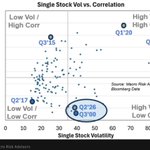
The gap between index-wide calm and single-stock volatility is nothing new for traders, but lately it’s grown extreme, reaching the widest level since 2000, data compiled by Macro Risk Advisors show bloomberg.com/news/articles/…


Jessica Menton retweeted

Investors have "added $22 billion into technology-focused US exchange-traded funds this quarter, compared with $4.6 billion into the rest of the market"
@JessicaMenton

$SPX dropped 0.4% on Wednesday, its sixth straight decline following a Federal Reserve interest-rate decision. That’s the longest stretch of losses since 2018, when the equities benchmark posted declines for seven consecutive policy decision days, data compiled by Bloomberg show.


$SPX earnings in the first half of 2026 are expected to reach 28%, the highest rate for a January-June period since 2004, excluding the rebounds after the pandemic and the GFC, according to data compiled by Wendy Soong, a BI equity strategy analyst bloomberg.com/news/articles/…


Options traders appeared to be getting ready for volatility even before Tuesday’s drop. Take open interest in VIX call options relative to puts, a ratio that climbed to its highest level of the year in a sign of increased demand for downside SPX protection
bloomberg.com/news/articles/…
