








Rajifah retweeted

Did you send your name aboard Artemis II???
If you did, then your name is literally in my pocket!! And every time you see me floating around the Orion spacecraft — that’s where your name is! With ME!
Don’t worry — I’ve kept your names safe as I’ve flown around the Moon 🫡 -Rise

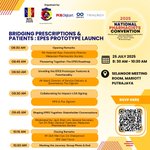
To Pharmacists, we will be showcasing the prototype for the Electronic Prescription Exchange System. Blockhain used for traceability. Come and meet us. Would love to hear your thoughts.

119
Rajifah retweeted

This year, Malaysia's public health care sector is estimated to need 17,393 specialists, exceeding the current 7,576 specialists. This translates to a shortage of 10,798 specialists (adjusted by attrition rate), based on 2022 MOH data presented last June.
Overall, the public service only has 44% of specialists needed for 2025 (excluding attrition rates).
Biggest gaps are in these specialties (i.e proportion of needs filled, excluding attrition rates):
- Cardiothoracic surgery: 18%
- Forensic pathology: 21%
- Family medicine: 22%
- Urology: 26%
- Oncology: 31%
Most specialties have less than half of the number of specialists needed (excluding attrition rates). All 25 specialties listed have estimated shortages.
By absolute number, the biggest specialist deficits (difference between projected needs and current number of specialists, adjusted by attrition rate) are in:
- Family medicine: 2,170
- Anaesthesiology & critical care: 1,123
- General surgery: 931
- Internal medicine: 767
- Emergency medicine: 708
Read more:
codeblue.galencentre.org/202…

Rajifah retweeted

Terdedah Dengan Dunia Startup Ketika Belajar MBA di MIT, Boston
" Kalau you study dekat Boston, San Francisco ataupun Palo Alto..... Semua orang di sekeliling you akan bercerita pasal startup " - Reez Nordin, Venture Capitalist
Rajifah retweeted

Sabtu minggu depan, jom jumpa kat Cyber!
I'll be sharing on how to run my go-to toolkit untuk validate idea MVP korang! Proven result & anti kumpau.
Workable PDF with your team nanti boleh di muat turun lepas habis session
⚠️ 80% seat dah occupied bit.ly/techtamu1

This arrived yesterday. R&D partnership with KPJU, KPJ D’sara, D’sara 2, Ampang & Tawakal for the development of AI for insulin titration for T2 diabetes. It’s still WIP.


2
4
432
Rajifah retweeted

Is there order behind Trump’s disorder?
This article reviews a policy paper by one of Trump’s top economic advisers to delve deeper into the economic logic of the Trump camp.
Read more by @chrischoongww here: krinstitute.org/Views-@-Trum…
#KhazanahResearchInstitute #KRI #AdvancingMalaysia #TrumpTariffs #Tariff


Rajifah retweeted
No one becomes a clinician to do paperwork, but it's becoming a bigger and bigger administrative burden, taking time and attention away from actually treating and supporting patients.
That’s why we’re introducing Microsoft Dragon Copilot, the industry’s first AI assistant for clinical workflow.
Rajifah retweeted
Our latest articles explore the limitations of the B40, M40, and T20 categories, highlighting the vulnerabilities of the Middle 50% (M50) and the skewed spending patterns of the Top 30% (T30).
In Part II, we also examine the issue of 'benefit cliffs'—how small salary increases can actually worsen financial stability for families by stripping away essential subsidies. Discover how smarter, more inclusive policies can support social mobility and create a fairer Malaysia.
Read the articles by @KriGregoryh and @SurayaIsmail22 below:
1) Rethinking ‘Who’s Rich?’ in Malaysia – Part 1: Lines and Meanings: krinstitute.org/Views-@-Reth…
2) Rethinking ‘Who’s Rich?’ in Malaysia – Part 2: Some considerations: krinstitute.org/Views-@-Reth…
#KhazanahResearchInstitute #KRI #AdvancingMalaysia


Rajifah retweeted

Among our most-read in 2024 ⤵️
A global study in @TheLancetPH reveals stark differences in major causes of disease burden between females and males. Findings underscore the need for gender-responsive approaches to health.
Read more: hubs.li/Q030zvyg0

ALT Figure of global rankings of the top 20 causes of DALYs globally for females and males in 2021. Copyright: 2024 The Author(s). Published by Elsevier Ltd. CC BY 4.0

In solidarity with Mesolitica
@khalilhimura @huseinzol05
Keep at it, as we always do 💪🏻


This

Many Big Tech players have tried to “disrupt” healthcare over the years:
→ Google tried to build a personal health record (later shut down).
→ Microsoft also tried to build a personal health record (also later shut down).
→ IBM Watson tried to build AI-powered clinical decision making tools (later sold off parts of the business)
→ Amazon tried to team up with JP Morgan Chase and Berkshire Hathaway to… I really don’t know. Although, to give them credit, Amazon’s come the closest with Amazon One Medical, Pharmacy and other initiatives still in place.
You can have all the resources in the world - billions of dollars, the brightest technology minds - and still struggle to build a solution that achieves adoption by patients and providers AND meaningfully improves health outcomes.
Because it’s not 1% idea + 99% execution as you’d expect in most tech companies.
It’s 10x harder in healthcare… it’s 0.1% idea + 99.9% execution.
This is why you see so many tech companies re-inventing the wheel in Healthcare:
“How has nobody built X tech product before?”
Until the innovator realizes it’s 10x harder because it wasn’t the tech that was the biggest barrier.
Most likely someone HAD built it before… but they couldn’t figure out everything else beyond the tech.
What this underlines is that in Health Tech:
→ Technology is necessary but not sufficient. People and Process often matter more.
→ We can’t “Technology” our way out of the biggest challenges in healthcare
The companies that win will be those that choose to:
→ Embed evidence-based clinical content, workflows and approaches into the Technology
→ Deeply understand day to day clinical workflows and needs of patients/providers
→ Build within the current reality of reimbursement models and economic incentives (while still advocating for a better future)
→ Be co-drivers (not passengers) for building more and more clinical evidence
I don’t know if most technologists have the patience, resilience and stomach to invest beyond the Tech to make it work.
You probably won’t be able to build the next trillion dollar company in healthcare - at least if your focus is on helping providers care for patients.
And if you’re a Big Tech company, building in healthcare certainly won’t move their bottom line as trillion dollar market cap companies.
So why would they care?
If it’s gotta be 0.1% idea and 99.9% execution… then you gotta be a little crazy and incredibly resilient to do it.
Hats off to the crazies.

1
113
