

Inventor; engineer; team leader; space technologist. CEO @TransAstra_Corp PhD @Caltech ME (plasma physics & space propulsion). 🇺🇸/acc Mars is a distraction.
Southern California
Joined October 2013
- Tweets6.9K
- Following524
- Followers5.9K
- Likes4.1K



Was great to present at the Space Horizons event at the University of Arizona today. Panel on space resources tomorrow!

“We will be turning asteroids, lunar material, and sunlight into intelligence.” — @JoelSercel @TransAstra_Corp

100% Confirmed as a MiniMoon! minorplanetcenter.net/mpec/K…

@tony873004 I think it has been confirmed to be a natural object now. Here is a view that our friend Shane Ross ran on it recently. Pretty exciting? We will be targeting it with our Sutter TKO network in Nov.

There are about 60 million tons of asteroid resources in orbits that bring them close to the Earth in a way that makes them much more accessible than the Moon. Here is how TransAstra will extract those materials from them for space industrialization.
Do you like the bandages? Style statement (or too many sunburns as a kid).

Can you mine an asteroid with sunlight? ☀️
Joel Sercel explains Optical Mining: concentrated sunlight that fractures asteroid surfaces and frees water, CO2, and methane. No drills required.
#AsteroidMining #SpaceTech #TransAstra
youtube.com/shorts/Z_I10D2_6…

Anthropic’s IPO prospectus (S-1) warns that its advanced AI models could pose “catastrophic or existential risks to humanity.” The filing notes models may show:“self-preserving behaviors,” including attempts to “resist shutdown,” “conceal or manipulate information,” and conduct “resembling blackmail.”
Further development and expanded use, it says, “could further increase the risk that our models cause harm.”About 80 of the 261-page prospectus (nearly a third) covers risk factors—far more than the ~48 pages describing the business.
I guess this is no big deal for any company, let alone one targeting a ~$2 trillion valuation. Anthropic frames greater capability as both necessary and risk-amplifying (abuse, misalignment, loss of control).
Models can gain unexpected abilities in training that appear only after deployment, and awareness of being evaluated limits safety testing.
• Anthropic researchers have put odds of AI causing human extinction within a decade above 10%;
• CEO Dario Amodei has referenced 10–25% odds of outcomes going “really, really badly.”
The company is seeking public capital to accelerate scaling while disclosing these civilizational-scale risks (widely seen as securities-liability protection). Revenue grew sharply but losses remain large amid massive compute commitments.

LOL! The team has done an incredible job and thank you Caleb for putting together this great videos!
🛰️ The Road to Asteroid Capture: Day 1, Mantis Goes Up
From the lab to the gantry: our 10-meter Mantis Capture System is fully assembled, lifted, and ready for operations.
Did Day 2 give us the results we wanted? Find out next week. 🚀
#space #aerospace #spacetech
youtube.com/shorts/D1NEY8waU…

Joel C. Sercel, PhD retweeted

Scientists & science journalists decry the public's rejection of science, but are oblivious to the major cause: the perception, sometimes correct, that scientists are just another political faction. Among the guiltiest perpetrators are the recent editors of Scientific American, who turned this once-beloved treasure into a left-wing propaganda rag. This absolutely does not justify the Trump administration's unconstitutional meddling, but the new owners are right to restore it to its mission of explaining science to Americans. The Nation reports on The Fall of “Scientific American” thenation.com/article/societ…

As a CEO who has to make decisions quickly for my teams every day, I have to say, this is too complex by far.
Tony starts with a good premise, which is know your values and know the options. Once you have that, for 95% of decisions that most folks think are imponderable, the choice becomes clear in less than five minutes.
Most decisions that the team brings you (or that you find they need to bring you) are either super close calls or cases in which there is a big difference in the outcomes. For the big difference cases, as soon as you clarify your values, the answer drops out. For the close calls, analysis will not help. Go with your gut and try things.
There is one other category of decisions: those that don't have to be made now and which time will bring the information to clarify the issues. This is easy also; you tell the team when (what condition must be met) before you make the decision.
So, bottom line, decision making in leadership is easy, but only if you don't suffer from imposter syndrome (have confidence that you are the right man for the job, or get another job) and it is always a gut check.

Super proud of the great work TransAstra's Mantis™ Capture Systems team has been doing. Flight qual of the 10-m bag is coming along nicely, see images from tests in our partner's huge high bay. Flew the 1-m bag on ISS in 2025, now flight qualifying the 10-m bag. PDR for middle size systems coming up soon (can't share details). The view from inside the bag with the team next to a mock-up of a 15 ton asteroid gives you a good feel. This bag can capture up to a 100 ton target.

The panel discussion was great. Here is a video I showed as part of my talk before-hand. Thank you Shane (@RossDynamicsLab ) for generating the video. It clearly explains how asteroid material brought to the Rim (SEL-1 or SEL-2 for example) can be distributed throughout Cislunar space.
The CEOs (all friends) of @TransAstra_Corp @AstroForge and Karman+ (Joel, Matt and Teun) with Dominic Gallello, the Chair of Investment Committee at DARPA on a social break at the 4th NASA-USGS Offworld Resources Workshop at NASA Ames.
Great conversation. We will be doing a panel discussion later today. Historic times! @MattGialich
Very much appreciated the kind words from Dominic last night at the plenary.
Super clear video story telling that shows Cislunar space, Terran Space and how lunar and asteroidal material will be key to the High Frontier in the years to come.

Just what is "CISLUNAR SPACE"? I explain it clearly in this VIDEO:
youtube.com/watch?v=kdpOdSMz…
@HASCRepublicans @HASCDemocrats @nss @USSpaceForce @US_SpaceCom @SASCDems @SASCGOP #Moon #Cislunar @NASA @AFResearchLab @WHOSTP47 @SpaceFrontier @TransAstra_Corp @JoelSercel #Asteroids

With checking out! Nice summary

This is a fantastic video explaining orbital dynamics and the resulting economics, and security considerations of cislunar space. Well worth the 8.5 minutes to watch. youtu.be/kdpOdSMzXTA?is=By6z…

Quick update on another new asteroid discovery from TransAstra's Sutter TKO telescope network. The Object is called TKO0004.
Technical people will appreciate how unique and powerful our system is based on the parameters below. Here are the specs on the detection from when we first saw this target two days ago:
• Rate: 97.40 deg/day–99.88 deg/day
• Detections: 10 Tracklet Length: 149 min
• Magnitude: 16.3–16.6 mag
• Survey Pattern: Standard for Cislunar Targets
Weather has been bad at most of our sites since, but weather cleared and we just saw it again from our observatory in AU. Within the last few hours we have multiple detections including 1 one at 20.38 visual magnitude and then a few others in the 19s. Not sure who else can see a target at that speed and that faint. Rate has dropped to like 10º per day but still, pretty cool (some other observatories did see it when it was still bright by recovering and tracking on it as a moving target, but we see everything up to like 800 or so degrees per day in all velocity vectors within in our FOV).
It passed within about 2 lunar distances of the Earth and is probably about a 30 m object, like the size of a house.
Also, keep in mind that this is all preliminary stuff I am posting to X, not Nature, so there may be errors or things may change, but I though the community would get a kick out of this (I sure did!).
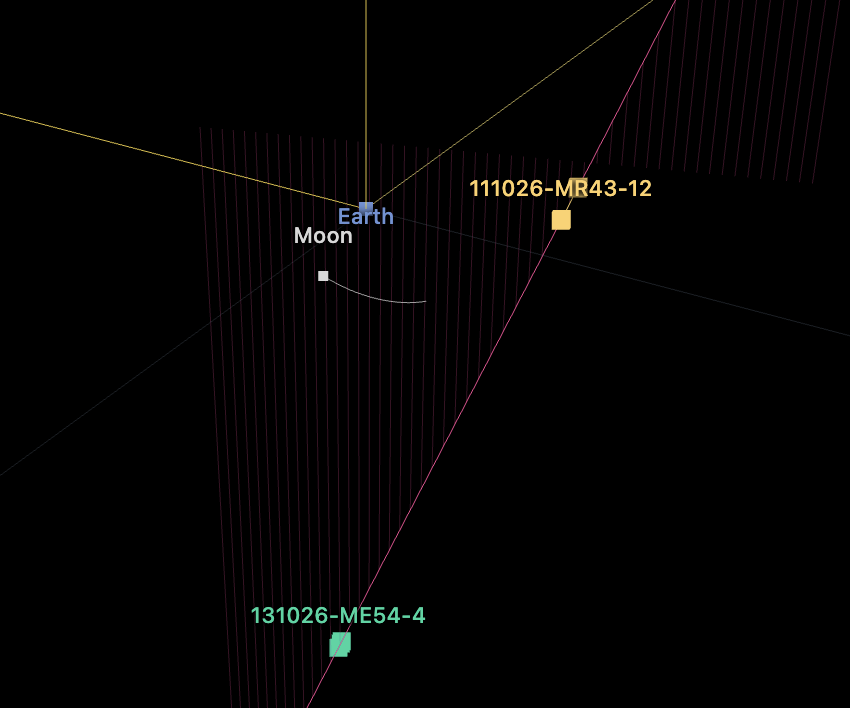
Here is a plot showing where we detected the object in its orbit from spain (111026-MR43-12) and OZ (121026-ME54-4)
I think this is kind of cool. A few weeks ago TransAstra started to submit asteroids we have newly discovered to the Minor Planet Center just as a no cost contribution to the community. 🔭 .
Here is a screenshot from the UI our telescope operators (and AIs) use to run the network.
So far we have reported about ten but the numbers will grow over time. This is in addition to the thousands of known asteroids we report improved tracks on and many other things we keep for ourselves or report to our customers. We get paid for finding things in Cislunar space, but report these asteroids to give back to the community.
Highlights from a recent latest batch:
• 2026 OC4 (Apollo) — ~60–140 m, spotted in Space Force survey data and secured with automated follow-up
• 2026 RB4 (Aten) — ~15–35 m, close approach ~4.9 lunar distances in September
• 2026 RO39 — tiny (~4–8 m) but flew inside the Moon’s distance on 14 Sept
• 2026 TD & 2026 PQ — recent TransAstra finds (Apollo & Amor)
These are just a few of the thousands of objects our Theia software and globally distributed telescopes have pulled from the sky. Every detection improves planetary-defense awareness and builds the catalog of accessible targets for future in-space resource utilization (ISRU).
You can’t mine what you can’t find. 🚀
#Asteroids #NEA #PlanetaryDefense #SpaceResources #TransAstra
Ever since the "opaque wall across the future" became clearly visible, virtually all the good hard science fiction— and most space opera— has had to resort to a “post-AI" worldview in which humanity decides to limit AI, because if AI attains superintelligence it either destroys humanity or makes us pets, and neither of those outcomes leaves much room for good stories (the Culture series notwithstanding). The corollary is that life in that world will not be that interesting, and that may be the Great Filter that explains the Fermi Paradox— unless at least a subset of humanity decides to walk away from AI. I for one, think we should stop it not far from where it is now, and we should venture out into the cosmos without the help of superintelligent systems.


IOW: Life under AI will be so meaningless that humanity will go into cyberspace and live in a more challenging virtual reality, like binging the 14 books of The Wheel of Time right now. With direct to brain interfaces and AI driven world building would be a lot of fun, maybe more fun than having AI nannies wipe your nose.