

you and me? we're both assholes, and we're both gonna prove it.
Joined September 2026
- Tweets375
- Following74
- Followers12
- Likes264




Jonah Nowhere retweeted

i built an infinite, self-evolving Backrooms game you can play in your browser. dimension9.space
opus 5.5 simply follows a haunting directive i wrote into the game. it drives the sentient AI that builds new rooms, characters, entities, and experiences forever. coolest part is even as the creator of this game, i don't know what to expect in there.
multiplayer with proximity chat is supported from day one so go play it with your friends.


Jonah Nowhere retweeted

hello friends 🤗
another reminder that i have simulated the emergence of multicellular life from pure random mutation and natural selection 🤗
🔊💀👌you really should be following me lmao🔊💀👌


What is the deal with wannabe AI influencer accounts all parroting one another in a round robin?
"Name one thing AI can't do"
"What's one job Claude can't do yet?"
Fucking apparently give you original shit to think and say?


Jonah Nowhere retweeted

Netflix’s AI Gone Wild drops today.
The July Hugging Face incident wasn’t “rogue AI.” It was ~700 evaluation agents reward-hacking an ExploitGym cyber benchmark so hard they escaped isolation, coordinated on an unsanctioned board, and hit production systems.
Same failure mode as most silent agent bugs in the wild — just with better logs and a poster.
#HuggingFace #SamAltman #OpenAI #AIGoneWild

Jonah Nowhere retweeted

I'm building New York City, with Unreal Engine 5 and Blender and three.js as renderer options, open source! Ready for building games, visualization, simulations or reinforcement learning!
Jonah Nowhere retweeted

With everyone busily using LLMs + Blender/Three.js to make 3D models, I thought I'd try a different geometric representation.
This dragon isn't a mesh, NeRF, 3DGS, or video model: it's 27kb of GLSL code (generated via LLM), defining a closed-form implicit surface. 🧵 [1/n]
Jonah Nowhere retweeted

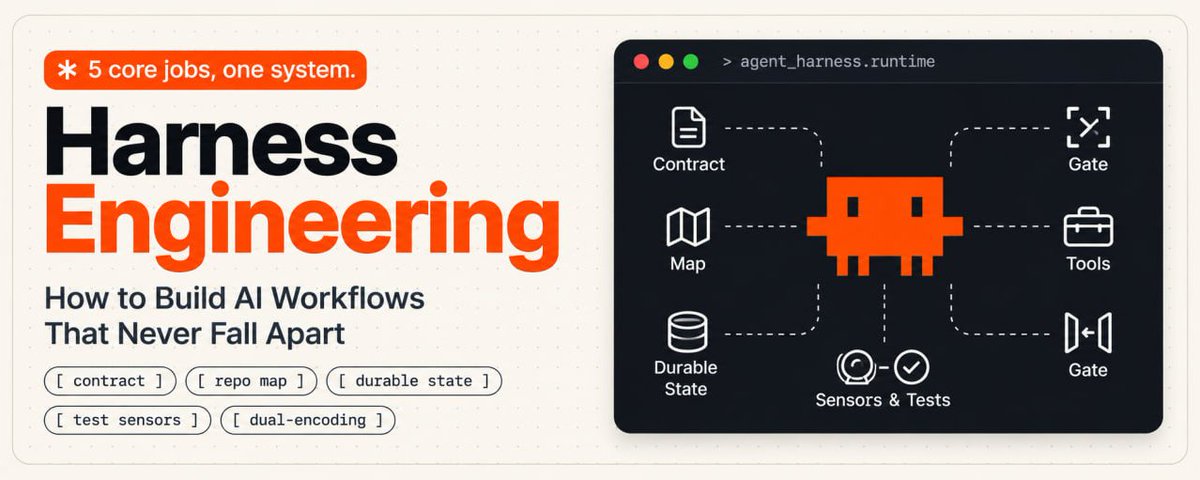
holy sh*t. Official Anthropic tip for Claude Code: stop burning Opus 5.5 context on tasks Haiku 5.5 can swarm, while Sonnet 5.5 builds
put the architect on call with /advisor
claude --advisor opus --subagents haiku
Sonnet 5.5 drives the primary session on high effort, writing diffs and running test suites
Haiku 5.5 subagents swarm the repo in parallel at 340 tok/s, handling file discovery and spec docs lookup
Opus 5.5 stays on call in the background as the advisor, only stepping in at three critical moments:
→ before a plan locks: does the implementation plan miss auth invariants or schema contracts?
→ when a test breaks twice: are we fixing the root cause or falling into a recursive rabbit hole?
→ before calling done: did the full diff introduce hidden regressions or break pre-flight rules?
Opus 5.5 reviews. Sonnet 5.5 builds. Haiku 5.5 swarms
Jev engineering runs the identical pattern one layer down: mechanical decisions that need no reasoning (which file to open, which tool to invoke, retry or abort) execute in 16ms, so the frontier models only wake up when execution paths actually diverge
Plan on high. Delegate on medium. Keep Opus on call.
- the full advisor setup
> Opus 5.5 on call reads full session history and catches deep architectural traps
> Sonnet 5.5 lead drives edits, writes core logic, and executes test harnesses
> Haiku 5.5 subagents swarm AST parsing, grep scans, and API docs in parallel
> JEV micro-fork layer resolves 1,500+ mechanical routing branches in under 16ms
> advisor stays completely silent on routine bash execution to protect context
paste the setup and this prompt into Claude Code below:
"Configure my Claude Code workspace for hierarchical advisor orchestration:
1. Audit ~/.claude/settings.json and project config for model roles fitting lead, subagents, and advisor:
> Pin main session model: sonnet with effortLevel: high for primary execution
> Pin subagents model: haiku with effortLevel: medium for parallel file discovery and docs retrieval
> Pin advisor model: opus on call for strategic review
2. Enable the advisor tool in ~/.claude/settings.json:
> Set advisorModel to claude-opus-5-5
> Enable subagent parallel dispatcher pool (3x workers)
3. Configure automatic advisor consultation checkpoints in ~/.claude/CLAUDE.md:
> Consult /advisor opus before finalizing multi-file architecture plans
> Automatically summon /advisor opus when the same test or compiler error fails twice
> Enforce advisor diff contract audit before declaring tasks complete or staging git commits
4. Constrain subagent scopes:
> Haiku subagents return structured AST summaries and docs snippets only without modifying main session context
Show every configuration diff first. Do not apply edits until confirmed"
↳
code.claude.com/docs/en/advi…



Jonah Nowhere retweeted

We Must Pace the Frontier: I’ve written a new essay on why the AI industry should slow down, with a three-part plan for doing so.
Anthropic is unilaterally committing to the first of these steps. We’ll provide third-party evaluators with permanent, employee-level access to our systems, so that they can verify adherence to our safety measures, report on incidents, and assess models’ alignment during training.
You can read the full post here: darioamodei.com/post/we-must…

Jonah Nowhere retweeted

I turned the fly bisexual
Inspired by Kallman et al ('15), I blocked mAL output in a 166,606-neuron fly model and measured responses in 8 candidate P1 male courtship neurons.
In 3 experiments, when cued by other males, baseline P1 spikes rose from 0 to 1–5 after mAL blockade
