

🇺🇸🇬🇧 · Data Scientist · Designer · Photographer
Joined June 2008
- Tweets6.2K
- Following1.2K
- Followers302
- Likes137K











𝕁𝕦𝕤𝕥𝕚𝕟 retweeted

Echt knap hoe snel iets eruit kan zien alsof het alweer bijna afgebroken gaat worden...
Winnaar van de Stadsbouwprijs Amersfoort 2024.


𝕁𝕦𝕤𝕥𝕚𝕟 retweeted

What if our public infrastructure was beautiful to the point that people not only didn't object to it, but openly wanted it because it would make places more attractive, in addition to more functional?


You are paying for this.
Plans to install a new defibrillator, public WiFi, and an emergency phone were refused.
Why?
Because of ‘visual clutter’.
The chance of survival goes down by up to 10% every minute without a defibrillator.
This is what happens when we have a system that prioritises what we can’t do, rather than what we can do.
We can’t build houses. We can’t build trains. We can’t build roads.
It’s time to change the system to focus on doing.
What would you change?


𝕁𝕦𝕤𝕥𝕚𝕟 retweeted

I visited Wurster Hall at UC Berkeley today. It was designed by, and currently houses, the architecture faculty.
The UC Berkeley website notes that "Wurster is often voted Berkeley's ugliest building."
I visited because I was curious about whether it would in person seem as unattractive as it does in photos. And, in short: it does. It's gaunt, austere, and filmed in grime. On an elysian campus, it stands out for its bleak hostility. It reminds me of the German submarine base in Bordeaux.
The UC Berkeley page agrees that it was never designed to be attractive, quoting the curator of their design archives: “Wurster and his handpicked architects didn’t want anything romantic, or sentimental — they hated the idea of ‘making pretty buildings. They wanted a serious building.”
I guess we have to concede success relative to their stated goals, but it does make one wonder what it all says about architecture as a discipline.

𝕁𝕦𝕤𝕥𝕚𝕟 retweeted

Who cares if it takes your TV longer to power up? It’s such a minor thing.
But there are so many minor things. And they multiply in number. Your quality of life is being destroyed by a death of a thousand cuts, due to energy austerity.

The Europoors are at it again.
I can't believe that this government looks at the slowest growing continent on planet earth and thinks 'yes, let's be more like them'.
Europe is a chronic disaster zone and we should largely be doing precisely the opposite of what it decrees - especially on energy and tech policy.


𝕁𝕦𝕤𝕥𝕚𝕟 retweeted

Dishwasher Manufacturers: If you rinse off your dishes in the sink before loading them into the dishwasher, they come out less clean!
This always gets me in trouble. I of course don’t rinse first, because it is a Dishwasher. Right?
Rinsing plates before loading the dishwasher feels diligent. Appliance makers say it is the very reason your dishes come out dirty.
Engineers at brands like Bosch and Whirlpool, alongside detergent makers like Cascade, have spent years advising consumers to stop pre-rinsing.
Contemporary dishwashers rely on internal turbidity sensors—optical eyes that gauge water clarity during the early wash cycle.
When pre-rinsed plates yield clean water, the machine misinterprets the load as lightly soiled, shortening cycle time and reducing water temperature.
Furthermore, the enzymes in modern powdered and gel detergents require food starches and proteins to latch onto; without debris to activate them, the surfactants simply wash down the drain, occasionally leaving alkaline film etched into glassware.
Oh there is more…
Cookware care harbors equally stubborn folklore. For decades, home cooks warned that a single drop of liquid soap would ruin a cast-iron skillet's seasoning. Lodge, which has made cast-iron cookware in Tennessee since 1896, explicitly debunks this in its care manuals.
The prohibition dates to the nineteenth century, when soaps were formulated with harsh lye (sodium hydroxide), a caustic alkali capable of stripping cured oil. Modern dish detergents contain mild surfactants that lift loose grease without breaking the polymerized oil cross-linked to the iron matrix.
A gentle wash with liquid soap leaves true seasoning intact.
A similar misconception surrounds kitchen waste disposers.
Generations of homeowners were told that tossing eggshells or ice down the drain sharpens the disposal blades.
InSinkErator, the inventor and largest maker of food waste disposers, notes that residential disposers do not contain blades at all. The central chamber houses blunt swiveling lugs on a spinning turntable.
These lugs do not slice; centrifugal force hurls food against a stationary outer ring of shredder teeth to pulverize it into a slurry. Eggshells cannot sharpen a blunt lug, and their fibrous membrane often snags in plumbing traps.
Even oven maintenance suffers from well-intended habits.
Appliance makers including GE and Frigidaire warn against lining the floor of an electric or gas oven with aluminum foil.
Modern ovens hide the heating element beneath an enamel floor. Foil traps and reflects radiant heat directly against the base, reaching temperatures high enough to melt the aluminum or permanently fuse it to the porcelain finish.

𝕁𝕦𝕤𝕥𝕚𝕟 retweeted

Your universe has no meaning to them. They will not try to understand. They will be rested, they will be warm, and they will still burn down your beautiful town hall.

🤖 Made with AI

You’re unable to view this Post because this account owner limits who can view their Posts. Learn more
𝕁𝕦𝕤𝕥𝕚𝕟 retweeted

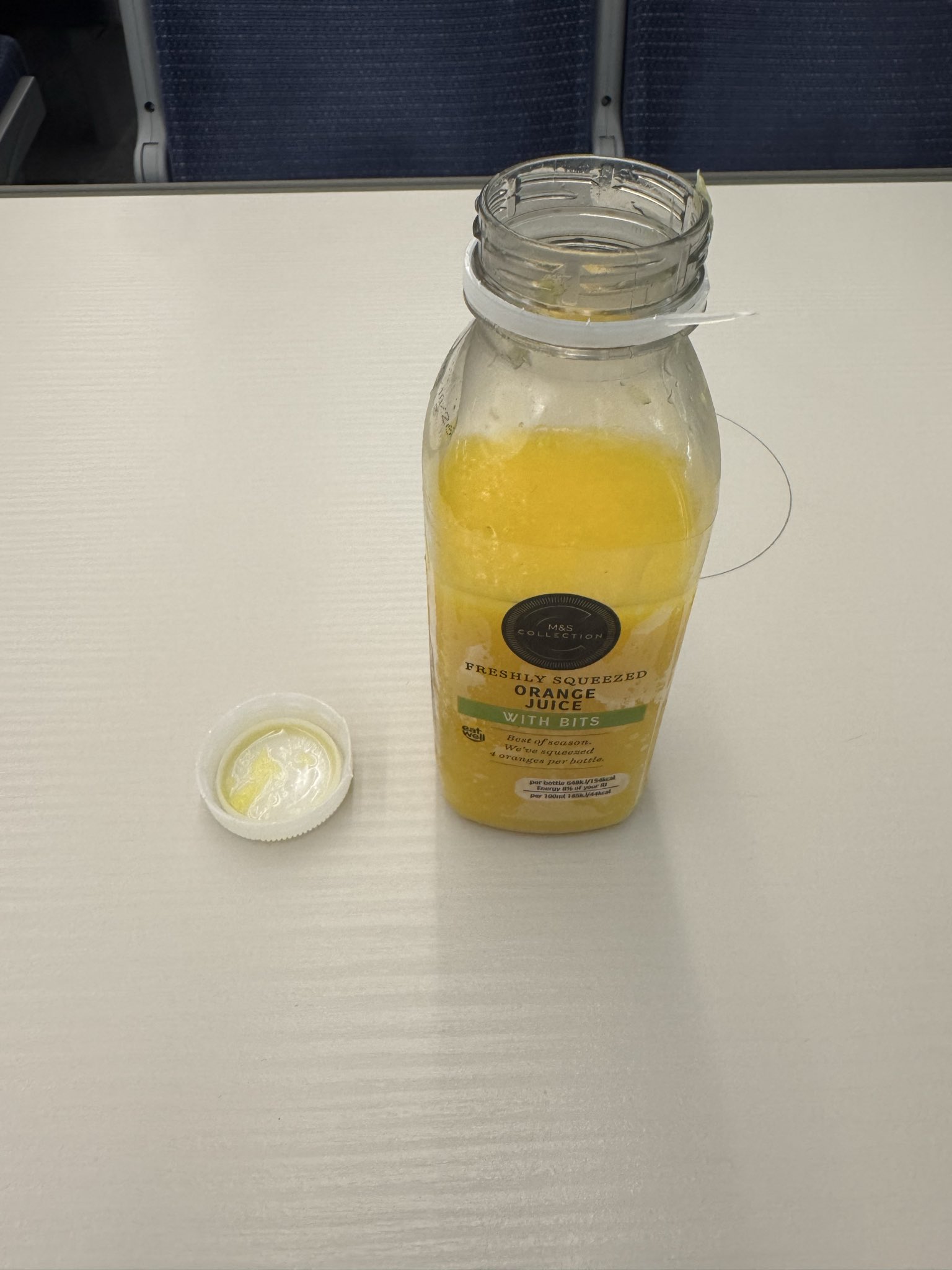
Please note this: M&S Freshly Squeezed Orange Juice (with bits).
As I opened the bottle, I saw a not inconsequential amount of the liquid (and bits) clinging to the lid.
Had I left the lid attached, there would be a non-zero chance the orange juice would gloop onto my white shirt.
I therefore tore off the lid (attached due to the EU’s Single-Use Plastics Directive 2019/904) in order to make the product useable.
It left a sticky scratchy bit of plastic at the top, which I now have to consciously think about avoiding as I drink my orange juice.
My overall product experience has been made materially worse. Oh, and I ripped off the lid anyway. No one wins from this insane regulation.


𝕁𝕦𝕤𝕥𝕚𝕟 retweeted

The absolute worst thing about opening this app is spotting a banger tweet for 0.2 seconds before the feed auto-refreshes and sends it straight into the void.
Gone forever.
𝕁𝕦𝕤𝕥𝕚𝕟 retweeted

I resigned from Slim Chickens today. I spent the last three years doing seasoning research at both Slim Chickens and arby's. Neither company is acting responsibly. They are racing straight to Four loko nuggets and gambling with our lives.


𝕁𝕦𝕤𝕥𝕚𝕟 retweeted

This whole thing has been disturbing to watch. The level of outright denialism and revisionist history, the institutional circling of the wagons, the number of people who would never in a million years have spoken against the fraud but will certainly speak against those who had the temerity to care about it when it was uncovered –
I've watched people recant things they know are true. I've watched some of my further left-of-center mutuals be harangued by their followers for stating straightforward truths plainly, because as an article of faith it is now gauche to be honest about this and shameful to care. I've watched a former Archbishop of Canterbury obfuscate and misrepresent the situation for political reasons, watched as powerful voices in the UK call for the press to be fettered lest it use its freedom unwisely, watched an outright Orwellian campaign to persuade people either to deny what their eyes and ears tell them or to dismiss it as a triviality that nobody should possibly care about.
A man is dead at his own hand, and it is tragic, particularly for his family and friends, that he declined to rebuild something meaningful after the extent of his fraud became public knowledge. But his choice to commit suicide absolutely cannot be used as an impetus to entrench a false frame and censorious impulses. Truth matters, and right now we're seeing a lot of people throw their reputations and their energy behind insisting that it does not.

I am bewildered, and not very impressed, by the visceral, naked, irrational hatred spat out by some defenders of Jason Arday. If a Cambridge professor is accused of being an unqualified charlatan, the accusation might be racially motivated. On the other hand it might not, depending on the evidence. The correct question to ask is not, ”What is the colour of his skin” but “Is it in fact true that he is an unqualified charlatan?” Please examine the evidence before leaping to the assumption of racism.
As for the idea that journalists “piled in on him” and “hounded him to his death”, most attacks were against Cambridge University. Jason himself was widely regarded as an unfortunate victim of foolish promotion way beyond his ability to cope. In appointing him to a professorship for which he was manifestly unqualified – in ludicrously describing him as “the best in the world” – certain senior members of the university showed a level of patronising condescension towards black people that could fairly be described as racism, while at the same time making him tragically vulnerable to such attacks as came his way.
𝕁𝕦𝕤𝕥𝕚𝕟 retweeted

*grasping at straws to make data centers look bad*
"what if they... pay TOO MUCH in taxes??"

𝕁𝕦𝕤𝕥𝕚𝕟 retweeted
I am bewildered, and not very impressed, by the visceral, naked, irrational hatred spat out by some defenders of Jason Arday. If a Cambridge professor is accused of being an unqualified charlatan, the accusation might be racially motivated. On the other hand it might not, depending on the evidence. The correct question to ask is not, ”What is the colour of his skin” but “Is it in fact true that he is an unqualified charlatan?” Please examine the evidence before leaping to the assumption of racism.
As for the idea that journalists “piled in on him” and “hounded him to his death”, most attacks were against Cambridge University. Jason himself was widely regarded as an unfortunate victim of foolish promotion way beyond his ability to cope. In appointing him to a professorship for which he was manifestly unqualified – in ludicrously describing him as “the best in the world” – certain senior members of the university showed a level of patronising condescension towards black people that could fairly be described as racism, while at the same time making him tragically vulnerable to such attacks as came his way.
𝕁𝕦𝕤𝕥𝕚𝕟 retweeted

Another example:
What is seen:
Jason Arday's suicide after total humiliation of being caught lying, exaggerating, and plagiarizing, and since he's black, blamed on racism.
What is not seen:
All the successful black professors, scholars, scientists, entrepreneurs, business owners, home owners, etc. who did so by hard work, creativity, risk taking, intelligence, etc., ignored by activists who only see a (mis)perceived victim.
If the activists are right that we're living in a hopelessly racist world, how did all these blacks become so successful?

Frédéric Bastiat's 1850 That Which is Seen and That Which is Not Seen is again relevant.
—Infrastructure: We see the new bridge; we don't see what would have been built with that money.
—Iran: we see they can't get a nuke; we don't see what we could have done with $37.5 billion.
—DEI: we see the new hires, we don't see more qualified candidates declined.
—Military: we see the big aircraft carriers & supersonic jets, we don't see how we might not need them for security, or what else that $$ could have been used for.
—Trans sports: we see MtF athletes competing, we don't see the women whom they replaced who lost their opportunity to compete.
—Bailouts 2009: we see corporations surviving, we don't see all the small investors & homeowners who lost everything who might have been bailed.
—Welfare/Social Transfers: we see poor people helped, we don't see what they might have done on their own or how the government might have helped other people.
—Homelessness: we see new apartment buildings built by the government for X times normal costs, we don't see alternative solutions.
—Covid school closures: we see the kids didn't get sick, we don't see what they didn't learn (or that they wouldn't have gotten sick anyway).
—Taxes: we see politicians parading their pet projects the public funds, we don't see what tax payers would have done with their $ that benefits society even more.
None of this is to pass judgment on what we should or shouldn't do, only to note what is almost always left out, namely what economists call "opportunity costs"—spending $$ on X means you are not spending it on X (or investing it, etc.).

Edinburgh Festival/Fringe is perhaps the most stark display of Apollonian vs Dionysian contrast, and every year it gets starker as the Dionysian Treadmill churns ever towards the gutter.
🤖 Made with AI


