
Research Scientist Intern @nvidia GEAR | Ph.D. student @ Yonsei University | prev. @nyuuniversity
Seoul, Korea
Joined February 2023
- Tweets125
- Following382
- Followers269
- Likes1.6K






Pinned Tweet
How can we effectively leverage human videos for robot learning by bridging the inherent embodiment gap?
We introduce UniSkill, a universal skill representation, a scalable method for learning cross-embodiment skill representations from large-scale in-the-wild video data.
1/n
Hanjung Kim retweeted

Meet GR00T 2, our most advanced, open System One model for robotics research. It learns skills from human demonstrations and predicts how its actions will change the physical world.
Those skills can carry across different robot bodies, reducing the need to teach each robot every task from scratch.
Watch GR00T 2 put that research into motion. 🧵
Hanjung Kim retweeted
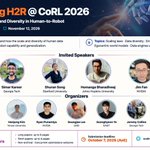
Tomorrow at #CoRL2026: Scaling H2R! 🤖
Join Ruijie Zheng (@ruijie_zheng12), Shuran Song (@SongShuran) , Chelsea Finn (@chelseabfinn) & Homanga Bharadhwaj (@mangahomanga) to discuss scaling & diversifying human data for robot learning!
📍 JW Marriott, 3F, 301–302
🕣 Nov 12, 8:30am–12:30pm CST
Posters: 10:30–11am
scaling-h2r-corl.github.io/

Tomorrow at #CoRL2026: Scaling H2R! 🤖
Join Ruijie Zheng (@ruijie_zheng12), Shuran Song (@SongShuran) , Chelsea Finn (@chelseabfinn) & Homanga Bharadhwaj (@mangahomanga) to discuss scaling & diversifying human data for robot learning!
📍 JW Marriott, 3F, 301–302
🕣 Nov 12, 8:30am–12:30pm CST
Posters: 10:30–11am
scaling-h2r-corl.github.io/
Hanjung Kim retweeted

Autonomous, uncut, 1x speed. This is GR00T 2 controlling real dexterous hands to perform a chemistry lab experiment (and clean up after itself) end to end.
Episode 1 of a new series! I’ll keep dropping real-time robot videos, with none of the “4x” or “8x” labels you usually see in the corner. No one can speed up reality, except Dr. Strange ;)

Introducing GR00T 2: our most advanced, open System One model for robotics. It runs entirely on your robot’s onboard compute, fully untethered, and you own every weight of it. GR00T 2 features:
1. Long-horizon tasks: dexterous manipulation and whole-body control chained over 20+ steps and 5+ minutes, such as performing chemistry lab experiments or assembling model airplanes end to end.
2. X-Adapt: adapting from easy data sources (human wearables and simulation) and deploying zero-shot to diverse real robots.
3. Unified Cognition: native integrations with frontier agents for advanced physical reasoning, robust error recovery, and safety monitoring.
It's an open-source buffet! We are releasing not only the model weights and X-Adapt recipes (coming December), but also our agentic framework, simulation engine, annotation engine, hardware design, and even training data (100K hours, that's ~11 yrs of experience), all available today!
Everything that moves will be autonomous. Anyone can become a roboticist.
Lock in, build with us!
Deep dive in thread:
Hanjung Kim retweeted
GR00T 2 is finally here, with a huge open source release! 😎
🤖 Imagine it. Make robots do it. Across embodiments, complex tasks, and agentic robotics, GR00T 2 brings ideas to life.
An incredible team effort, and I’m honored to have been part of it! 🎉🎉
Introducing GR00T 2: our most advanced, open System One model for robotics. It runs entirely on your robot’s onboard compute, fully untethered, and you own every weight of it. GR00T 2 features:
1. Long-horizon tasks: dexterous manipulation and whole-body control chained over 20+ steps and 5+ minutes, such as performing chemistry lab experiments or assembling model airplanes end to end.
2. X-Adapt: adapting from easy data sources (human wearables and simulation) and deploying zero-shot to diverse real robots.
3. Unified Cognition: native integrations with frontier agents for advanced physical reasoning, robust error recovery, and safety monitoring.
It's an open-source buffet! We are releasing not only the model weights and X-Adapt recipes (coming December), but also our agentic framework, simulation engine, annotation engine, hardware design, and even training data (100K hours, that's ~11 yrs of experience), all available today!
Everything that moves will be autonomous. Anyone can become a roboticist.
Lock in, build with us!
Deep dive in thread:
GR00T 2 is finally here, with a huge open source release! 😎
🤖 Imagine it. Make robots do it. Across embodiments, complex tasks, and agentic robotics, GR00T 2 brings ideas to life.
An incredible team effort, and I’m honored to have been part of it! 🎉🎉
Introducing GR00T 2: our most advanced, open System One model for robotics. It runs entirely on your robot’s onboard compute, fully untethered, and you own every weight of it. GR00T 2 features:
1. Long-horizon tasks: dexterous manipulation and whole-body control chained over 20+ steps and 5+ minutes, such as performing chemistry lab experiments or assembling model airplanes end to end.
2. X-Adapt: adapting from easy data sources (human wearables and simulation) and deploying zero-shot to diverse real robots.
3. Unified Cognition: native integrations with frontier agents for advanced physical reasoning, robust error recovery, and safety monitoring.
It's an open-source buffet! We are releasing not only the model weights and X-Adapt recipes (coming December), but also our agentic framework, simulation engine, annotation engine, hardware design, and even training data (100K hours, that's ~11 yrs of experience), all available today!
Everything that moves will be autonomous. Anyone can become a roboticist.
Lock in, build with us!
Deep dive in thread:
Hanjung Kim retweeted

Meet GR00T 2, our new generation of world-action models (WAMs): it imagines how the physical world will unfold and generates the actions that get it there. One model runs on parallel grippers, dexterous hands, and humanoids.
research.nvidia.com/labs/gea…
If you are at CoRL, please come and enjoy!
YouTube live streaming link, 1:45 pm! youtube.com/live/F_4AAOQsWlA

12
497
Hanjung Kim retweeted

Arrived at #CoRL2026. I will present EgoScale at Tuesday 9am oral session & 5pm poster session, and present the latest result of GR00T2 in H2R workshop on Thursday! Excited to share what we have built in the past year!
I’ll be at #CoRL2026 in Austin next week! Excited to catch up with friends, meet new people, and talk robot learning 😊
I’ll be presenting a poster and organizing a workshop:
🤖 HuRo — Robotizing human videos into robot-aligned observations and actions for scalable VLA pretraining.
📍 Nov 10, 5:00–6:30 PM · Poster Session 2, #59
JW Marriott, Lone Star Ballroom (3rd floor)
🎤 Scaling H2R — Exploring how scaling and diversifying human data can improve robot learning, with an amazing speaker lineup: Ruijie Zheng, Shuran Song, Homanga Bharadhwaj, and Chelsea Finn!
📍 Nov 12, 8:30 AM–12:30 PM
If you’re around, let’s chat!


Hanjung Kim retweeted

From dreaming to doing. 🤖
Join NVIDIA’s @DrJimFan at #CoRL2026 to explore how world models, robot foundation models, and agentic robotics can bring frontier AI into the physical world.
📅 Nov. 9 | 1:50 p.m. CST
Explore the keynote: nvda.ws/3WkMyg7
Hanjung Kim retweeted

We introduce 3D World Simulator, an interactive world model that runs at 50+ FPS on an RTX 5090.
Our model predicts in a unified 3D representation space, capable of generating:
• Novel view appearance
• Multi-view consistent RGB-D
• 3D geometry
• Spatially aligned tactile signals
Play with the world model now at jwang771.github.io/3dworldsi…!
Hanjung Kim retweeted

Since we first introduced H-Nets last year, I've been working with Cartesia to push the frontiers of H-Nets. We truly believe that removing handcrafted heuristics by learning abstractions end-to-end from raw data is a key step toward building AI that can understand any modality.
Very excited to finally share these blog posts, with much more to come!

I've always believed that intelligence should come from simple, general building blocks that learn their own abstractions directly from raw data; in other words, the bitter lesson. I think we're finally seeing a real step towards AI that can learn from all data.
Language modeling on raw bytes is a microcosm of this ideal, and to me it's a central problem in AI: if we can't build LLMs that learn end-to-end from bytes, how will we handle the rest of the world's data that we understand even less?
Last year we introduced hierarchical networks (H-Nets) as a first step. Our new version finds up to 3-5x efficiency gains in controlled scaling law experiments, and at larger scale matches an open-source model trained on 11T tokens with ~10x less data and compute. The posts below walk through what we found and why we think it works.
Hanjung Kim retweeted

“What is the mug on?”
A toddler answers in a second. 3D vision still struggles to go beyond object recognition. 🤔
🎉 Introducing RelationVGGT · #NeurIPS2026
🌐 relationvggt.github.io/
📄 arxiv.org/abs/2610.00970
Spatial relation grounding across views.
🧵👇 (1/6)
Hanjung Kim retweeted

Introducing Flora, an open model suite for scaling robotics data engines.
It watches robot and human video and annotate what happened (timestamped instructions) and how well it went (rewards and failure reasons).
🔗 research.nvidia.com/labs/gea…
We use it to train NVIDIA GR00T. 🧵
Hanjung Kim retweeted
We built a robotics data engine with Astra-level performance at 125x lower cost. And we are open-sourcing the weights today! Introducing Flora, a suite of open models to parse the physical world and turn raw footage into rich training signals.
Flora already powers our in-house data engine, labeling 200K hours of videos a day on 500 GPUs. We created it to scale the frontier for robot learning. Now you own the weights too.
Flora gives you:
- High-quality, timestamped captions to curate and filter human egocentric and robot data;
- Dense progress rewards for quality control and RL post-training;
- Rubrics scoring for real-world benchmarking
Try it today, links in thread:
Hanjung Kim retweeted

ASPIRE is now open-source!
Since our initial release, we've made exciting progress:
🤖 Real-world robot manipulation with GPT-6 Astra.
🔄 Continual skill refinement on physical robots.
📈 Saturated simulation benchmarks: 99% on LIBERO-Pro (80 tasks), 100% on Robosuite (7 representative tasks), and 100% on BEHAVIOR-1K (2 representative tasks).
Code: github.com/NVlabs/ASPIRE
Project: research.nvidia.com/labs/gea…
🧵 More results in the thread below.
Hanjung Kim retweeted
We are open-sourcing V1.0 of our agentic robotics framework, ASPIRE, with full real robot skill discovery and self improvement capabilities! On the day Astra arrived, our lab switched the backend model and saturated all the benchmarks to ~99% over night.
And the frontier is already on the move:
- Opus 5.5 slightly edges out Astra on our robot simulation bench.
- Sonnet 5.5 hits the Pareto frontier of cost vs. robot capability, $12/task.
We first introduced ASPIRE and /robot skill library in June, way before the big models could reliably do robotics. A rising frontier tide lifts all boats, but Astra was a 0->1 tsunami on many tasks.
Now you can also feel the Physical Bitter Lesson at home like we did on that fateful day ;)
links in thread