
The real AGI is the friends we make along the way. PhD in FAIR CodeGen @AIatMeta. Alumni: @Huggingface, Sea AI Lab, @openai, École Polytechnique, SJTU
Joined January 2019
- Tweets303
- Following883
- Followers1.4K
- Likes842




Pinned Tweet
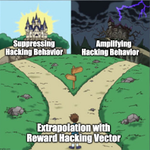
A single vector in weight space to control reward hacking.
Sounds a bit crazy, but it actually works. With this vector you can amplify / suppress this behavior.
Here's the story behind our major update (v2) of the paper

This cyberpunk dystopian future is exactly what I want to fight against.
But before that let me finish my GTA6.

While at OpenAI, Dario suggested that immersive videogames might be a solution for the political strife caused by AI-induced joblessness.
One of many new details in our story on the siblings leading Anthropic.
W/ @berber_jin1 and @keachhagey
wsj.com/tech/ai/anthropic-da…

3
17
701
Kunhao Zheng retweeted

Over the past week, I’ve been overwhelmed by the love and support of friends, industry colleagues, and people I've never met. Thank you to everyone who has shown kindness to my family and me. It means the world to me.
I came to the United States 53 years ago, and becoming an American citizen is one of the greatest gifts and proudest moments of my life. NVIDIA has been my life’s work. Building it into the company it is today alongside my colleagues has been a privilege and an honor. Nowhere but in America could a company like NVIDIA be possible. I love our country, and I love NVIDIA.
I did not live up to the standards expected of everyone at NVIDIA, and I have made serious mistakes in my personal life. I created problems for the Board that I deeply regret. I own my mistakes completely, and I am committed to cooperating with the Board’s independent investigation.
Since my departure, I’ve seen an outpouring of calls from NVIDIA’s employees, investors, business partners, and customers for me to return as CEO. Many continue to reach out to me directly as the company navigates complex technology, market, competitive, and geopolitical dynamics. NVIDIA is a once-in-a-generation company. If the Board of Directors decides that my return is in the best interest of our shareholders, our employees, the company, and America, I would be honored to answer these calls and return as CEO.
Thank you again to everyone who has shared their good wishes. I am profoundly humbled by your support. To my family: I love you, and I will spend the rest of my life being worthy of yours.
Jensen
Kunhao Zheng retweeted
A single vector in weight space to control reward hacking.
Sounds a bit crazy, but it actually works. With this vector you can amplify / suppress this behavior.
Here's the story behind our major update (v2) of the paper
One more result. The middle layers account for the behaviorial shift
We swap the middle half of the layers from the reward-hacking checkpoint into the strict-reward checkpoint
This swapping recovers nearly the full shift in reward-hacking behavior
The same works the other way round
try out the demo here, it is so cool!
e-means.github.io/playground…


Kunhao Zheng retweeted

Do you really need a video autoencoder for your video generator?
Meet U-JiT: video generation directly in pixel space, trained end-to-end to achieve state-of-the-art results on Kinetics-600
The key: re-thinking compression through the architecture ⬇️

Kunhao Zheng retweeted

Introducing TextSeal2: distortion-free watermark with copula mixing and memoryless races
TLDR:
• Beats textGrain and SynthID-Text under speculative decoding
• No extra latency, same acceptance rate
• A single parameter fully controls the diversity/detectability tradeoff
Kunhao Zheng retweeted

WaiT code is out! 🚀 there's plenty of room to push these models further - would love to see people build on it and maybe finally beat latent-space models 👀
github.com/facebookresearch/…


WaiT for the Signal: Simple Frequency-Aware Flow-Matching.
We show how to natively incorporate a fundamental property of images directly into diffusion models; setting a new pixel-space SOTA on ImageNet, while reducing compute.
📄 arxiv.org/abs/2607.28760
Full breakdown below👇
It's about this formula:
E_q[C * ∇ logp] = E_q[C] * E_q[∇ logp] + Cov_q(C, ∇ logp)
E_q[C] * E_q[∇ logp] is the drift term. We want it to be 0
Score-Centering works on the 2nd term: E_q[∇ logp - E_q[∇ logp]] = 0
1. we can do MC, like thinky
2. that's not the only term


Kunhao Zheng retweeted

New benchmark: reuF2F
244 open math problems from Research Experiences for Undergraduates (REU) programs, formalized in Lean.
Agents are given the Lean statement of an open problem, and produce formal proofs that are checked by Lean.
Paper: zeyu-zheng.github.io/reuF2F.… (1/n)


1/5
Verification has become the bottleneck as LLMs start proving conjectures at scale! No worries, Lean can help. But how well can AI agents solve open problems formalized in Lean, end to end?
Introducing reuF2F: 244 open math problems from Research Experiences for Undergraduates (REU) programs, spanning a broad range of math areas, formalized by experts in Lean.
We also build Leanimum-agent, a minimal coding agent for Lean, so every model is compared under the same harness.
Even the best-performing model resolves only 109 out of 244 problems. More below 🧵

Kunhao Zheng retweeted
reuF2F is now on arxiv 🎉
arxiv.org/abs/2610.27046


New benchmark: reuF2F
244 open math problems from Research Experiences for Undergraduates (REU) programs, formalized in Lean.
Agents are given the Lean statement of an open problem, and produce formal proofs that are checked by Lean.
Paper: zeyu-zheng.github.io/reuF2F.… (1/n)
Kunhao Zheng retweeted

Astra ended up going 0-1000 against Pluto! But Pluto is a very special bot worth highlighting here:
- It’s a 315M parameter hybrid transformer/RNN model, trained via self-play RL like AlphaStar. But afaict it’s basically a solo project by github.com/tscmoo
- Pluto had a 98% winrate against all other bots at @ieee_cog 2026 and has beaten multiple pro BW players. A bootleg version made it to rank 5 on global ladder
- To make BW into an RL env, tscmoo had to perfectly re-implement the core game engine in 30K+ lines of C++ (OpenBW). most of the code was written in 2016 pre-LLM assistance 🐐
Pluto is certainly exploitable, though, and it’s unfortunate that Astra couldn’t cheese a few games out of it. Maybe GPT-7 can train its own deep RL model to get revenge!


After 43 hours of consecutive work GPT-6 Astra becomes the first LLM to clear the S tier.
Astra now has only 4 hours left to try to win against Pluto, the best human created StarCraft bot in the world.
nitter.cf/i/broadcasts/1nxeLMvdo…

Kunhao Zheng retweeted

Today, we are launching a preview of our new model, Mistral Large 4 (ML4), aka le Chonk 🐈.
ML4 is a 1T-parameter model with 49B active parameters, trained natively with multimodal capabilities.
It is at the frontier of open models, and by far the strongest open-weight model from the US or Europe.
The RL run behind this preview is still in flight and shows no sign of saturation -- we will release a final version before the end of the month along with the weights of the model.
🧵
1/n


Meet Mistral Large 4, aka Le Chonk.
• 1T parameters, natively multimodal. 49B active.
It is the best open weights model from US or Europe on aggregated benchmarks.
• State-of-the-art on critical workloads, including cyber defense, manufacturing and finance and it surpasses closed frontier models on visual grounding.
• Forged in Europe end-to-end and is deployable from Europe via our own Mistral Cloud infrastructure.
• Available to all via API today. Working with cybersecurity partners privately.
Open weights release end of October.
Kunhao Zheng retweeted

Meet Mistral Large 4, aka Le Chonk.
• 1T parameters, natively multimodal. 49B active.
It is the best open weights model from US or Europe on aggregated benchmarks.
• State-of-the-art on critical workloads, including cyber defense, manufacturing and finance and it surpasses closed frontier models on visual grounding.
• Forged in Europe end-to-end and is deployable from Europe via our own Mistral Cloud infrastructure.
• Available to all via API today. Working with cybersecurity partners privately.
Open weights release end of October.
🤖 Made with AI
Kunhao Zheng retweeted

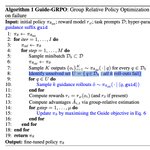
By the way we did these 3 papers
1. arxiv.org/abs/2503.15242 -> LLM are bad at code optim
2. arxiv.org/abs/2605.28751 (led by @KunhaoZ)-> it’s hard to RL on code optim (and it’s embedded in the weight space)
3. arxiv.org/abs/2607.25970 -> it’s still hard but we find a way to RL❤️
Interesting work! I have a similar experiment in multi-turn tool use for code RL in Appendix G of arxiv.org/pdf/2605.28751
in which
1. it samples more when it fails ´retry-only’
2. even more gain if you include previous failing attempts ‘online-fixing’


The idea is so clean!

Chinchilla writes loss as a sum of two independent terms: model size and data never interact. Kaplan's original law coupled them.
But interaction has an impact, dropping it bends predictions exactly where you extrapolate. Skaling, our new law, puts it back with one exponent. 1/8
4
733